Mount Purgatory Myth Meaning & Symbolism
A soul's arduous climb up a terraced mountain, guided by reason and love, to purify sin and regain lost freedom before entering paradise.
The Tale of Mount Purgatory
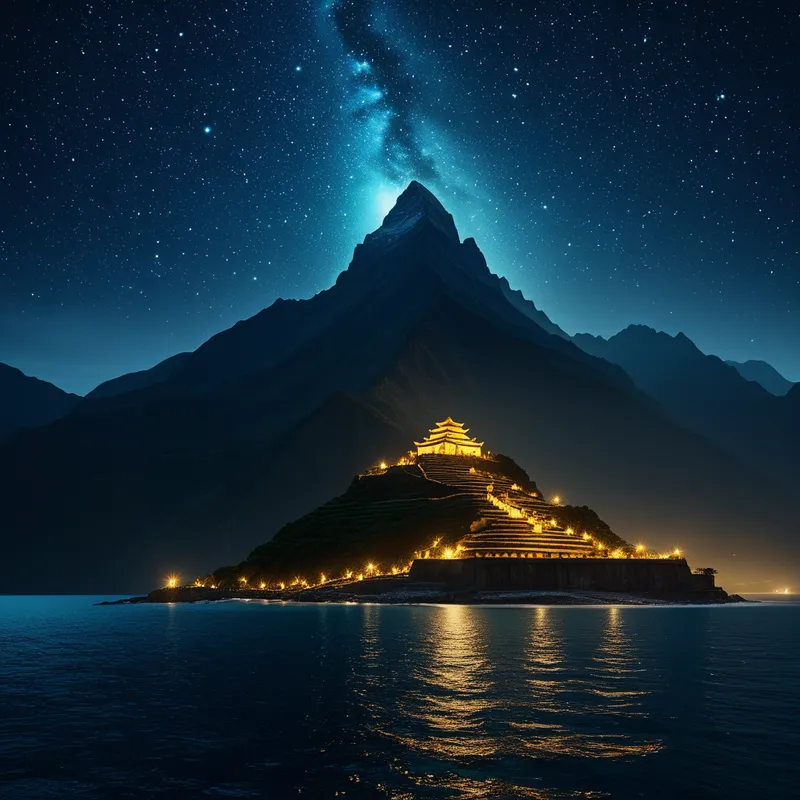
The sky was not yet dawn, but a strange, pearly light clung to the horizon over a vast, silent sea. From those mournful waters rose a mountain so colossal its peak was lost in the starry vault of heaven. This was no earthly crag; it was the Mount of Purgatory, the anvil upon which souls were hammered back into their true shape.
Upon its shore, two figures stood. One was a living man, Dante, his face etched with the weariness of a journey through Hell itself. The other was his guide, Virgil, whose calm presence was a bulwark against the awe of this place. Before them, an old man with a face of blinding light barred their path—Cato of Utica, the stern keeper of this realm of hope. With a gesture, he commanded the sea-reeds to be gathered and bound around Dante’s waist, a symbol of humility to gird him for the climb.
And so the ascent began. The lower slopes were Ante-Purgatory, where souls who delayed repentance waited, singing psalms under a sky that wheeled with stars brighter than any seen on Earth. Here, Dante met princes and poets, all suspended in patient longing. But the true mountain awaited—a soaring cone carved into seven vast terraces, each corresponding to one of the seven deadly sins.
On the first terrace, the proud were bent double under crushing stones, their eyes fixed on carvings of humility in the marble path. On the second, the envious wore haircloth, their eyelids sewn shut with iron wire. On the third, a thick, acrid smoke blinded the wrathful, who moved through it singing the Agnus Dei. Each circle was a theater of counter-suffering, a divine pedagogy where the wound became the cure.
Angels, beings of pure intellect and love, stood at the passes between terraces. With a sword of light, one would strike Dante’s forehead, carving away a letter P for each terrace conquered. With each step upward, the weight of the soul lightened. The very air changed; it grew sweeter, the light more direct and joyful. On the terrace of sloth, the souls ran with furious zeal. On the summit, the Garden of Eden bloomed—a pristine earthly paradise where Beatrice awaited, a figure of divine revelation who would replace Virgil, for where reason ends, grace begins.
The final act was a baptism not of water, but of remembrance and fire. Dante drank from the rivers Lethe and Eunoe, and passed through a wall of flame that burned away the last attachment to earthly desire. Cleansed, weightless, and free, he stood at last upon the peak, ready to turn his eyes toward the spinning spheres of Paradise. The mountain had done its work; the soul was made fit for the stars.
Cultural Origins & Context
This myth is not of a people, but of a single, monumental consciousness: Dante Alighieri. Composed in the early 14th century, The Divine Comedy is a summa of medieval Christian thought, classical learning, and deeply personal politics. Written in the vernacular Italian rather than Latin, it was a revolutionary act, making profound theology and philosophy accessible and weaving it into a gripping personal narrative of exile, loss, and hope.
The myth of Mount Purgatory was born in a cultural moment where the geography of the afterlife was being meticulously charted by the Church. Dante’s genius was to synthesize this theology with Aristotelian ethics, Ptolemaic cosmology, and his own poetic vision into a coherent, tangible landscape. The mountain itself is a direct counterpoint to the funnel of Hell; one descends into fragmentation, the other ascends toward integration. It was passed down not by oral bards, but through manuscripts and later print, becoming a cornerstone of Western literature. Its societal function was multifaceted: it was a moral compass, a theological treatise, and, for Dante, a profound act of personal and political justification, placing his enemies in Hell and his ideals in Heaven.
Symbolic Architecture
At its core, Mount Purgatory is a grand symbol of the corrective and educative function of suffering. It is not a place of punishment, but of healing. The mountain’s structure is the architecture of the soul in repair.
The path to freedom is not a flight from burden, but the conscious, willing bearing of the correct burden—the one that sculpts the self.
The seven terraces are not arbitrary tortures but homeopathic remedies. Pride is cured by the pressure of humility; sloth by the fire of zeal. This represents a profound psychological truth: our fixations and compulsions contain their own antidote, if we have the courage to engage with them directly. Virgil, symbolizing human reason and philosophical wisdom, can guide the soul through the process of recognizing and ordering its errors. But he cannot enter Paradise. The summit belongs to Beatrice, symbolizing Divine Love, revelatory grace, and the integrated Self. This marks the critical transition from self-improvement to self-transcendence, from the ego’s project to the soul’s destiny.
The entire journey is governed by time and law. The mountain turns with the stars, and souls can only ascend when the sun shines—a symbol of divine illumination. This reflects the necessity of right timing and alignment with a reality greater than our personal will in any process of deep change.

The Dreamer's Resonance
When this myth stirs in the modern unconscious, it rarely appears as a medieval mountain. Instead, one dreams of endless staircases in office buildings, of climbing a sheer rock face with heavy weights tied to one’s back, or of being in a vast, institutional laundry, scrubbing at stains that won’t come out. The somatic feeling is one of arduous, deliberate effort—a grinding fatigue that is somehow purposeful.
Such dreams often surface during life transitions that demand atonement or integration: after a failed relationship where one must face one’s own envy or pride, during recovery from an addiction (the terraces of gluttony or lust), or when striving for a goal requires overcoming deep-seated sloth or fear. The dream is mapping the psyche’s own purgatorial process. The “P” carved on Dante’s forehead translates in the dreamer as a nagging sense of a specific, identifiable flaw—a “mark” of character they know they must work to erase. The dream confirms they are in the process, often feeling stuck on a particular “terrace,” repeating a lesson until it is learned. The arrival of a “Virgil” figure in the dream—a calm, knowledgeable guide—signals the activation of the dreamer’s own observing ego and intellect, ready to supervise the difficult work.
Alchemical Translation
The alchemical opus—nigredo (blackening), albedo (whitening), rubedo (reddening)—finds a perfect model in Dante’s climb. The nigredo is the descent through Hell, the confrontation with the shadow in all its horror. Mount Purgatory is the grand albedo, the washing and purification.
The soul’s ascent is the slow calcination of the personal past, burning away the dross of identity to reveal the golden core of being.
Each terrace is a stage in the separatio and purificatio of the complex elements of the personality. The proud ego is crushed and humbled (calcination). The murky waters of envy and wrath are distilled into clarity (distillation). The base matter of gluttony and lust is sublimated into a higher, spiritualized energy (sublimation). This is not repression, but transmutation—the energy of the sin is not destroyed but redirected and refined.
The arrival in the Earthly Paradise is the albedo achieved: the soul is cleansed, white, and innocent again. But the final steps—the drink from Lethe and Eunoe, and the wall of flame—represent the rubedo. This is the synthesis, where the purified elements are reunited, now imbued with the gold of conscious experience. One forgets the guilt of sin (Lethe) but remembers the lesson of the struggle (Eunoe). The fire is the ultimate test of surrender, burning away the last vestige of the will that says “I” separate from the divine source. The pilgrim who emerges is no longer just Dante, but the individuated Self, ready to gaze into the eternal mirror of the cosmos. For the modern individual, the myth maps the non-linear, often painful, but ultimately liberating journey from being driven by unconscious complexes to living from a centered, authentic, and responsible core.
Associated Symbols
Explore related symbols from the CaleaDream lexicon: