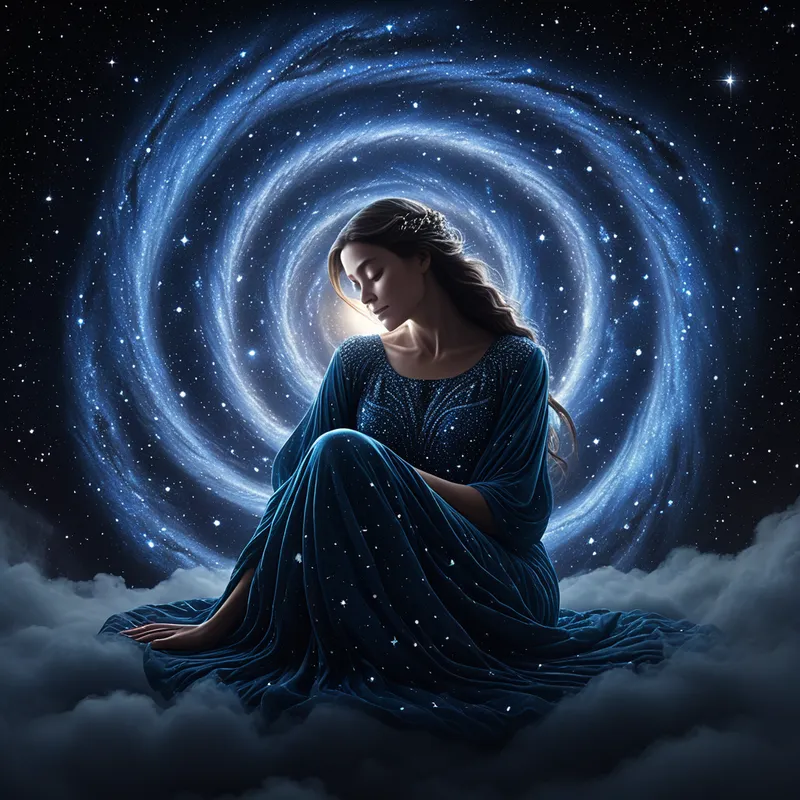
Mother's Lap Myth Meaning & Symbolism
A universal myth of a cosmic womb or sanctuary where all existence finds rest, dissolution, and the promise of renewal.
The Tale of Mother's Lap
Listen. Beyond the clamor of cities and the rustle of forests, beneath the turning of the seasons and the pulsing of your own heart, there is a silence. And in that silence, a story is whispered. It is the oldest story, the one written in the longing of every creature that has ever drawn breath.
In the time before time, when the world was a chorus of raw potential, there existed a presence known only as The Mother of All Things. She was not a goddess of a single mountain or river, but the very ground of being itself. Her form was the soft curve of the horizon, her breath the wind that carries seeds, her heartbeat the slow, deep rhythm of tectonic plates. And she had a lap—a space of infinite comfort and profound stillness.
For eons, the sparks of life danced and struggled upon her vast body. Heroes built kingdoms, lovers wept and rejoiced, artists carved beauty from stone and sound. But a weariness, a deep, soul-aching fatigue, would eventually find them all. It was not the fatigue of muscle, but of being—the exhaustion of maintaining a separate self in a world of endless change.
When this weariness became too great, a call would sound within them, a silent melody older than memory. They would leave their palaces and hovels, their triumphs and regrets, and begin a final, inward journey. The warrior would lay down his sword, feeling it crumble to rust. The queen would shed her crown, watching it dissolve into light. The thinker would release his thoughts, seeing them float away like dandelion seeds.
Their journey was a great unraveling. As they traveled, the world around them softened. Colors bled into one another, sounds melted into a single hum, the very boundary between their skin and the air began to fade. They were not walking to a place, but out of place, returning to a state prior to form.
And then, they would find Her. Or rather, they would cease to be the "they" that was seeking, and simply be within Her. There, in Mother's Lap, all striving ended. The hero was no longer heroic, the sinner no longer burdened. Distinctions of success and failure, joy and sorrow, self and other, dissolved like salt in a warm, boundless sea. It was not an annihilation, but a homecoming to a state of pure, undifferentiated presence—a deep, dreamless sleep within the awake awareness of the source.
There, in that cosmic cradle, they rested. For a night, or for ten thousand years. And from that profound rest, nourished by the essence of the Mother herself, a new possibility would stir. Not as the same person, but as a fresh potential, a new note in the eternal song, ready to be woven back into the tapestry of becoming.
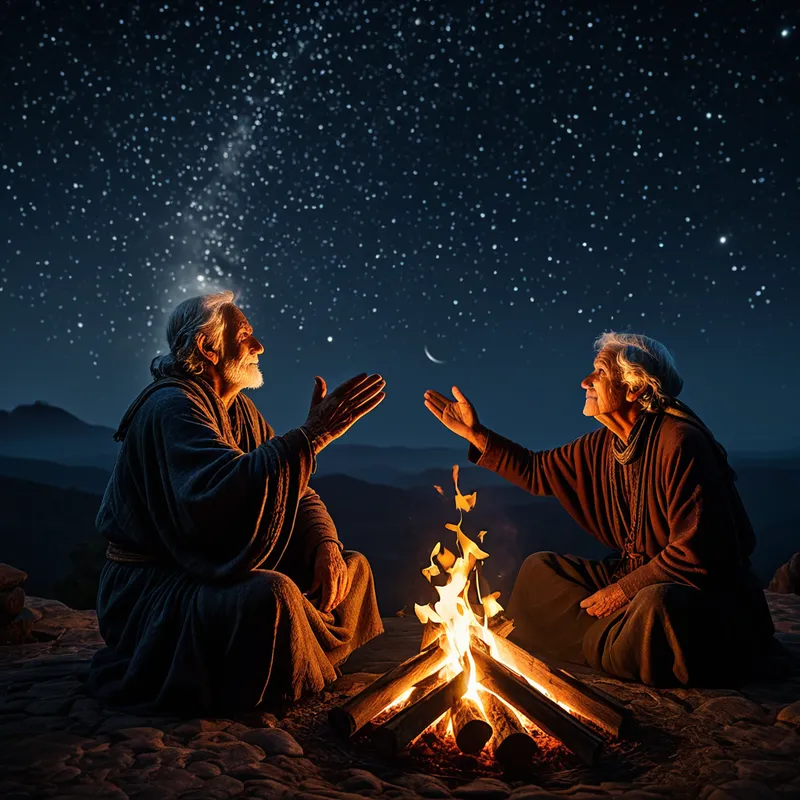
Cultural Origins & Context
The myth of Mother's Lap is not the property of any single culture, but a mythologem that appears in the folklore, religious imagery, and philosophical musings of peoples across the globe. It is a story told not in sacred texts, but around hearths, in lullabies, and in the metaphors used to console the dying. Its tellers were grandmothers soothing frightened children, shamans guiding souls in transition, and poets giving voice to the inexpressible longing for peace.
In some traditions, it is hinted at in the concept of Samsara and the yearning for Moksha or Nirvana—a release back into the undifferentiated source. In others, it is the "Womb of the Earth" to which all bodies return. Its societal function was multifaceted: it was a theology for the end of life, a psychology for the end of striving, and a cosmology that offered an ultimate, compassionate resolution to the drama of existence. It taught that exhaustion has a sacred purpose, and that dissolution is not an enemy, but a prelude to a different kind of wholeness.
Symbolic Architecture
Psychologically, Mother's Lap represents the deepest layer of the unconscious—not the personal unconscious of repressed memories, but the collective unconscious itself, the primordial matrix from which consciousness emerges. The "lap" is the containing, all-accepting space of this matrix.
The journey to the Lap is the ego's surrender to the Self. It is the conscious mind, weary of its own project of separation, voluntarily returning its borrowed light to the great, dark sun of the psyche.
The figures who make the journey symbolize aspects of the psyche that have become over-identified with their roles: the Hero ego, the Ruler superego, the Sage intellect. Their "unraveling" is the painful but necessary process of deintegration. The Lap itself symbolizes the state of non-duality, where the tension of opposites (life/death, success/failure, self/other) is temporarily suspended in a state of pure potential. It is the ultimate expression of the Caregiver archetype operating at a cosmic scale.
The Dreamer's Resonance
In modern dreams, this myth does not appear as a literal goddess. It manifests through powerful somatic and environmental symbols. To dream of sinking into impossibly soft, welcoming earth, or of being held in a vast, dark, watery space that feels utterly safe, is to touch this archetype. To dream of a room in your childhood home you never knew existed, filled with a profound, peaceful silence, is to find its antechamber.
These dreams often occur during periods of profound burnout, identity crisis, or after a major life chapter has conclusively ended. The psychological process is one of nervous system reset. The conscious mind, overwhelmed by complexity and burden, is signaling its need for a return to source code. The dream is not advocating for literal death, but for a psychic death—a letting go of outdated identities, compulsive doing, and the exhausting performance of the self. The body in the dream often feels a palpable, deep relief, a "sigh" of the soul. It is the psyche's innate healing mechanism prescribing the medicine of profound rest and ego-dissolution.

Alchemical Translation
The alchemical process mirrored in this myth is the Rubedo followed by a return to the Nigredo—not as regression, but as a cyclical return to the origin with gained essence. For the modern individual pursuing individuation, the myth models the critical, non-linear phase following a period of great conscious achievement or conflict (the hero's journey).
Individuation is not a linear ascent, but a spiral. We must consent to periodic descents into formlessness, trusting that the Lap is not a void, but a womb.
The "triumph" here is the courage to stop. It is the willed dissolution of hard-won persona. The modern seeker might engage this process through deep retreat, sensory deprivation, profound meditation, or creative fallow periods—any practice that facilitates a stop in the machinery of identity. The goal is not to remain dissolved, but to be re-imagined from a deeper ground. One returns from such an encounter not "recharged" in the common sense, but fundamentally re-configured—simpler, quieter, and aligned with a more authentic, less effortful expression of being. The Mother's Lap offers the ultimate paradox: to find your true strength, you must first find the courage to be utterly, completely soft.
Associated Symbols
Explore related symbols from the CaleaDream lexicon: