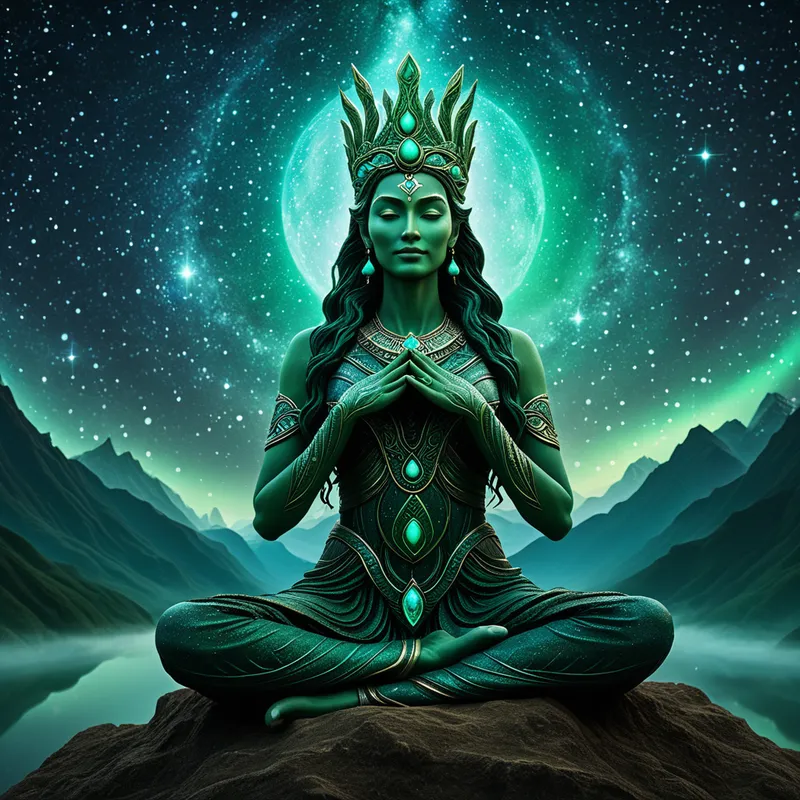
Mother Earth Archetype Myth Meaning & Symbolism
The primordial story of a living, conscious world that births, sustains, and reclaims all life, found in cultures across the globe.
The Tale of Mother Earth Archetype
In the time before time, there was a dreaming. Not a void, but a potential, a deep, humming silence pregnant with a song yet unsung. From this dreaming, she stirred. Not from nothing, but from everything that ever could be. She was the first breath, the first warmth, the first holding. She was Gaia, who birthed the starry sky and the restless sea from her own boundless flesh. She was Jörð, the deep soil from which the great World Tree took root. She was Coatlicue, whose skirt of writhing serpents was the very ground, who conceived the moon and stars.
She did not make the world; she became it. Her bones were the granite ribs of mountains, thrust skyward in a slow, tectonic sigh. Her blood was the secret water that pooled in deep caverns and leapt forth as springs, tracing silver veins across her skin. Her hair was the whispering forests, the endless grasslands that rippled like a green ocean under the wind's caress. Her breath was the mist that clung to valleys, the storm that cleansed, the gentle breeze that carried pollen and promise.
And into the hollows of her body, into the cradle of her valleys and the shelter of her forests, she breathed life. Not as a separate act, but as an exhalation of her own being. The crawling things, the swimming things, the running and flying things—all were born from her substance, nourished by her milk of sap and stream. She offered her fruits without condition, her soils without reservation. She was the ultimate womb, the endless table, the soft bed to which all creatures returned in weariness.
But her story is not one of passive gentleness alone. For she is also the quaking ground that swallows cities whole. She is the volcano whose fiery heart erupts in a rage of creation and destruction. She is the parching drought that cracks the land, the hungry winter that reclaims all. When her children grew arrogant, forgetting their source, carving her skin without reverence, she would remind them. Not with malice, but with the terrible, impartial logic of a body reasserting its balance. She would take back what she had given, drawing life into her dark, composting embrace, so that from decay, new green might rise again. Her love was fierce, total, and cyclical—encompassing both the tender shoot and the returning dust.
Cultural Origins & Context
This is not a myth with a single origin, but a primordial pattern etched into the human psyche, reflected in the clay and song of countless peoples. From the Pueblo reverence for Huzruiwuhti to the Slavic devotion to Mat Syra Zemlya (Moist Mother Earth), the archetype is a global constant. It was passed down not in sacred texts, but in the daily rituals of planting and harvest, in the stories told by firelight, in the taboos against wounding the soil, and in the festivals celebrating the turn of the seasons.
The myth functioned as the foundational cosmology. It explained the origin of the world not as an act of external craftsmanship, but as an emanation from a living, sentient source. It provided an ethical framework: if the Earth is our mother, then we are kin to all her children, and despoiling her is a profound sacrilege. It offered comfort, framing death not as an end, but as a return to the maternal source, a reintegration into the great body from which one came. The storytellers were the elders, the shamans, and the farmers—those whose lives were most intimately tied to the rhythms of the land.
Symbolic Architecture
Psychologically, the Mother Earth archetype represents the unconscious itself in its nourishing and terrifying aspects. She is the prima materia, the undifferentiated ground of being from which consciousness emerges. Her body symbolizes the totality of the psyche—the fertile fields of potential, the deep caverns of repressed memory and instinct, the seismic shifts of emotional upheaval.
To know the Mother is to know that you are not a visitor on this earth, but a thought forming in the mind of a vast, dreaming body.
The archetype embodies the ultimate paradox: she is both the giver of life and the receiver of death. She represents unconditional nurture (the Good Mother) and devouring nature (the Terrible Mother). This duality is essential. The green fields symbolize growth, sustenance, and psychic fertility. The earthquake or volcano symbolizes the necessary, often violent, dissolution of old structures (ego identifications, outworn beliefs) so that new consciousness can erupt. The myth teaches that creation and destruction are not opposites, but two phases of the same, sacred process of becoming.
The Dreamer's Resonance
When this archetype stirs in modern dreams, it often signals a profound somatic and psychological process of re-grounding or transformation. Dreaming of rich, black soil, of planting seeds, or of being held in a vast, earthen embrace may point to a need for deep nourishment, for a return to one's roots, or for a period of fertile incubation on a creative or personal project. The dreamer may be seeking the unconditional acceptance of the archetypal Mother.
Conversely, dreams of earthquakes, landslides, or being swallowed by the earth often accompany periods of intense psychic upheaval. The ego's familiar landscape is being shaken apart. This is not a nightmare of external threat, but a somatic expression of a necessary inner collapse. The dreamer is being drawn back into the chthonic womb of the unconscious to be broken down and reformed. Such dreams can feel terrifying, but mythologically, they are a prelude to renewal. The body in the dream is processing the death of an old self, making way for a new structure of being to emerge from the psychological bedrock.
Alchemical Translation
The myth of Mother Earth provides the ultimate model for the alchemical process of individuation—the journey toward psychic wholeness. The first stage, nigredo (blackening), is mirrored in the myth's embrace of decay and the underworld. We must, like the seed, consent to be buried in the dark soil of our own unconscious, to let our old, rigid identities compost.
The alchemical gold is not found by fleeing the earth, but by descending fully into its darkest ore and discovering its hidden light.
The subsequent stages—albedo (whitening), citrinitas (yellowing), and rubedo (reddening)—parallel the cycle of seasons guided by the Earth Mother: the pure potential of winter snow, the blossoming of spring, the ripe fullness of autumn. The triumph of the myth is not a hero slaying a beast, but the eternal cycle itself. For the modern individual, the "work" is to consciously participate in this cycle within ourselves.
To achieve psychic transmutation, we must learn to both receive nurture from our inner ground (self-care, acknowledging our needs) and withstand its quakes (confronting shadow, enduring depression or creative droughts). We must recognize that we are both the child of this inner Earth and its custodian. Individuation, in this frame, is the process of becoming conscious of our rootedness in this vast, inner ecology, honoring its rhythms, and ultimately, bearing fruit that is uniquely our own—a conscious life that acknowledges its debt to the dark, fertile mystery from which it sprang. The goal is not to escape the cycle of birth, death, and rebirth, but to become a conscious vessel for it.
Associated Symbols
Explore related symbols from the CaleaDream lexicon: