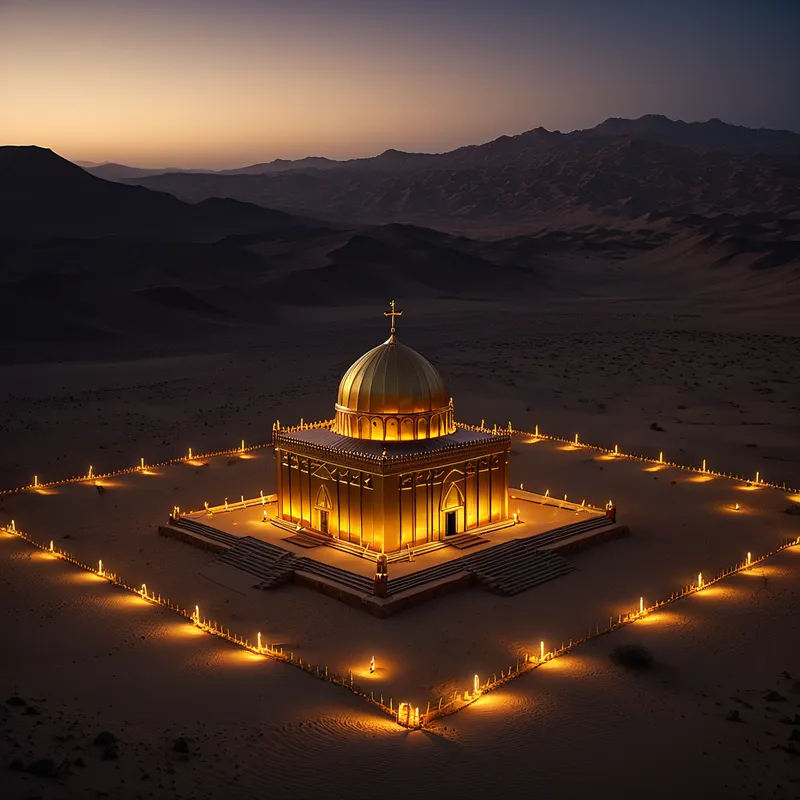
Moses' Tabernacle Myth Meaning & Symbolism
A myth of a portable sacred space built in the wilderness, a blueprint for divine encounter and the ordering of a chaotic soul.
The Tale of Moses’ Tabernacle
Hear now the tale of the dwelling place, woven not of stone but of obedience and awe. The air over Sinai was thin and charged, a silence so profound it hummed. The people, a sea of restless souls freed from the brick kilns of Egypt, camped at the mountain’s foot, a formless multitude beneath a formless sky. They had witnessed plagues and a parted sea, but the presence of the Holy One was a consuming fire upon the peak, a terror and a longing.
To [Moses](/myths/moses “Myth from Biblical culture.”/), who dared ascend into the smoke and thunder, came not just laws etched in stone, but a vision. A blueprint for sacred intimacy. “Let them make me a sanctuary,” the voice declared, “that I may dwell among them.” The command was precise, a geometry of grace. Not a fixed temple, but a tent—a [Tabernacle](/myths/tabernacle “Myth from Biblical culture.”/)—to journey with them.
And so [the desert](/myths/the-desert “Myth from Biblical culture.”/) stirred with a new purpose. From the hearts stirred by the spirit, offerings flowed: acacia wood, scarlet yarn, fine linen, oil, spices, and gold—wealth not hoarded but consecrated. Bezalel and Oholiab oversaw the work, their hands guided by heavenly wisdom. The sound of hammers on gold overlays, the scent of cedar and incense, the sight of skilled hands weaving cherubim into violet tapestries—the chaos of the camp began to orbit a sacred center.
They built from the inside out, from the heart of the mystery. First, the Holy of Holies, a perfect cube veiled in darkness, destined to hold the Ark of the Covenant. Then the Holy Place, with its seven-branched [Menorah](/myths/menorah “Myth from Judeo-Christian culture.”/) casting an eternal flame and the Table of [Showbread](/myths/showbread “Myth from Biblical culture.”/). Finally, the outer court, defined by linen curtains, with the Altar of Burnt Offering and the Laver for washing.
On the day of completion, a cloud—the palpable [Shekinah](/myths/shekinah “Myth from Christian culture.”/)—descended and covered the Tent of Meeting. The glory of the Lord filled [the Tabernacle](/myths/the-tabernacle “Myth from Biblical culture.”/). When the cloud lifted, they would journey. When it settled, they would rest. The formless people now had a heart. The wandering nation had a mobile axis mundi. God had pitched his tent among them, and [the wilderness](/myths/the-wilderness “Myth from Biblical culture.”/) was no longer empty.
Cultural Origins & Context
This narrative is embedded in the heart of [the Torah](/myths/the-torah “Myth from Jewish culture.”/), specifically the books of Exodus and Leviticus. It functions as a foundational charter myth for a people in [the crucible](/myths/the-crucible “Myth from Alchemical culture.”/) of identity formation. Having escaped the imperial, static cosmology of Egypt with its monumental stone temples, [the Israelites](/myths/the-israelites “Myth from Abrahamic culture.”/) are forged in the liminal space of the desert. The Tabernacle myth provided a radical alternative: a sacred order that was portable, participatory, and centered on relationship rather than imperial grandeur.
It was a story told and retold by priests (Kohanim) and levites, not merely as history but as active liturgical and legal instruction. The meticulous details of its construction—the materials, dimensions, and rituals—were less about antique carpentry and more about encoding a complete system of cosmic and social order. It served to differentiate the community from surrounding cultures, establish a priestly hierarchy, and, most profoundly, answer the terrifying question of how a transcendent God could be approached without being consumed. The Tabernacle was the answer: a structured, mediated encounter.
Symbolic Architecture
The Tabernacle is a master [symbol](/symbols/symbol “Symbol: A symbol can represent an idea, concept, or belief, serving as a powerful tool for communication and understanding.”/) of sacred [psychology](/symbols/psychology “Symbol: Psychology in dreams often represents the exploration of the self, the subconscious mind, and emotional conflicts.”/), a map of the [soul](/symbols/soul “Symbol: The soul represents the essence of a person, encompassing their spirit, identity, and connection to the universe.”/)‘s [journey](/symbols/journey “Symbol: A journey in dreams typically signifies adventure, growth, or a significant life transition.”/) toward the divine. Its [structure](/symbols/structure “Symbol: Structure in dreams often symbolizes stability, organization, and the framework of one’s life, reflecting how one perceives their environment and personal life.”/) is a [series](/symbols/series “Symbol: A series in dreams can represent continuity, progression in life events, or the need for routine.”/) of concentric zones of increasing holiness, modeling a [path](/symbols/path “Symbol: The ‘path’ symbolizes a journey, choices, and the direction one’s life is taking, often representing individual growth and exploration.”/) of progressive interiorization and purification.
The outer court, accessible to all Israel, represents the [realm](/symbols/realm “Symbol: The symbol of ‘Realm’ often signifies the boundaries of one’s consciousness, experiences, or emotional states, suggesting aspects of reality that are either explored or ignored.”/) of the [body](/symbols/body “Symbol: The body in dreams often symbolizes the dreamer’s self-identity, personal health, and the relationship they have with their physical existence.”/) and communal [life](/symbols/life “Symbol: The symbol of ‘Life’ represents a journey of growth, interconnectedness, and existential meaning, encompassing both the joys and challenges that define human experience.”/). The [Altar](/symbols/altar “Symbol: An altar represents a sacred space for rituals, offering, and connection to the divine, embodying spirituality and devotion.”/) signifies the sacrifice of [the ego](/myths/the-ego “Myth from Jungian culture.”/)‘s raw impulses, while the Laver symbolizes the cleansing of conscious [action](/symbols/action “Symbol: Action in dreams represents the drive for agency, motivation, and the ability to take control of situations in waking life.”/). The Tabernacle proper is the [realm](/symbols/realm “Symbol: The symbol of ‘Realm’ often signifies the boundaries of one’s consciousness, experiences, or emotional states, suggesting aspects of reality that are either explored or ignored.”/) of the [psyche](/myths/psyche “Myth from Greek culture.”/). The Holy Place, with its [Menorah](/symbols/menorah “Symbol: A seven-branched candelabrum central to Judaism, symbolizing divine light, wisdom, and the enduring covenant between God and the Jewish people.”/) ([illumination](/symbols/illumination “Symbol: A sudden clarity or revelation, often representing spiritual awakening, intellectual breakthrough, or the dispelling of ignorance.”/) of [consciousness](/symbols/consciousness “Symbol: Consciousness represents the state of awareness and perception, encompassing thoughts, feelings, and experiences.”/)), [Table](/symbols/table “Symbol: Tables in dreams often symbolize stability, social interactions, and a platform for discussions, negotiations, or decisions in our waking life.”/) (sustenance from the unconscious), and [Altar](/symbols/altar “Symbol: An altar represents a sacred space for rituals, offering, and connection to the divine, embodying spirituality and devotion.”/) of [Incense](/symbols/incense “Symbol: Incense represents spiritual communication, purification, and the transformation of the material into the ethereal through smoke.”/) (the rising of [prayer](/symbols/prayer “Symbol: Prayer represents communication with the divine or a higher power, often reflecting inner desires and spiritual needs.”/) or [intuition](/symbols/intuition “Symbol: The immediate, non-rational understanding of truth or insight, often described as a ‘gut feeling’ or inner knowing that bypasses conscious reasoning.”/)), represents the illuminated inner world where symbolic processes are active.
The final veil is the threshold of the Self, where the persona is utterly left behind.
The Holy of Holies, entered only by the High [Priest](/symbols/priest “Symbol: A priest symbolizes spirituality, guidance, and the quest for understanding the deeper meanings of life.”/) once a [year](/symbols/year “Symbol: A unit of time measuring cycles, growth, and passage. Represents life stages, progress, and mortality.”/), is the innermost sanctum of the psyche—[the Self](/myths/the-self “Myth from Jungian culture.”/). It is dark, beyond images, containing only the Ark and the unmediated, terrifying, and gracious [presence](/symbols/presence “Symbol: Presence in dreams often signifies awareness or acknowledgment of something significant in one’s life.”/). The entire structure, oriented toward the east and journeying through [wilderness](/symbols/wilderness “Symbol: Wilderness often symbolizes the untamed aspects of the self and the unconscious mind, representing a space for personal exploration and discovery.”/), is a dynamic symbol of the individuating psyche moving through life’s chaotic unknowns, guided by an inner, numinous center.
The Dreamer’s Resonance
To dream of the Tabernacle is to dream of psychic integration in a time of inner diaspora. One may dream of constructing a complex, beautiful interior space within a barren landscape, or of searching for a sacred center in a chaotic camp. Such dreams often arise during periods of profound transition, where old structures of identity or belief have collapsed (the “Egypt” of the psyche), and one is in the vulnerable, formless “wilderness” of becoming.
The somatic feeling is often one of simultaneous awe and acute precision—a sense that something of immense importance must be assembled correctly from within. Dreaming of the veil signifies confronting the boundary between the known ego and the unknown depths of the Self. Anxiety in the dream may reflect a fear of this encounter, while a sense of peace may indicate a readiness to acknowledge and orient around a deeper, guiding center. It is the psyche’s blueprint for creating sacred order out of inner chaos.
Alchemical Translation
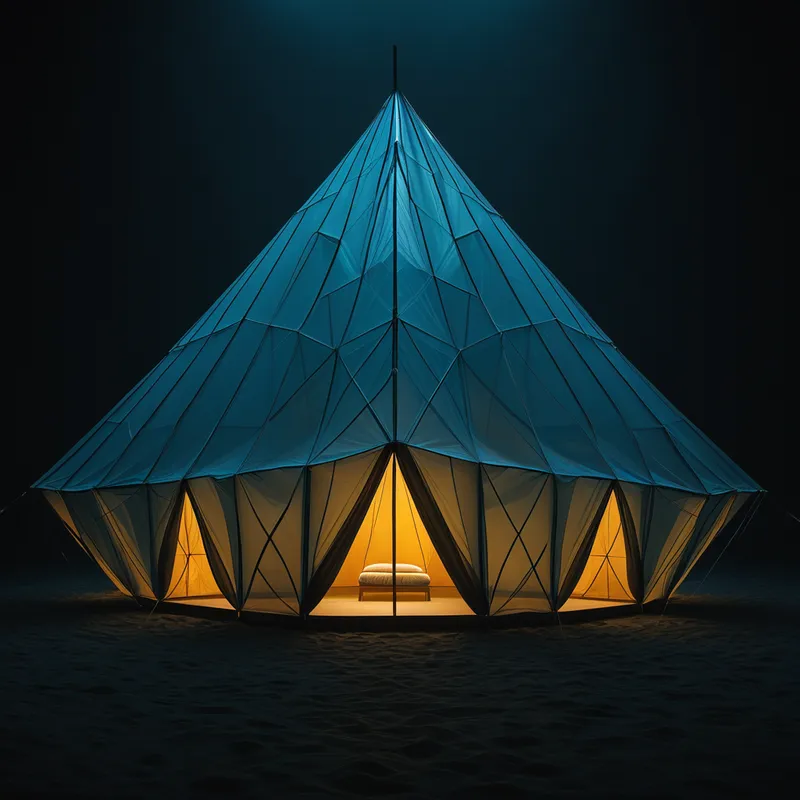
The alchemical process mirrored in the Tabernacle myth is the opus contra naturam—the work against nature—which here means the work against psychic chaos and fragmentation. The base materials (the scattered, enslaved psyche) are gathered, willingly offered up, and transmuted through devoted work (Bezalel’s spirit-inspired craft) into a coherent, hierarchical vessel capable of containing [the divine spark](/myths/the-divine-spark “Myth from Gnostic culture.”/).
The wilderness journey is the [nigredo](/myths/nigredo “Myth from Alchemical culture.”/), the blackening, the dissolution of the old, rigid identity. The receiving of the blueprint on Sinai is the albedo, the whitening, the illuminating vision of a new possibility. The construction itself is the citrinitas, the yellowing, the meticulous, conscious labor of building new inner structures—disciplines, values, symbolic understandings. Finally, the descent of the Shekinah is the [rubedo](/myths/rubedo “Myth from Alchemical culture.”/), the reddening, the culmination where the constructed vessel is vivified by the transcendent Self, resulting in a living, guided wholeness.
The goal is not to become divine, but to become a vessel so rightly ordered that the divine can indwell.
For the modern individual, this myth models the necessity of building an inner [temenos](/myths/temenos “Myth from Greek culture.”/)—a protected, sacred space—amidst the noise of [the world](/myths/the-world “Myth from Tarot culture.”/). It teaches that wholeness (individuation) is not a static achievement but a portable, dynamic process. One must gather the scattered pieces of one’s experience (the offerings), follow the inner law or calling (the blueprint), and through conscious effort, construct a life that has a holy center. The presence that fills that personal tabernacle is not a theological abstraction, but the experience of meaning, purpose, and authentic connection to the depths of one’s own being.
Associated Symbols
Explore related symbols from the CaleaDream lexicon: