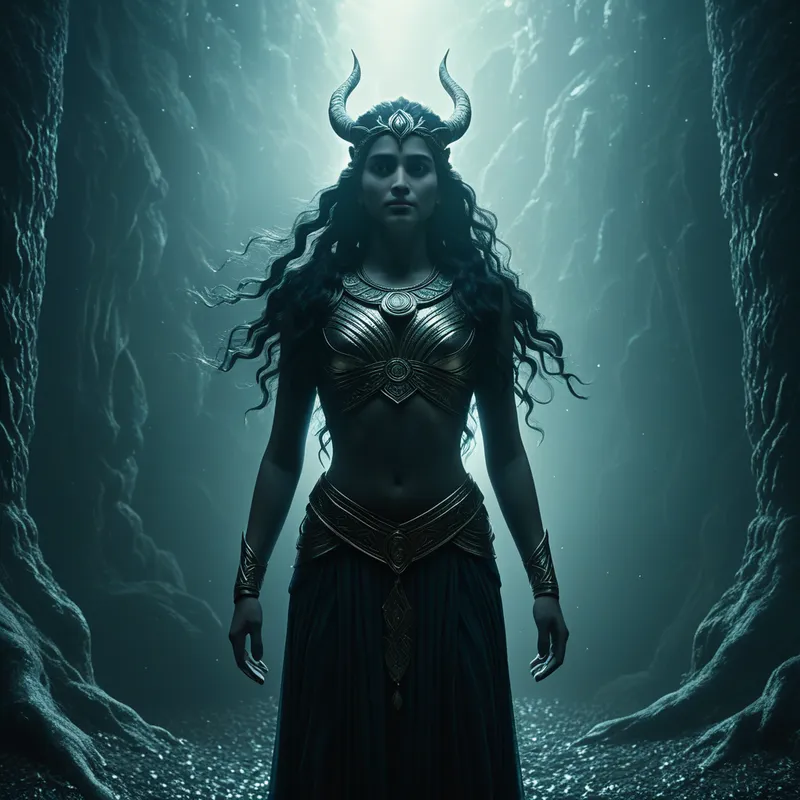
Moses and Khidr
The prophet Moses journeys with the enigmatic Khidr, who performs seemingly unjust acts that conceal deeper divine wisdom and spiritual truths.
The Tale of Moses and Khidr
The story unfolds not in the glare of prophecy, but in the soft, uncertain light of a quest. [Moses](/myths/moses “Myth from Biblical culture.”/), the lawgiver, the bringer of divine order, is asked by an unseen questioner: “Who is the most knowledgeable of men?” Confident in his role, Moses answers, “I am.” But the Divine Voice corrects him, revealing there exists a servant, one more deeply taught, at the junction of the two seas. A restless yearning stirs in Moses’s heart—a yearning not for more law, but for the knowledge that lies beyond it. He resolves to find this servant, taking with him a single companion and a humble provision: a salted fish.
Their journey is long, a pilgrimage across the barrenness of the known. At a rock where they rest, Moses sleeps. The fish, touched by a secret spring, comes to life and slips into the [water](/myths/water “Myth from Chinese culture.”/), vanishing without a trace. This is the first sign, a silent miracle Moses misses. When they press on, forgetting the incident, a figure awaits them at the promised junction. Moses recognizes him instantly, not by face, but by presence. This is Khidr, the Green One, whose name whispers of eternal, verdant wisdom.
“May I follow you,” Moses asks, “so that you may teach me of the right guidance you have been taught?” Khidr’s response is a gentle, devastating condition. “You will not be able to have patience with me. For how can you be patient about that which your knowledge cannot comprehend?” Moses, steadfast, promises patience and vows not to question any act. Thus, their journey begins—not across deserts, but into the terrain of inscrutable action.
They board a small ship. Once at sea, Khidr damages it, scuttling a hole in the hull. Moses, the protector of the weak, is aghast. “Have you made a hole in it to drown its people? You have certainly done a grave [thing](/myths/thing “Myth from Norse culture.”/)!” He forgets his vow. Khidr reminds him: “Did I not say that you would not be able to have patience with me?” Moses, chastened, apologizes, and they continue.
On land, they encounter a young boy. Khidr, without hesitation, kills him. This is too much for Moses’s moral framework. “Have you killed an innocent soul who killed no one? You have certainly done a horrible thing!” Again, Khidr repeats his warning, and again, Moses pleads for another chance.
Finally, they enter a town whose people refuse them hospitality. There, they find a wall on the verge of collapse. Instead of leaving it, Khidr rebuilds it with his own hands. Moses, bewildered by this gratuitous labor for an ungrateful people, cannot contain himself. “If you wished, you could have taken a payment for it!” This is the third breach. Their companionship is at an end.
Before they part, Khidr unveils the hidden reality behind each unbearable act. The ship belonged to poor fishermen; a tyrannical king was seizing every sound vessel. By damaging it, Khidr preserved it for its rightful owners. The slain boy was destined to grow into a source of grief and disbelief for his righteous parents; in his place, God would grant them a purer, more merciful child. The wall concealed a treasure belonging to two orphaned boys; by restoring it, Khidr preserved their inheritance until they came of age. Each act of apparent [chaos](/myths/chaos “Myth from Greek culture.”/) or cruelty was, in truth, a stitch in a hidden tapestry of mercy, a surgical incision made by a hand that sees the end in the beginning. Moses is left on the shore of his understanding, humbled, having glimpsed the fathomless depth of a wisdom that operates beyond [the horizon](/myths/the-horizon “Myth from Various culture.”/) of human [justice](/myths/justice “Myth from Tarot culture.”/).
Cultural Origins & Context
The narrative is immortalized in the Qur’an, in Surah Al-Kahf (verses 60-82). It is presented as a true story of the prophet Moses, yet its texture is distinctly allegorical, placing it within a rich stream of wisdom literature. In Islamic exegesis and folklore, Khidr transcends a single historical identity. He is often considered a prophet, a wali (saint), or an immortal spirit guided by God’s direct knowledge (‘ilm ladunni). His epithet, “the Green,” connects him to the vitality of nature, eternal life, and the direct, experiential knowledge that springs perpetually from the divine source, unlike the received knowledge of scripture.
The tale serves as a [cornerstone](/myths/cornerstone “Myth from Biblical culture.”/) in Islamic spirituality, particularly within Sufism. It is a parable of the limits of exoteric knowledge (‘ilm) and the necessity of esoteric, inspired knowledge (ma’rifah). The story is traditionally recited weekly, as a protection from tribulation, hinting that its core lesson is a spiritual antidote to the rigidity of the mind. It establishes a profound theological principle: divine wisdom (ḥikmah) often operates in ways that are opaque to human reason and moral calculus, demanding a surrender of judgment to a higher, unseen order.
Symbolic Architecture
The [journey](/symbols/journey “Symbol: A journey in dreams typically signifies adventure, growth, or a significant life transition.”/) is an archetypal map of the [soul](/symbols/soul “Symbol: The soul represents the essence of a person, encompassing their spirit, identity, and connection to the universe.”/)’s education. Moses represents the nafs al-lawwamah, [the self](/myths/the-self “Myth from Jungian culture.”/)-accusing soul, striving for righteousness through law and discernible justice. Khidr embodies the nafs al-muṭma’innah, the soul at [peace](/symbols/peace “Symbol: Peace represents a state of tranquility and harmony, both internally and externally, often reflecting a desire for resolution and serenity in one’s life.”/), which acts from a unified, divine [perspective](/symbols/perspective “Symbol: Perspective in dreams reflects one’s viewpoints, attitudes, and how one interprets experiences.”/). Their conflict is not between right and wrong, but between two orders of [reality](/symbols/reality “Symbol: Reality signifies the state of existence and perception, often reflecting one’s understanding of truth and life experiences.”/): the horizontal [plane](/symbols/plane “Symbol: Dreaming of a plane often symbolizes a desire for freedom, adventure, and new possibilities, as well as transitions in life.”/) of cause, effect, and moral consequence, and the vertical plane of direct divine causality and timeless [purpose](/symbols/purpose “Symbol: Purpose signifies direction, meaning, and intention in life, often reflecting personal ambitions and core values.”/).
The ship, the boy, and the wall are not random events. They are the three great tests of the spiritual seeker: the test of property (worldly means), the test of offspring (attachment and future hope), and the test of worldly favor (the ego’s desire for recognition). Khidr’s actions systematically dismantle Moses’s attachment to the apparent good in each.
The “[junction](/symbols/junction “Symbol: A point of convergence, decision, or transition where paths meet, representing choices, opportunities, or life changes.”/) of the two seas” is perhaps the most potent [symbol](/symbols/symbol “Symbol: A symbol can represent an idea, concept, or belief, serving as a powerful tool for communication and understanding.”/). It is the confluence of the outer sea of manifest [revelation](/symbols/revelation “Symbol: A sudden, profound disclosure of truth or insight, often through artistic or musical means, that transforms understanding.”/) (Moses) and the inner sea of hidden inspiration (Khidr), the meeting point of the exoteric and the esoteric, where the salted fish—a [symbol](/symbols/symbol “Symbol: A symbol can represent an idea, concept, or belief, serving as a powerful tool for communication and understanding.”/) of dead, preserved [knowledge](/symbols/knowledge “Symbol: Knowledge symbolizes learning, understanding, and wisdom, embodying the acquisition of information and enlightenment.”/)—is revived by the [water](/symbols/water “Symbol: Water symbolizes the subconscious mind, emotions, and the flow of life, representing both cleansing and creation.”/) of [life](/symbols/life “Symbol: The symbol of ‘Life’ represents a journey of growth, interconnectedness, and existential meaning, encompassing both the joys and challenges that define human experience.”/).
The Dreamer’s Resonance
Why does this ancient story haunt the modern [psyche](/myths/psyche “Myth from Greek culture.”/)? It speaks directly to the core human experience of confronting events that shatter our sense of fairness and meaning. A sudden loss, a senseless tragedy, a betrayal by fate—these are our personal encounters with Khidr’s actions. The myth gives form to the agonizing question: “Why?” It validates our initial, Moses-like outrage, our demand for a moral ledger that balances. But it does not leave us there.
Psychologically, Khidr represents the autonomous, guiding function of the Self, the central archetype of wholeness in the psyche. This inner Khidr often acts in ways that the conscious ego, our inner Moses, experiences as destructive, irrational, or cruel. It might break apart a long-held career (the ship), end a relationship (the slain boy), or force us to labor without reward for a future wholeness we cannot yet see (the rebuilt wall). The story is a profound map for navigating life’s crises, suggesting that what feels like annihilation may be the hidden hand of a deeper intelligence working toward integration, forcing [the ego](/myths/the-ego “Myth from Jungian culture.”/) to relinquish its limited control for a greater pattern.

Alchemical Translation
In the alchemy of the soul, this myth describes the [nigredo](/myths/nigredo “Myth from Alchemical culture.”/)—the blackening, the dissolution—as a necessary, guided process. Moses’s certainty is the [prima materia](/myths/prima-materia “Myth from Alchemical culture.”/), the base metal of righteous ego. Khidr is the mysterious alchemist, applying the fires of paradoxical experience. Each shocking act is a solve, a dissolution of Moses’s rigid structures of knowing. The subsequent explanation is the coagula, the revelation of the new, golden meaning hidden within the blackened matter.
The patience Khidr demands is not passive endurance, but the active, agonizing capacity to hold the tension of opposites—between justice and mercy, destruction and preservation, horror and grace—without rushing to premature judgment. This is the crucible where literal understanding is transmuted into wisdom.
The ultimate product of this alchemical journey is not more knowledge for Moses, but the shattering of his knowledge. He is left not with answers, but with the capacity for a new kind of knowing: one rooted in humility, awe, and the acceptance of a mystery that administers its own severe mercy. He returns to his people not with a new tablet of law, but with the silent, unteachable knowledge of the limit of all law.
Associated Symbols
Explore related symbols from the CaleaDream lexicon:
- Water — The medium of life, hidden knowledge, and the unconscious; it revives the salted fish and represents the boundless sea of divine wisdom.
- Journey — The fundamental movement from known to unknown, from the certainty of law to the mystery of direct guidance.
- Key — The conditional patience Moses must hold, which unlocks the hidden meanings behind Khidr’s inscrutable actions.
- Shadow — Khidr embodies [the shadow](/myths/the-shadow “Myth from Jungian culture.”/) of the prophetic tradition, performing acts that seem immoral yet conceal a higher, integrative purpose.
- Veiled Knowledge — The core treasure of the story: wisdom that is deliberately concealed from surface understanding, requiring a transformation to perceive.
- Ocean of Knowledge — The vast, unfathomable depth of divine wisdom in which Khidr navigates, contrasting with Moses’s river of clear, legal truth.
- Mystery — The essential atmosphere of the tale; the acceptance of the unknowable as a higher form of knowing.
- Faith — Not as blind belief, but as the trust required to endure the dissolution of one’s own understanding in service to a hidden whole.
- [Death](/myths/death “Myth from Tarot culture.”/) — Represented in the slain boy, not as an end but as a brutal, necessary transformation for the sake of future life and purity.
- Trickster — Khidr’s role as one who subverts expectation and moral convention to reveal a deeper, often unsettling, truth.
- Rebirth — The implicit promise of the entire ordeal: the death of literal-mindedness gives birth to a living, spiritual understanding.
- Islamic Crescent — A symbol of the faith tradition that holds this story as a central mystery, guiding the soul through cycles of darkness toward illuminating wisdom.