
Moses Myth Meaning & Symbolism
A prince turned prophet leads a people from slavery to covenant, wrestling with divine fire, tyrannical power, and his own fractured self.
The Tale of Moses
Hear now a tale of thresholds, whispered on the wind across the sands of time. It begins in the shadow of the crocodile god, in the land of black earth and mighty river, Kemet. A Pharaoh, his heart hardened as granite, feared the multitude of a foreign people within his borders. A decree went forth, chilling as the Nile’s night wind: every newborn son of the Hebrews was to be cast into the river’s embrace.
But one mother, her soul a well of desperate courage, wove a basket of papyrus and pitch. She placed her infant within this tiny ark and set it adrift among the reeds where the Pharaoh’s own daughter came to bathe. The child’s cries pierced her heart. She drew him from the water and named him Moshe, Moses. Thus, a slave child was raised in the palace of his people’s oppressor, a prince with a secret heart.
Years flowed like the Nile. Moses, now a man, witnessed an Egyptian overseer beating a Hebrew slave. Fire erupted in his chest—a fire of justice, or perhaps of fractured identity—and he struck the Egyptian down, burying him in the sand. Fear sent him fleeing east, into the vast, scorching embrace of the Midian desert. There, at a lonely well, he found a new life, a wife, and the quiet rhythms of a shepherd.
But the desert holds more than silence. One day, near the mountain of Horeb, he saw a wonder: a bush, engulfed in flame, yet not consumed. From the heart of the fire came a Voice that was not of the wind. “I AM WHO I AM,” it declared, the God of his fathers. The Voice had seen the misery of His people in Egypt. The task was laid upon the shepherd: “You must lead my people out.”
Moses stood barefoot on holy ground, his objections crumbling like sandcastles before a tide. “Who am I that I should go?” The Voice provided signs: a staff that became a serpent, a hand that turned leprous and was cleansed. With his brother Aaron as his tongue, Moses returned to the court he had fled. “Let my people go,” he demanded of the new Pharaoh.
But Pharaoh’s heart was stone. Thus began the great contest, the ten plagues—water turned to blood, infestations of frogs, gnats, flies, pestilence, boils, hail, locusts, darkness—each a dismantling of an Egyptian god, each met with a harder heart. Finally, the most terrible night: the angel of death passed over the land, taking every firstborn son where the blood of a lamb did not mark the door. From the palace arose a great cry. Broken, Pharaoh relented. “Go!”
And so they went, a ragged nation of former slaves, a cloud by day and a pillar of fire by night their guides. But Pharaoh’s heart hardened one last time. His chariots thundered in pursuit, pinning the people against the shores of the Yam Suph. Despair washed over them. Then Moses raised his staff. A mighty east wind blew all night, and the waters were driven back, heaping up like walls. On dry ground they crossed, a path through the abyss. As the last Israelite reached the far shore, Moses stretched out his hand again. The walls of water collapsed, swallowing the chariots and the army whole.
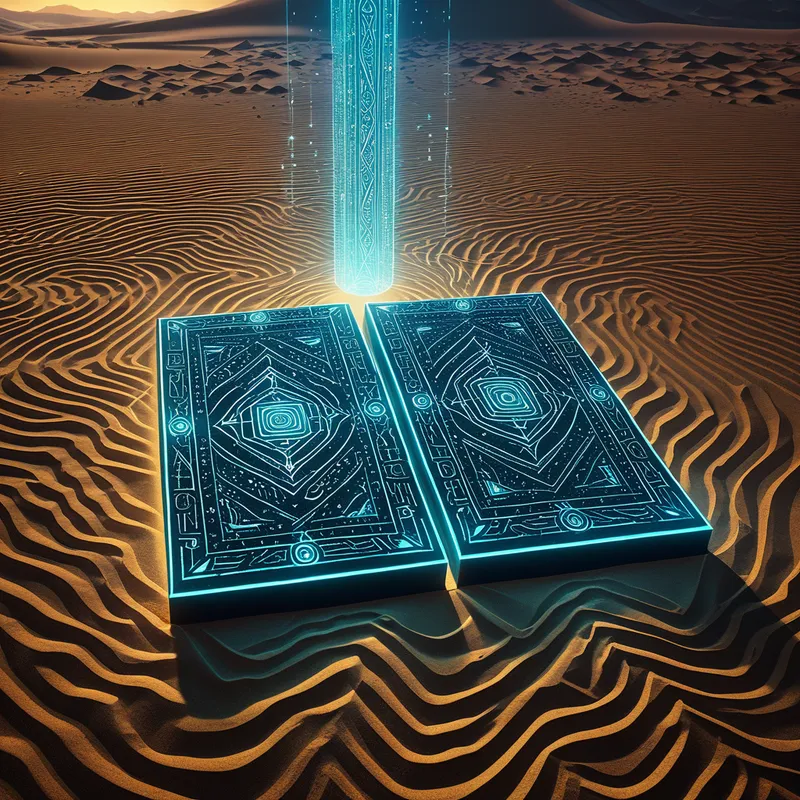
Through the wilderness they wandered, a people learning to be free. At the mountain, amidst thunder and smoke, Moses ascended alone into the cloud. There, for forty days and nights, he communed with the Divine. He returned bearing two tablets of stone, inscribed by the very finger of God with the covenant, the Aseret HaDibrot. But he found his people in revelry, worshipping a golden calf forged from their own jewelry. In a fury of holy anguish, he shattered the tablets upon the rocks.
Yet the covenant was remade. Moses led, he judged, he interceded, carrying the burden of this stiff-necked people for forty years. He brought them to the very edge of the promised land, to gaze upon it from the heights of Nebo. But he would not cross over. The Voice spoke: “This is the land I promised. I have let you see it with your eyes, but you shall not go over there.” And there, on that mountain, Moses the liberator, the lawgiver, the man who spoke with God face to face, laid down and died. No man knows his burial place to this day.

Cultural Origins & Context
The myth of Moses is the foundational national epic of ancient Israel, the story that answers the core question: “Who are we?” It is not a single, frozen text but a living narrative woven from oral traditions, likely compiled during the monarchy or the Babylonian exile as a means of preserving identity under threat. Scholars identify potential sources—the Yahwist, Elohist, Priestly, and Deuteronomist traditions—each adding layers to the tapestry, from intimate encounters with God to detailed legal codes.
Its societal function was multifaceted. For a people often under the heel of empires, it was a story of origin and destiny, explaining their unique covenant with YHWH and their right to the land of Canaan. It transformed a likely complex history of semi-nomadic groups and local revolts into a grand, divine drama of liberation. The law given through Moses provided the ethical and ritual architecture for a society meant to be distinct from its neighbors, a “kingdom of priests and a holy nation.” The myth was told and retold at Passover, in synagogue readings, and in daily prayer, ensuring that every generation would see themselves as having personally come out of Egypt, making liberation a perpetual, internal reality.
Symbolic Architecture
At its heart, the myth of Moses is the biography of a consciousness tasked with bridging impossible divides: between the divine and the human, freedom and law, the individual and the collective.
Moses himself is the ultimate figure of the liminal. He is neither Egyptian nor Hebrew, prince nor slave, murderer nor saint. He exists in the borderlands, which is precisely why he can hear the call from the burning bush—a symbol of divine immanence, God present in the ordinary yet utterly transcendent, consuming but not destroying.
The call to consciousness always begins at the border of what we know, in the place where our old identity burns away but our essence remains.
The Exodus is the archetypal journey from the constricted psyche (Egypt, Mitzrayim) into the vast, terrifying, and formative space of the wilderness. Pharaoh represents the tyrannical, rigidified complex of the ego that enslaves the instinctual and creative life. The plagues are the psyche’s necessary, chaotic upheaval to break that complex’s hold. The parting of the sea symbolizes the terrifying but transformative passage through the depths of the unconscious, where the old pursuing forces of the ego are dissolved.
The forty years in the desert represent the long, arduous process of psychological integration. The giving of the Law (Torah) is not merely imposition, but the establishment of an internal structure—a conscious ethical framework—to contain the newfound freedom, without which it collapses into the chaos of the golden calf (the regressive pull of unconscious, idolatrous impulses).
The Dreamer's Resonance
When the pattern of the Moses myth stirs in modern dreams, it signals a profound crisis and calling of identity. To dream of being hidden in a basket among reeds may speak to a feeling of being secretly preserved from a hostile environment, or of a dual heritage causing inner conflict. A burning bush in a dream is a potent symbol of a numinous encounter—a sudden, awe-inspiring insight or calling that feels sacred and demands attention, often related to one’s life purpose.
Dreams of confronting a powerful, unyielding authority (a Pharaoh) reflect an internal struggle against a domineering inner voice or external structure that enslaves the dreamer’s autonomy. Dreams of leading a group through a perilous passage, or of walls of water, indicate the dreamer is navigating a major life transition, feeling the pressure of past patterns (the pursuing chariots) while moving toward a new state of being. To dream of coming down from a mountain with a sacred gift, only to find one’s community in chaos, mirrors the painful gap between personal revelation and collective understanding, a somatic experience of profound alienation and responsibility.
Alchemical Translation
The alchemical journey of Moses maps the process of individuation with stark clarity. It begins with the nigredo, the blackening: Moses in Egypt, his identity confused, his violent act burying his past in the sand, followed by the ash-gray despair of exile in the desert.
The encounter at the burning bush is the albedo, the whitening: a moment of brilliant, illuminating revelation. The divine “I AM” calls forth the dreamer’s own true “I am,” separating it from the false identities of prince or shepherd. This is the acquisition of the lapis of purpose.
The promised land is not a place to be reached, but a state of being to be glimpsed. The real work is the walking, the weathering, the carrying of the law through the wilderness of the soul.
The confrontation with Pharaoh is the arduous citrinitas, the yellowing or suffering, where the old ego-structure is systematically challenged and dismantled (the plagues). The passage through the sea is the dissolution of the prima materia in the waters of the unconscious, a death of the old self.
The forty years in the desert represent the slow, grinding work of rubedo, the reddening. Here, the brilliant insight of the bush must be made durable, tested by hunger, thirst, and rebellion. The law received on the mountain (a symbol of transcendent consciousness) must be integrated into the daily life of the community (the embodied psyche). The shattering of the first tablets is not failure, but a necessary part of the process—the ideal must break against the reality of the human material so it can be remade in a more resilient form.
Moses’s final view of the land he will not enter is the ultimate alchemical truth. The goal of individuation is not a perfect, static state of arrival. It is the faithful conduction of the transformative principle through a lifetime. The dreamer dies integrated, having seen the wholeness, but understanding that the journey itself—the leading out, the covenant-making, the bearing of the burden—was the entire point. The law is internalized; the prophet can rest.
Associated Symbols
Explore related symbols from the CaleaDream lexicon:
- Stand
- Crib
- Protest
- Passport
- Right Foot
- Drawing Lines
- Harriet Tubman's Lantern
- Civil Rights Protest Sign
- Martin Luther King's Speech
- Lincoln's Emancipation Proclamation
- Civil Rights Poster
- Vast Desert Plain
- Footprint
- Torah Scroll
- Yarmulke Cap
- Destiny's Call
- Desert Vision
- Executive Order
- Civil Rights
- Imperative
- Podium
- Glimpsing