Morpheus Myth Meaning & Symbolism
The myth of Morpheus, the divine shaper of human dreams, reveals the profound power of the unconscious to craft reality and deliver divine truths.
The Tale of Morpheus
Listen, and let the veil between worlds grow thin. In the silent, sunless west, where the Lethe whispers its forgetful song, there lies a cave. This is no ordinary hollow in the earth, but the threshold to the realm of Hypnos. Here, no light of Helios ever pierces; here, the air is heavy with the scent of earth and the drowsy perfume of blooming poppies.
Within this twilight kingdom, Hypnos rests on a couch of ebony, wrapped in soft, dark robes. But he is not alone. From him flow his sons, the countless Oneiroi—dreams of all kinds, flitting like bats into the night. Among this multitude, three stand apart, born of the goddess Nyx herself. They are the master craftsmen of slumber. And the greatest of these is Morpheus.
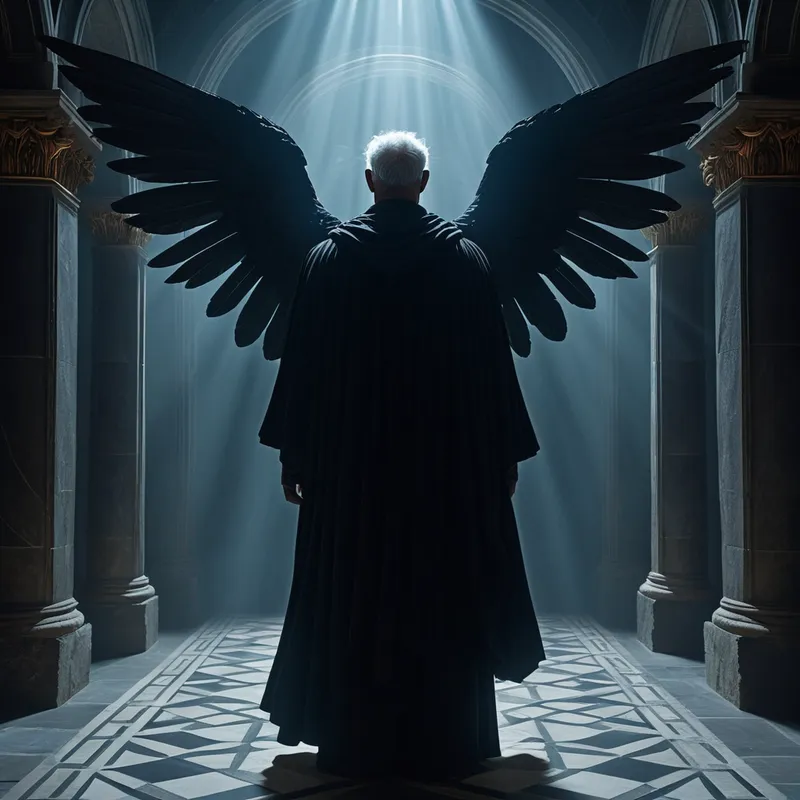
His name means “The Shaper of Form.” While his brother Phobetor crafts the forms of beasts and Phantasos fashions the forms of earth and water, Morpheus holds the supreme art: he takes the likeness of men. He can weave the exact visage, the voice, the gait, the very sorrow in the eyes of any human soul. His wings are the color of a starless midnight, and in his hand, he carries the stem of the poppy, the key to his craft.
Now, hear of his great work. Far across the wine-dark sea, a queen named Alcyone wept. Her husband, King Ceyx, was lost to a storm. The goddess Hera, moved by a devotee’s despair, summoned her messenger Iris. Iris descended on her rainbow bridge to the cave of Hypnos. She brushed past the slumbering dreams and made her plea: Morpheus must go.
The great shaper awoke. At his father’s silent command, he passed through one of two gates that stand beside the cave: the Gate of Horn, for true dreams, or the Gate of Ivory, for false. On this sacred mission, he chose the horn. He flew, a silent shadow over the sleeping world, until he came to Alcyone’s chamber. There, he did not appear as a god. He shaped himself. He took the drowned form of Ceyx, pale and cold, seaweed in his hair, saltwater on his lips. He stood at the foot of her bed, his voice a hollow echo of the king’s. “Your husband is dead,” the apparition spoke. “The sea has taken him. Weep for me.”
Alcyone awoke with a cry, the phantom’s words etched into her soul, the vision seared behind her eyes. It was a message of cruel truth, a divine communiqué delivered in the only language the heart can fully receive in its vulnerable state: the vivid, undeniable reality of a dream. Morpheus’s work was done. The shaper of forms dissolved, his essence flowing back like mist to the dark river and the poppy-strewn cave, his duty to gods and mortals complete.

Cultural Origins & Context
The myth of Morpheus is primarily preserved for us in the epic Latin poetry of Ovid, in his Metamorphoses. While Ovid was Roman, he drew extensively on earlier Greek mythological traditions, and the figure of Morpheus and his family—Hypnos, the Oneiroi—are deeply rooted in Greek cosmology. Earlier Greek poets like Hesiod named Hypnos and the Oneiroi as children of Nyx (Night), establishing their primordial, elemental power.
In the Greek worldview, dreams were not mere neurological noise; they were daimonic events, visitations from a parallel, sacred reality. They were messages, prophecies, warnings, and sometimes deceptions sent by the gods. The myth of Morpheus served a critical societal function: it provided a sacred framework for understanding these powerful, nightly experiences. It explained why dreams could feel more real than waking life (because a divine craftsman made them so) and why some dreams proved true while others were misleading (the two gates). The myth elevated the dream from a personal curiosity to a transaction with the divine order, a moment when the soul was permeable to influences from the realm of gods and the dead.
Symbolic Architecture
Morpheus is the archetypal personification of the psyche’s immense, autonomous capacity for representation. He is not the dream’s author (that is the god or the unconscious sending the message) but its masterful director and actor.
He represents the innate psychic faculty that takes raw, wordless emotion, memory, and impulse and clothes them in the compelling imagery of our inner world.
His specificity is key. He does not deal in vague feelings but in precise, recognizable forms—the exact face of a lost loved one, the familiar sound of a voice. This symbolizes how the unconscious communicates not in abstracts, but in concrete, personal symbols that carry immense emotional truth for the dreamer. The poppy signifies both the necessary narcosis (the silencing of the ego and waking mind) required for this communication to occur, and the potential for illusion or escape.
The two gates—of Horn and Ivory—are perhaps the myth’s most profound psychological symbols. They represent the dreamer’s, and the ego’s, fundamental dilemma: discernment. Which visions are authentic messages from the deeper Self (Horn, a substance that is translucent, true)? Which are the ego’s own fantasies, defenses, or deceptions (Ivory, a substance that is opaque, beautiful, but concealing)? Morpheus, as the operative force, can pass through either, reminding us that the imagery itself is neutral; its truth or falsehood depends on its source and our ability to interpret it.
The Dreamer's Resonance
When a modern individual dreams with the vivid, hyper-real intensity of a Morphean visitation, a specific psychological process is underway. It is not merely a memory replay. It is the unconscious employing its full symbolic arsenal to get a message through the ego’s defenses.
Somatically, one might awaken from such a dream with a pounding heart, tears on their cheeks, or a profound sense of awe or dread—the body confirming the reality the psyche has just experienced. Psychologically, this pattern manifests when there is a critical piece of unintegrated truth. It could be a repressed grief (like Alcyone’s), an unrecognized self-aspect, or a looming life decision. The unconscious, in its wisdom, crafts a scenario so undeniable it shatters the dreamer’s complacency.
To dream of a precise, speaking image of a person from one’s life—especially one who is absent or deceased—is to directly experience the Morpheus function. The dream-ego is being shown something it needs to see, in a form it cannot rationalize away. The modern dreamer encountering this is at a threshold. The message has been delivered. The work of waking integration—of understanding why that form was chosen to deliver this truth—now begins.

Alchemical Translation
The alchemical process mirrored in the myth of Morpheus is the opus of imaginatio—the sacred work of the imagination. For the modern individual seeking individuation, the myth models the crucial stage of engaging with the autonomous, image-making power of the unconscious.
The first step is the narcosis: the voluntary stilling of the conscious mind’s chatter (entering the Cave of Hypnos). This is meditation, active imagination, or simply respectful attention to inner life.
Next is the development of a relationship with the inner shaper. This means learning the symbolic language of one’s own psyche—recognizing the personal “forms” (people, settings, objects) that your inner Morpheus uses to communicate. This is the study of one’s own dreams and fantasies without premature judgment or interpretation.
The core struggle and triumph is one of discernment at the Gate. The ego must learn to differentiate between mere wish-fulfillment (ivory dreams emanating from its own desires) and the transformative, often challenging, symbols of the Self (horn dreams). Receiving a “Morphean” dream is an invitation to this work. The phantom of Ceyx delivered a devastating truth, but that truth was the necessary catalyst for Alcyone’s ultimate transformation (in the myth, she and Ceyx are turned into kingfishers, united forever).
For us, the alchemical translation is this: We must honor the shaper within. We must grant that our nightly visions are crafted with divine artistry for a purpose. By engaging with these forms—not as random nonsense, but as sacred, intentional communications—we begin to transmute raw unconscious content into the gold of conscious insight. We move from being passive recipients of dreams to active collaborators with the inner magician who shapes them, slowly integrating the messages from the deep, dark river of psyche into the waking fabric of our lives.
Associated Symbols
Explore related symbols from the CaleaDream lexicon: