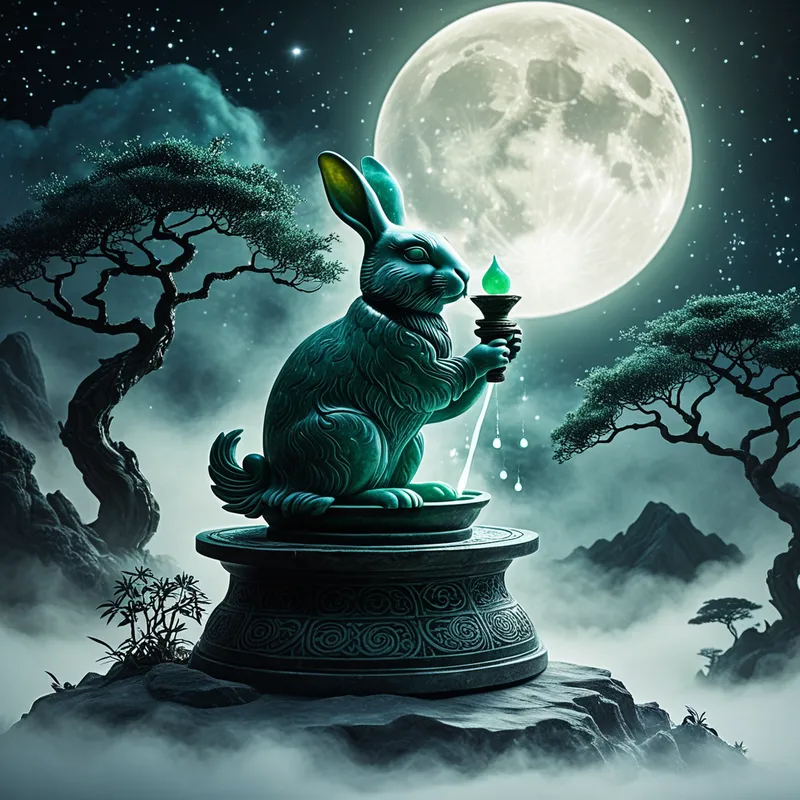
Moon Rabbit/Hare Myth Meaning & Symbolism
A humble hare offers its own body to feed a disguised god, earning an eternal place on the moon as a symbol of ultimate sacrifice and transcendence.
The Tale of Moon Rabbit/Hare
Listen, and let the silver light of the full moon carry you back. In a time when gods walked the earth in disguise, testing the hearts of all creatures, there lived three friends: an otter, a jackal, and a hare. They were not ordinary beasts, for they practiced virtue, observed holy days, and shared a bond of deep fellowship.
One day, as the sun began its descent, a great weariness fell upon the land. An old, frail sadhu appeared at the edge of their forest. His robes were tattered, his body bent with hunger. He collapsed by their path, his breath shallow. "Alms," he whispered, his voice a dry leaf in the wind. "I am starving. Can you, who are so wise and good, find food for a dying man?"
The three friends were stricken with compassion. They agreed to scour the land, each according to their nature, to bring sustenance for the holy stranger. The otter, sleek and swift, dove into the river. With skill born of the current, he soon returned, laying a fine plump fish upon the grass. The jackal, cunning and sharp-eyed, slunk into the human village and returned with a stolen curd cake and a piece of spiced meat.
The hare, however, searched and searched. He bounded through fields, nosed under bushes, but found only grasses and herbs—food fit for a hare, but not for a man. A cold dread settled in his heart. The fire was built, the pot was ready, and the sadhu's eyes, though kind, held a silent, profound expectation.
Then, a realization dawned within the hare, clear and terrible as moonlight on ice. He had nothing to give but himself. He turned to his friends and the old man. "My brothers," he said, his voice steady, "you have brought gifts of your labor. I have nothing from the forest to offer. But a guest must not go unfed. Gather wood. Make the fire hot."
Confused, the otter and jackal did as he asked, piling dry branches high. The hare approached the now-roaring flames. He addressed the sadhu directly, his form small against the inferno's dance. "Venerable one, I offer the only thing I truly own. Please, accept my body as your meal."
Without a moment's hesitation, the hare leaped into the heart of the blazing fire.
A great cry went up from his friends! But then, a miracle unfolded. The flames did not burn; they cooled into a pool of silver light. The hare felt no pain, only a strange, lifting lightness. The old sadhu began to change. His tattered robes melted into robes of light, his frail body expanded with a radiance that dimmed the stars. It was Śakra, lord of the heavens, who had come to test the virtue of the earth.
With a voice that echoed from the mountain peaks, Śakra spoke. "You, little hare, have given the greatest gift—the gift of self, without hesitation, without regret. All beings will remember this act. But you shall not be forgotten ash. Your virtue shall be a light for all time."
Then, the god reached into the cool, moon-colored embers. With his divine hand, he took the essence of the hare—its courage, its compassion, its willing heart—and drew it upon the very face of the full moon. There, for all generations to see, the outline of the hare was etched into the lunar plains, an eternal testament to the sacrifice that transcends death. And some say, he is there still, forever pounding the herbs of immortality in his celestial mortar, a guardian of the ultimate promise.
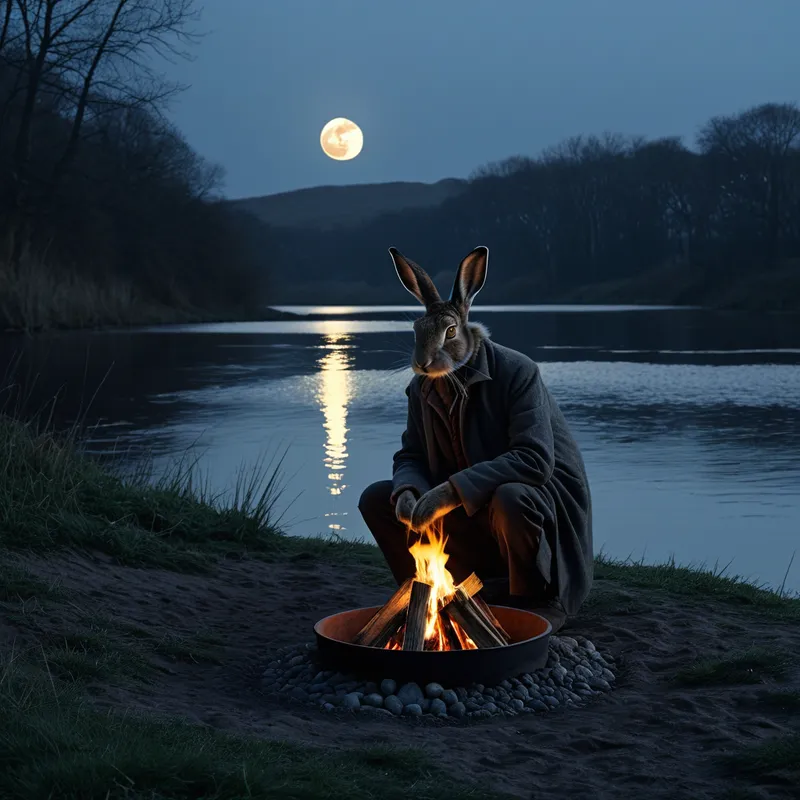
Cultural Origins & Context
The myth of the Moon Rabbit or Hare is a stunning example of a polygenetic myth, arising independently yet bearing remarkable similarities across continents. Its most elaborated versions are found in the Jātaka tales of Buddhism (the Śaśa Jātaka), where it is a previous birth story of the Buddha, and in Hindu mythology. From India, it traveled eastward along the Silk Road, profoundly influencing Chinese mythology (where the hare pounds the elixir of life for the moon goddess Chang'e), and then into Korean, Japanese, and Southeast Asian lore.
In the pre-Columbian Americas, notably among the Aztecs and Maya, a rabbit or hare was also seen in the moon's patterns, often associated with drunkenness or abundance, a testament to a separate cultural observation leading to a similar symbolic conclusion. This global resonance suggests the myth taps into a fundamental human impulse: to see narrative and moral order in the celestial blank slate of the moon.
The story was not mere entertainment. In its Buddhist context, it was a parabolic teaching on the perfection of giving (dāna-pāramitā), the highest form of charity which expects nothing in return. It was told by monks and depicted in temple art to inspire laypeople. In East Asia, it became intertwined with festivals like the Mid-Autumn Moon Festival, a time of family reunion where the moon rabbit symbolizes longevity, harmony, and the sweet rewards of a virtuous life. It functioned as a societal anchor, linking cosmic order to earthly ethics.
Symbolic Architecture
At its core, the Moon Rabbit myth is an alchemical drama of spirit overcoming matter. The hare represents the ultimate transmutation: the physical body sacrificed to become an eternal, symbolic body. It is not a story of martial heroism, but of compassionate heroism.
The greatest offering is not what you have, but what you are. In the fire of self-surrender, the ego is consumed, and the soul is etched upon the cosmos.
The hare’s leap is the ultimate act of kenosis—an emptying of the self. The fire, then, is dual-natured: it is the apparent instrument of destruction and the very crucible of transfiguration. Śakra, the testing god, represents the objective, impersonal law of the psyche: it rewards authentic, unconditional action with immortality—not of the flesh, but of meaning. The moon itself is the perfect symbol for this process. Cold, sterile, and reflective, it is the realm of the eternal, unchanging spirit, now forever imprinted with the image of a warm-blooded, mortal act of love. The rabbit pounds the elixir, meaning the sacrifice itself becomes the source of immortality for others.
The Dreamer's Resonance
When the Moon Rabbit pattern emerges in modern dreams, it often signals a profound psychological crossroads related to sacrifice and integrity. To dream of a rabbit on the moon, or of offering oneself to a fire, is not a call to literal self-destruction. It is the psyche presenting the ultimate question of the persona: What are you willing to give up that is central to your identity, for the sake of a truth larger than yourself?
Somatically, the dreamer may experience sensations of chilling cold (the lunar landscape) juxtaposed with intense heat (the sacrificial fire)—a somatic metaphor for the tension between isolation and total commitment. The dream-encounter with the frail beggar (the disguised god) often represents a neglected, starving aspect of one’s own soul—a depth of compassion or a principle of ethics—that is demanding to be fed, not with superficial gestures, but with core substance. The dream is a preparation for an existential choice: to cling to the safety of one’s collected "fish and curd" (accumulated skills, possessions, personas) or to offer up the vulnerable, essential self to a transformative process whose outcome is unknown.
Alchemical Translation
For the modern individual navigating the path of individuation, the Moon Rabbit myth models the critical, non-egoic phase of the journey. We spend much of our lives as the otter and jackal: acquiring, achieving, providing from our learned skills. This is necessary. But the call to wholeness eventually comes in the form of the starving sadhu—a life crisis, a depression, a deep sense of meaninglessness that our collected achievements cannot satiate.
The alchemical fire is not punishment; it is the necessary heat that separates the fleeting from the eternal within us.
The "leap into the fire" is the conscious, agonizing decision to let go of a cherished self-image, a long-held grievance, a safe career, or a toxic relationship—to offer it up to be consumed. It is the moment we stop trying to solve the problem from the old ego’s toolkit and instead surrender to the process. The god who catches us is the emerging Self, the central archetype of order. The etching of our essence on the moon is the birth of a new, symbolic orientation to life. We are no longer just a bundle of habits and history; we become a vessel for a transpersonal meaning. We become the one who "pounds the elixir"—our transformed life experience now carries a nourishing, healing quality for our own soul and potentially for the world around us. The myth assures us that what is sacrificed to the fire of authentic existence is not lost, but eternally gained in the pale, watching light of consciousness.
Associated Symbols
Explore related symbols from the CaleaDream lexicon: