
Monomyth Myth Meaning & Symbolism
The timeless story of the hero's departure, initiation, and return, echoing the universal human journey of transformation and self-discovery.
The Tale of Monomyth
Listen. There is a rhythm older than the drumbeat, a path worn into the world’s dreaming before the first city was built. It begins not with a bang, but with a whisper—a restless stirring in the soul of one who hears a call that others cannot.
In a place that is every place and a time that is all time, there lived one who was both ordinary and chosen. Their world was the Village of the Known, bounded by familiar fields and the comforting smoke of hearth fires. Yet, beyond the last fence post lay the Forest of Unbecoming, where shadows moved with a purpose and the wind carried forgotten names. The call came—as a dream of a distant mountain, a prophecy from a wandering crone, or a blight that withered the crops. It was a summons that could not be ignored, though the heart clenched with fear.
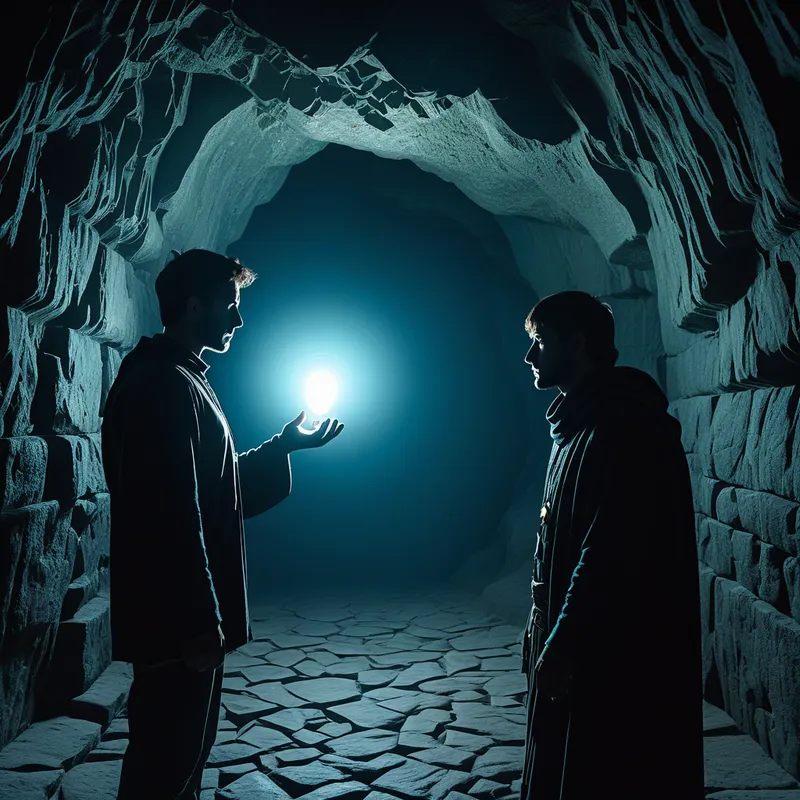
And so, they departed. They crossed the Threshold of the First Step, often aided by a wizened guide who offered a talisman—a word of advice, a key, a sword. The forest swallowed them. Here, in the belly of the unknown, they faced the Trials of the Thickening Dark. They outwitted trickster spirits, navigated labyrinthine caves, and fought beasts that wore the faces of their own deepest fears. Each trial stripped away a layer of who they thought they were.
At the deepest point, in the heart-chamber of the world, they faced the Dragon of the Abyss. This was no mere monster, but a power of cosmic opposition. The battle was terrible, a clash that shook the roots of reality. It was never won by strength alone, but by a flash of insight, a remembered mercy, or a sacrifice that transformed the very terms of the conflict. From the dragon’s hoard or its fallen form, they seized the Elixir of Restoration.
But the journey was only half complete. Bearing the elixir, they turned homeward, often pursued by the wrathful remnants of the old order. They returned across the final threshold, not as the person who left, but as one remade. The elixir—a healing herb, a sacred word, a cup of wisdom—was bestowed upon the Village of the Known, healing its blight, ending its drought, or silencing its sorrows. The one who returned was both stranger and savior, forever marked by the road, forever holding the silence of the deep forest within their eyes.
Cultural Origins & Context
The tale of the Monomyth has no single birthplace, for its seeds are in the very soil of human experience. It is the ur-narrative, emerging independently in the epic poetry of Mesopotamia, the hero cycles of Celtic lore, the ancestor stories of West Africa, the dreamtime journeys of Indigenous Australia, and the spiritual biographies of Asian ascetics. It was not authored but assembled, piece by psychic piece, by countless generations of storytellers—shamans, bards, griots, and elders—who saw in the structure of a great deed a map for the human soul.
Its societal function was multifaceted. On one level, it was a cultural manual, encoding the values of courage, perseverance, and sacrifice necessary for tribal survival. On another, it was a cosmological anchor, explaining through metaphor how order triumphs over chaos. Most profoundly, it served as a Rite of Passage Template. Adolescents hearing the story were implicitly instructed in the psychological process of leaving childhood, facing the trials of adulthood, and returning to contribute to the community. The myth was a collective dream, rehearsing the most dangerous and necessary journey any individual would undertake: the journey toward a whole self.
Symbolic Architecture
The Monomyth is not a story about slaying literal dragons in distant lands. It is a precise symbolic diagram of the psyche's evolution. The Village of the Known represents the conscious ego—its comforts, its limitations, its illusions of control. The call to adventure is the first, often uncomfortable, stirring of the Self, the total, unified psyche beyond the ego.
The refusal of the call is the ego's desperate bargain to stay small, to choose the certainty of misery over the misery of uncertainty.
The crossing of the threshold symbolizes the ego's surrender, allowing itself to be drawn into the vast, uncharted territory of the unconscious. The trials and helpers are encounters with archetypes—the Trickster, the Mother, the Wise Old One—each representing facets of the psyche that must be integrated. The central ordeal and confrontation with the dragon is the ultimate engagement with the Shadow, the repository of all we deny in ourselves. Victory is not annihilation, but integration. Seizing the elixir is the attainment of a new level of consciousness, a psychic centering. The return is the often-difficult task of bringing that transformed consciousness back to bear on "ordinary" life, healing one's personal world.

The Dreamer's Resonance
When the pattern of the Monomyth stirs in modern dreams, it signals a psyche in motion. You may dream of being tasked with an impossible mission at work (the call), of packing a bag for a train you’re about to miss (the threshold), or of navigating a endlessly shifting, bureaucratic maze (the trials). These are not prophecies of external adventure, but somatic maps of internal process.
The body often participates. Dreams of being chased (refusal/pursuit), of finding a hidden room in your house (discovering unconscious content), or of receiving a gift from a mysterious figure (meeting the helper) all speak to this archetypal current activating. The psychological process is one of deintegration. The old, adapted personality structure is being challenged, broken down, or outgrown. The dream-ego is being forced to relinquish control and venture into the discomfort of new psychological territory. This can manifest in waking life as anxiety, restless dissatisfaction, or a sense of meaninglessness—the call manifesting as crisis when it goes unheard.

Alchemical Translation
For the modern individual, the Monomyth is the alchemical formula for individuation. The hero's journey is the soul's journey from the leaden state of unconscious identification (the village) to the golden state of self-realization (the return with the elixir).
The first alchemical stage, Nigredo (the blackening), is the call to adventure and the descent into the forest. It is the necessary depression, confusion, and dissolution of the ego's certainties. The trials represent Albedo (the whitening), the washing and purifying of the psyche through confrontation with its own contents. The confrontation with the dragon is the fiery Rubedo (the reddening), the passionate and often painful struggle that leads to the coniunctio, the sacred marriage of opposites—conscious and unconscious, light and shadow.
The elixir is not found, but forged in the heat of that confrontation; it is the philosopher's stone of the integrated personality.
Finally, the return is Citrinitas (the yellowing), the radiating of that integrated consciousness back into the world, transforming not just the individual but their sphere of influence. To live the Monomyth is to engage consciously with one's own development. It means recognizing the "call" in a life crisis, seeking out "helpers" in mentors or therapy, courageously facing one's inner "dragons" of trauma or fear, and ultimately "returning" with the hard-won wisdom to live more authentically and compassionately. The path is never walked twice in the same way, for each of us must find our own forest, face our own dragon, and brew our own, unique elixir.
Associated Symbols
Explore related symbols from the CaleaDream lexicon: