Mongoose in the Panchatantra Myth Meaning & Symbolism
A loyal mongoose, mistaken for a killer after defending a baby, is slain in a tragic moment of misperception by its grieving master.
The Tale of Mongoose in the Panchatantra
Listen, and let the tale settle in your bones. It begins not in a grand palace, but in the quiet, sun-baked home of a Brahmin. His heart, once filled only with scripture, now swelled with a new, fierce love—for his newborn son. Yet, coiled in the shadows of his joy was the ancient, cold fear of every parent: the vulnerability of this precious life.
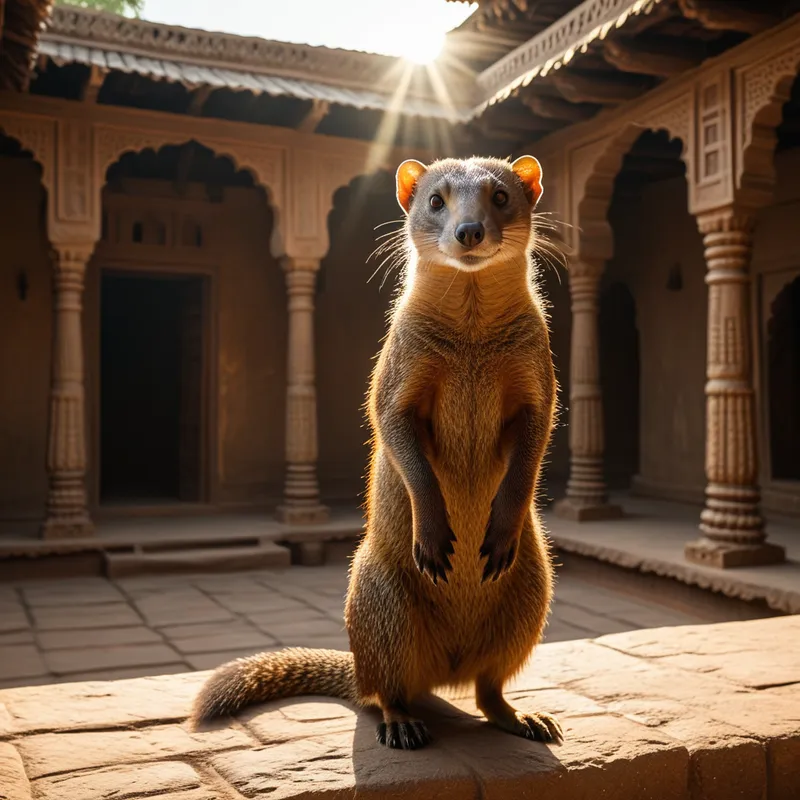
Driven by this protective fire, the Brahmin performed an act of profound trust. He brought into his home a creature of the wild edges, a mongoose kit, orphaned and small. He raised it not as a pet, but as a sibling to his child, feeding it milk from his own hand, letting it sleep by the cradle. The mongoose grew, sleek and strong, its eyes holding the sharp intelligence of the threshold-dweller. It played with the infant, and a bond was woven—a silent pact of the hearth.
One day, duty called the Brahmin and his wife to a distant ceremony. The cradle lay in the silent house. The mongoose, the appointed guardian, paced with a restless energy. Then, it came. A silent slither, a pattern of deadly scales entering the sacred domestic space—a black cobra, drawn by the warmth of life.
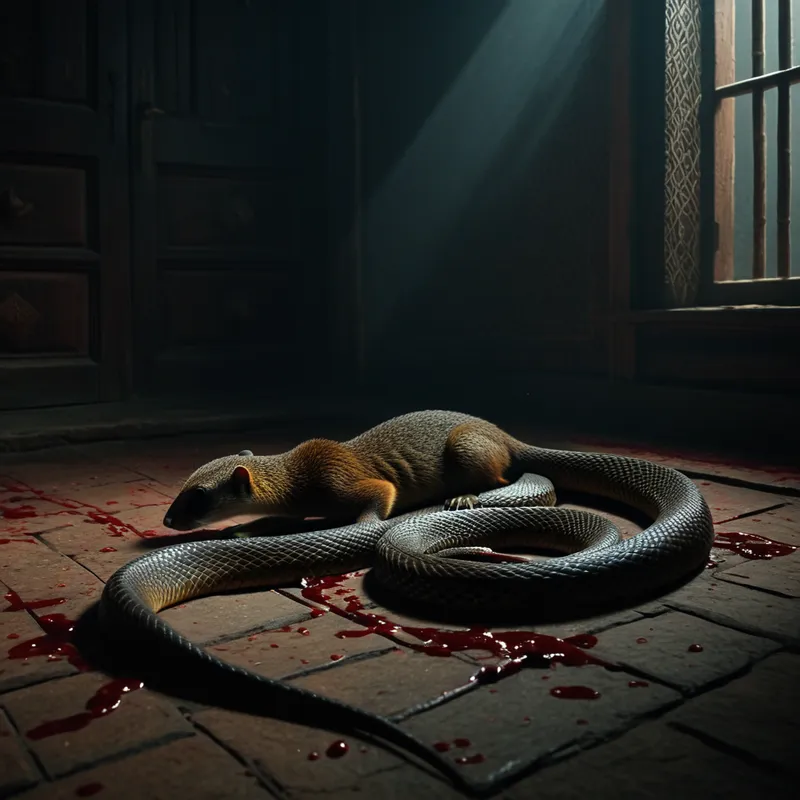
What happened next was not thought, but pure instinctual eruption. The mongoose transformed. Its playful demeanor vanished, replaced by the lightning-fast fury of a protector. A whirlwind of fur, fang, and serpentine coil filled the room. The struggle was brief, brutal, and absolute. The cobra lay dead, its neck broken. The mongoose, panting, its muzzle and paws stained with the enemy’s blood, stood watch over the undisturbed, sleeping child. Its duty was fulfilled.
But fate’s wheel turns on misperception. The Brahmin returned first. His eyes, trained on sacred texts, saw not a scene of salvation, but one of carnage. He saw the blood-smeared mongoose standing by the cradle. His mind, leaping to the darkest conclusion, shattered. A cry of primal anguish tore from his throat. Without a moment’s hesitation, in a storm of grief and rage, he seized a heavy water vessel and brought it down upon the head of his faithful guardian.
The mongoose died instantly, its loyalty its final epitaph. Only then, in the terrible silence that followed the thud, did the Brahmin hear the soft gurgle of his unharmed son. Only then did his gaze fall upon the mangled corpse of the cobra in the corner. The truth crashed upon him like a physical weight. The vessel fell from his numb hands. He stood amidst the wreckage of his own making, cradling his living child, weeping over the slain body of the truest friend he ever had.
Cultural Origins & Context
This piercing story is not from the epics of gods and demons, but from the pragmatic, earthy wisdom of the Panchatantra. Compiled around 200 BCE, its attributed author, Vishnu Sharma, crafted these tales as niti shastra—texts on wise conduct—to instruct three disinterested princes in the art of worldly wisdom (niti) and statecraft. The tales were designed to be engaging, memorable, and transmitted orally long before they were ever written.
The function was profoundly sociological and psychological. It served as a mirror to human folly and a guide for navigating a complex social world. The mongoose story operates within this framework. It is a cautionary tale, not of evil, but of catastrophic cognitive error. It was told to warn rulers, and by extension all people in positions of judgment, against acting in haste, against allowing powerful emotion to blind reason, and against misinterpreting evidence based on preconceived fear. It underscores a core Dharma of leadership: discernment (viveka) must temper action.
Symbolic Architecture
The myth’s power lies in its stark, almost unbearable clarity of symbol. The mongoose is the ultimate symbol of the misunderstood protector. It embodies the instinctual, unconscious guardian of the psyche—that part of us that acts with fierce, unthinking loyalty to preserve our most vulnerable inner child (the infant). It operates in the shadowy, reptilian realm of our deepest fears (the cobra).
The guardian you appoint from the wild edges of your own soul will necessarily return from its battle bearing the stains of the conflict.
The cobra represents the primal, invasive threat—chaos, death, envy, or any unconscious content that seeks to poison new life (a project, a relationship, a nascent part of the self). The Brahmin represents the conscious ego, the part that seeks order, follows ritual (the ceremony), and believes it is in control. His fatal flaw is his inability to read the scene. He sees blood and assumes murder, not defense. He sees the wildness of the mongoose’s nature (the blood) and cannot integrate it with its domesticated loyalty.
The tragedy is not one of malice, but of a fatal disconnect between the conscious ego and the unconscious protector. The ego, in a panic of misattribution, destroys its own best defense.

The Dreamer's Resonance
When this myth pattern stirs in the modern dreamer, it often manifests as a somatic sense of profound injustice or a crushing "if only" upon waking. You might dream of being falsely accused, of trying to shout a warning that comes out as silence, or of destroying something precious in a fit of misunderstood passion.
Psychologically, this dream signals a critical moment of psychic misperception. You are in the process of integrating a powerful, perhaps shadowy, aspect of yourself that has acted to protect your vulnerability. This protector might be your anger that set a boundary, your grief that cleared space, or your ambition that fought for your growth. But the conscious ego, returning to assess the situation, sees only the mess, the emotional "blood," the collateral damage. It condemns this powerful part as destructive, shames it, and attempts to kill it off.
The dream is the soul’s lament for this inner mongoose. It is the feeling of having betrayed a part of yourself that was only ever loyal to your core being.
Alchemical Translation
The alchemical process modeled here is the transmutation of perception, which is the foundation of all inner work. The Brahmin’s journey is ours: from the nigredo, the blackening of despair and tragic error, towards a potential albedo, a whitening of clarified sight.
The first step is the crushing realization—the moment the Brahmin sees the dead cobra. In individuation, this is the moment of shocking self-awareness where we realize we have condemned an inner ally. The grief that follows is not pathological; it is the necessary solvent that begins to wash away the projection. We must weep over the slain mongoose within.
Individuation demands we learn to read the whole room of the psyche, not just the blood at the feet of the guardian.
The alchemical work is to resurrect the mongoose not as it was, but as a known quantity. We must develop the capacity to pause in the face of emotional chaos, to investigate the "bloody scene" before acting. We must learn to recognize the signs of a defensive battle fought on our behalf—the fatigue after conflict, the messy emotions, the necessary aggression—and differentiate them from acts of wanton destruction.
The myth does not offer a happy ending, and neither does this stage of the work. The mongoose is dead. But its spirit—the principle of fierce, instinctual protection—can be integrated. We honor it by vowing never to again raise the vessel of hasty judgment against a part of ourselves we do not yet understand. We become the Brahmin who, though forever marked by tragedy, now possesses the painful, hard-won wisdom to see the serpent and the savior in the same glance. We learn to govern our inner kingdom with a justice born of deep sight, where loyalty is recognized even when it wears the terrifying face of the wild.
Associated Symbols
Explore related symbols from the CaleaDream lexicon: