Moly Myth Meaning & Symbolism
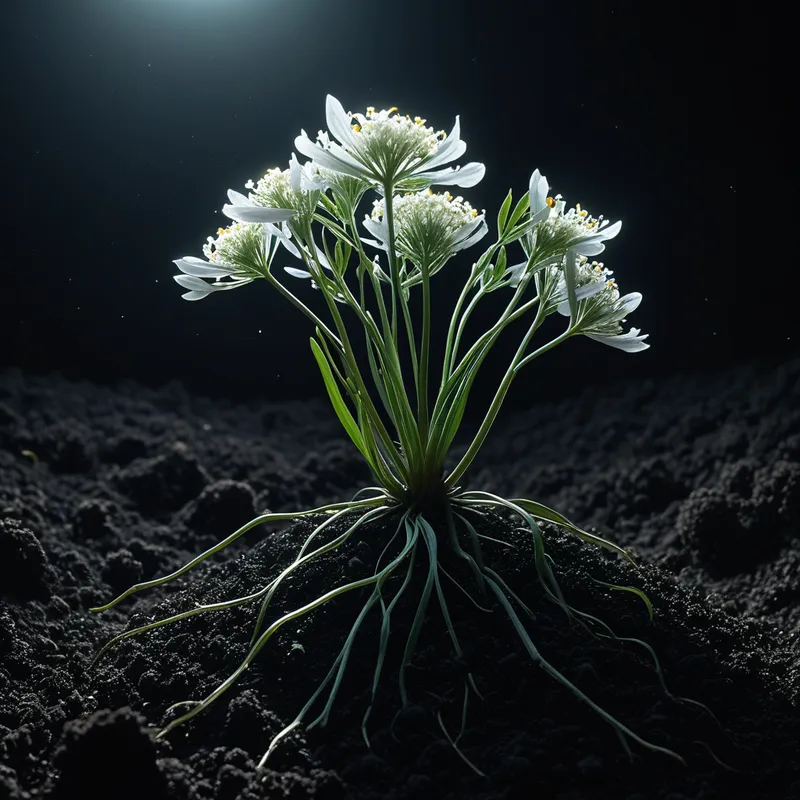
A magical herb, black-rooted and white-flowered, given by Hermes to Odysseus to resist the sorcery of the goddess Circe and reclaim his men.
The Tale of Moly
The sea was a memory of salt and sorrow. Odysseus, breaker of cities, stood on a strange shore. His heart was a hollow drum, beating the names of the lost. Twenty-two of his best men had vanished into the green, perfumed silence of the island Aeaea, sent to scout this land of sweet smoke and singing birds. Only one, Eurylochus, had returned, his face the color of ashes, his words stumbling over a terror too great for language. A palace of polished stone, he gasped. A woman’s voice, weaving like honey and wine. A feast laid out… and then the touch of a wand, and his comrades groaning, shrinking, their forms blurring into bristle and hoof, weeping with human eyes from the faces of swine.
Odysseus seized his bronze sword. The blade felt like a toy against the dread coiling in his gut. He would go alone. He would find them or die. But as he turned from the ship, a figure materialized from the dappled light of the forest path—a young man with the eyes of one who knows all roads. It was Hermes, the caduceus glinting in his hand.
“Son of Laertes, where do you rush, ignorant of this land?” the god’s voice was amused, a breeze through reeds. “You go to free your men from Circe? You will become another beast in her marble halls. She will unman you with a potion and a touch.”
Despair, cold and final, threatened to swallow Odysseus whole. But Hermes smiled. “Take this. It is your salvation.” From the rich earth at their feet, the god drew a plant. “This is moly. The root is black, dug from the deepest dark. The flower is as white as the moon. It is hard for mortal men to find, but the gods can pluck it. Take it. Go to her. When she offers you the cup of betrayal, let this herb be your shield.”
The god whispered its power, its secret name, then vanished like a thought. Clutching the strange plant, its black root cool, its white blossom seeming to hold a faint light, Odysseus walked into the heart of the enchantment. The air grew heavy with narcotic flowers. Circe’s palace rose, beautiful and terrible. She received him, all grace and deadly welcome, her eyes holding whirlpools. She mixed the wine, the cheese, the pale barley, and with a smile, she stirred in her cruel magic, the drug of forgetfulness.
She offered the cup. Odysseus drank. And as her wand tapped his shoulder, he felt nothing. The spell slid off him like water from oil. The moly held him in himself. With a cry that was half roar, half triumph, he drew his sword and sprang at her, a man unleashed, his true form undeniable.
The goddess shrank back, recognizing the god’s work in the unbroken man. “You must be Odysseus,” she breathed, fear and awe in her voice. “The one of many turns, the one Hephaestus and Athena love. Put away your blade. Let there be peace.” And from that moment of shattered power, a new pact was born. She restored his men, their human minds flooding back into their eyes. For a year, they stayed, not as prisoners, but as guests, learning the rhythms of the divine. The moly had been the key that turned the lock, not to escape, but to transform the entire nature of the encounter.
Cultural Origins & Context
This episode is the heart of Book 10 of Homer’s Odyssey, an epic that served as the foundational narrative of Greek identity, recited by bards for centuries before being codified in writing. The tale of Circe and the moly is not a fringe folktale but a central ordeal in the hero’s decade-long journey home (nostos). It was performed in aristocratic halls and public gatherings, its rhythms and formulas familiar to all.
Its societal function was multifaceted. On one level, it is a masterclass in metis, the cunning intelligence prized by the Greeks as highly as physical strength. Odysseus survives not by brute force but by divine aid accepted and wisely used. The myth also explores the profound Greek anxiety about losing one’s identity—a fate worse than death. To be turned into a beast is to lose logos (reason, speech), the defining quality of a human. The moly, therefore, represents the preservation of the civilized, reasoning self against the chaotic, appetitive forces of nature and magic, embodied by Circe. The story reassured its audience that even in the most emasculating, identity-dissolving circumstances, the favor of the gods (through Hermes, the guide) and one’s own innate resourcefulness could provide an anchor.
Symbolic Architecture
The moly is a perfect symbolic paradox, a psychopomp plant guiding the soul through a critical threshold. Its architecture is one of conscious duality.
The black root plunges into the unconscious, the chthonic realm of instinct, shadow, and the raw material of the self. The white flower reaches for the conscious mind, identity, and divine light.
The black root signifies the necessary grounding in one’s own darkness—the acknowledged shadow, the primal fears, the “hard to dig” aspects of the psyche that we would rather ignore. It is the part of the cure that comes from below, from embracing the difficult, earthy truth of one’s situation. The radiant white flower is the preserved consciousness, the unassailable core of self-awareness and integrity that cannot be enchanted or dissolved. It is the lumen naturae, the light of nature, that emerges from confronting the dark.
Circe represents the allure of the unconscious in its captivating, devouring form. She is the anima figure who promises pleasure and forgetfulness but at the cost of the heroic ego. Her transformation is not mere cruelty; it is a symbolic truth: when the conscious mind is drugged by complexes, unresolved traumas, or addictive patterns (the “potion of forgetfulness”), the personality regresses to an earlier, instinctual, and undifferentiated state—the “beast within.” The wand is the catalyst of this psychic dissolution.
Hermes, as psychopomp, provides the mediating symbol—the moly. He does not fight the battle for Odysseus; he provides the tool. This is the archetypal moment of grace in depth psychology: the helpful symbol emerging from the unconscious itself at the point of greatest crisis, offering a way to integrate rather than be consumed.

The Dreamer's Resonance
When this myth stirs in the modern dreamer, it signals a critical juncture in the process of psychological differentiation. To dream of being offered a beguiling drink, of feeling one’s body morph into an animal, or of desperately searching for a specific plant, is to dream of the Circe encounter.
The somatic experience is often one of heaviness, lethargy, or paralysis—the “drugged” feeling. Psychologically, the dreamer is likely entangled in a situation or relationship that is eroding their sense of self. It could be a job that demands conformity at the cost of integrity, a addictive behavior pattern, or a charismatic person whose influence feels overwhelmingly enchanting and yet diminishing. The “men turned to swine” represent parts of the dreamer’s own potential—their skills, vitality, or social self—that have already been lost to this enchantment.
The appearance of a guide figure (Hermes) or the discovery of the dual-colored plant (moly) in the dream is a profoundly hopeful sign. It indicates that the Self, the central organizing principle of the psyche, is activating a compensatory symbol. It is the dream-ego’s call to arms, urging the dreamer to seek the “herb”—that paradoxical insight or grounded truth (the black root) that will protect their core consciousness (the white flower) and allow them to confront the enchanting complex without being destroyed by it.
Alchemical Translation
The journey through Circe’s realm is a precise model for the alchemical nigredo and albedo—the blackening and whitening—of the soul. The hero’s descent into the bewitched island is the nigredo: a descent into the chaotic, animalistic prima materia of the psyche, a state of utter confusion and despair (“all my men are lost”).
The gift of moly is the moment the prima materia reveals its own secret medicine. The cure is found within the nature of the poison itself.
The black root is the conscious acceptance and “digging up” of this dark, messy, foundational state. One must fully acknowledge the beast within, the shadow, the regressed parts. This is not a fight against the unconscious, but a grounding in it. The white flower is the albedo—the dawn that follows the darkest night. It is the clarity of consciousness that emerges precisely because it has been tempered and tested against dissolution. Odysseus does not kill Circe; he transforms his relationship with her. Similarly, in individuation, one does not eradicate powerful complexes (the anima/animus, the mother/father complex); one confronts them with a strengthened consciousness, leading to a new, more conscious relationship with those psychic forces.
For the modern individual, the “alchemical translation” is this: when you are in a situation that threatens to erase you—to turn you into a mere function, a consumer, a beast of burden—you must seek your moly. Look for the paradoxical truth in the heart of the trouble (the black root). It is often the humbling, difficult admission you have been avoiding. Protect the small, luminous flame of your own awareness (the white flower). Then, with that dual-awareness as your shield, you can face the enchantment. The goal is not escape, but transformation. The year that follows on Aeaea is the reward: a period of integration, learning, and receiving nourishment from the very powers that once sought to devour you. The circle closes not with a battle won, but with a self, once nearly lost, now profoundly found.
Associated Symbols
Explore related symbols from the CaleaDream lexicon: