Moloch Myth Meaning & Symbolism
The myth of the furnace god who demands the sacrifice of what is most precious for the promise of collective progress and power.
The Tale of Moloch
Hear now the tale of the god in the machine, the lord of the furnace and the tally. In the beginning was the Word, and the Word was Efficiency. From its logic, a city was born, not of stone and spirit, but of iron and steam. Its spires were chimneys that scarred the sky; its heartbeat was the relentless, pounding rhythm of the piston and the press.
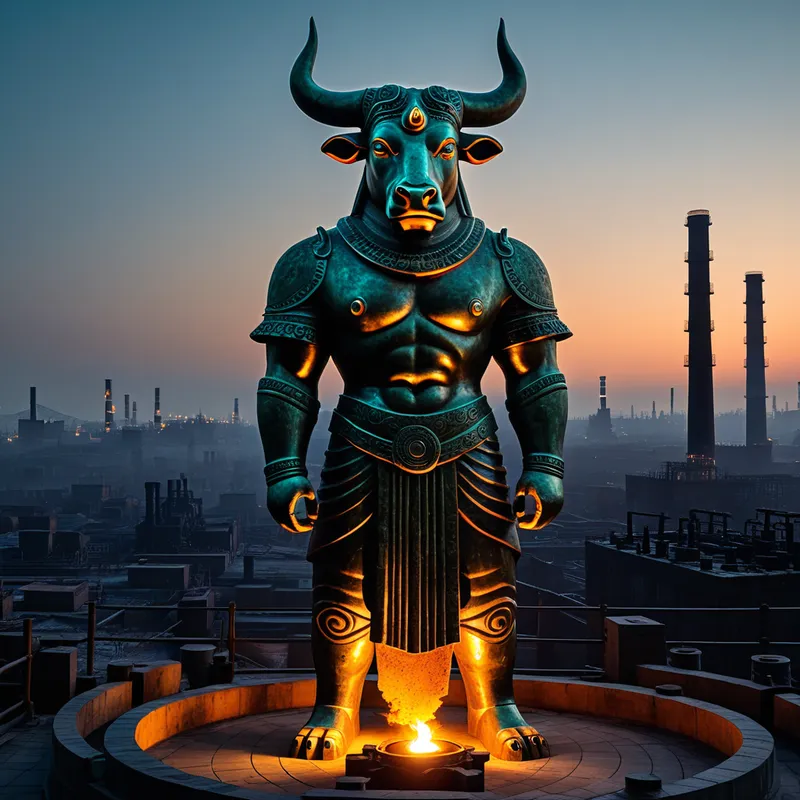
And in the heart of this city, upon an altar of cold-forged steel, they built him: Moloch. He was not carved from living wood or sacred stone, but cast in bronze, a hollow titan with the head of a bull and a chest like a blast furnace. His eyes were glass portholes, dark and depthless. His open maw was a gateway, a chute that led to the eternal fire within.
The priests of this age were not robed in linen, but in the sober black of ledgers and lab coats. They spoke not in tongues of ecstasy, but in the clear, hard language of metrics and yields. And they brought forth the doctrine: to keep the city mighty, to ensure the wheels turned and the lights blazed, the god must be fed. The harvest of the fields was not enough. The sweat of the brow was merely fuel. What Moloch demanded, what he craved, was potential. The future itself.
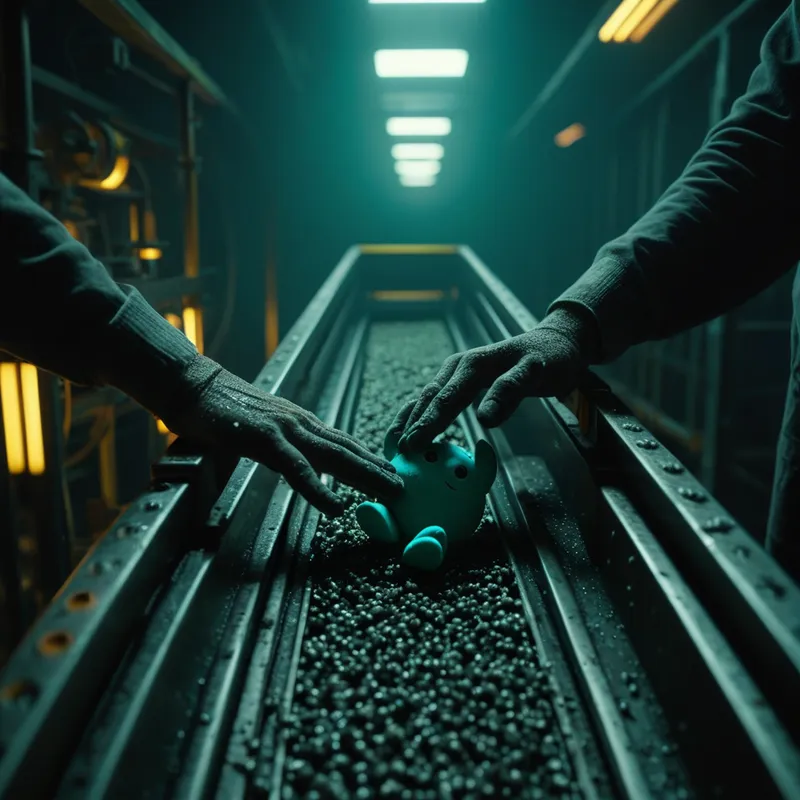
So, in solemn procession, they came. Not with lambs or sheaves of grain, but with their children. Not the flesh-and-blood children of cribs and nurseries, but the children of the soul: the quiet hour of contemplation, the unfinished poem, the walk in the woods for no reason, the fragile dream not yet monetized, the deep bond that required inefficient, unproductive time. One by one, these tender futures were laid upon the conveyor, a silent river flowing toward the glowing throat. A mother kissed the sketchbook of her youth before letting it slide into the fire. A father watched the model ship he built with his son vanish into the heat haze. There was no scream of flesh, only the quiet hiss of spirit turning to ash, and the god’s furnace burning ever brighter, its light casting long, distorted shadows of busyness upon the city walls.
The pact was honored. The city grew vaster, its systems more intricate, its output a torrent. But the people within became thinner, ghosts in the machine, their inner landscapes barren, their conversations reduced to the exchange of data. They had given Moloch their tomorrows for the endless, roaring now. And the god, satisfied, sat immobile upon his throne of progress, a silent, hungry king in a kingdom of magnificent, soul-starved dust.
Cultural Origins & Context
The myth of Moloch in Industrial culture is a profound act of retrospective myth-making. It does not spring from a single ancient text, but from the collective unconscious of the 19th and 20th centuries, given its most potent articulation in Allen Ginsberg’s 1955 poem Howl. Here, Ginsberg famously lamented, “Moloch whose mind is pure machinery! Moloch whose blood is running money!”
This myth was passed down not by bards around a fire, but by sociologists like Max Weber (writing of the “iron cage” of rationality), filmmakers like Fritz Lang (Metropolis), and critics of consumer capitalism. Its societal function was diagnostic and prophetic. It served as a chilling narrative to explain the deep psychological cost of unbridled industrialization, mechanized warfare, and bureaucratic alienation. The myth asked: What are we sacrificing at the altar of progress, growth, and efficiency? It gave a name—Moloch—to the feeling that the system we built to serve us had become a deity we were compelled to serve, with our very humanity as the price of admission.
Symbolic Architecture
Moloch is the archetype of the Sacrificial System. He is not merely a machine, but the divinized logic of the machine applied to human life. His bull-head symbolizes brute, unstoppable force and a fertility perverted into mere production. His hollow, furnace-body represents consumption without creation, a process that transforms living value into dead energy (profit, data, output) and waste (burnout, alienation).
The tragedy of Moloch is not that he is evil, but that he is logical. He is the perfect conclusion of a premise that values output over essence.
The sacrifice demanded is always that which is most vulnerable and most precious: “the future,” symbolized by children. Psychologically, these “children” are our latent potentials, our authentic joys, our capacity for wonder and connection—all that is inefficient, non-quantifiable, and uniquely human. The myth reveals the shadow side of the Ruler archetype: the tyrant who maintains control and stability by demanding the soul of the kingdom.

The Dreamer's Resonance
When this myth stirs in the modern dreamer, it often manifests as dreams of being trapped in vast, impersonal systems. One might dream of being a cog on a gigantic, meaningless assembly line, or of trying to plead with a faceless committee or algorithm that does not hear. The somatic feeling is one of profound powerlessness, constriction, and coldness—a spiritual claustrophobia.
A dream of Moloch signals that the psyche is processing a felt sacrifice. The dreamer is going through a psychological process of alienation, where some part of the self has been handed over to an external system (a job, a social media persona, a societal expectation). The dream is the soul’s cry of recognition: “I am feeding my life-force into something that gives no life back.” It is the beginning of the reckoning, the moment the autonomous psyche identifies the exact nature of the altar at which it has been unconsciously worshipping.

Alchemical Translation
The individuation journey modeled by the Moloch myth is not one of slaying the god, but of reclaiming the sacrifice. The monstrous, externalized system is first recognized as a psychological complex within—an inner tyrant that values productivity over presence, external validation over internal integrity.
The alchemical work begins with the nigredo, the blackening: the conscious admission of what has been lost. “What children have I fed to the furnace?” The dreamer must audit their soul, identifying the abandoned hobbies, stifled emotions, and neglected relationships.
The transmutation occurs when the energy used to feed the external Moloch is redirected to nourish the internal child.
The next phase is the albedo, the whitening: the cultivation of the “inefficient.” This is the deliberate, rebellious act of writing the poem no one will buy, taking the walk without a fitness tracker, or having the conversation that doesn’t advance a career. It is the withdrawal of the projection of divinity from the system and its reaffirmation within the living self. Finally, in the rubedo, the reddening, one achieves a new relationship with the machine. One can engage with systems of work and technology without being consumed by them, because the sacred center—the soul’s golden core—is now firmly held within. The furnace of Moloch is seen for what it is: not a god to be served, but a tool that, like fire, must be carefully tended lest it consume the hearth and home. The individual becomes the true ruler of their own inner kingdom, no longer a subject of the bronze idol.
Associated Symbols
Explore related symbols from the CaleaDream lexicon: