Moccus Myth Meaning & Symbolism
A tale of the divine boar, a sovereign beast of the forest, whose pursuit reveals the sacred contract between hunter, hunted, and the land itself.
The Tale of Moccus
Listen. The forest is not silent. Beneath the sigh of ancient oaks and the chatter of the stream, there is a deeper rhythm—the heartbeat of the land. And in the deepest thicket, where the sunlight fractures into emerald shards, he waits.
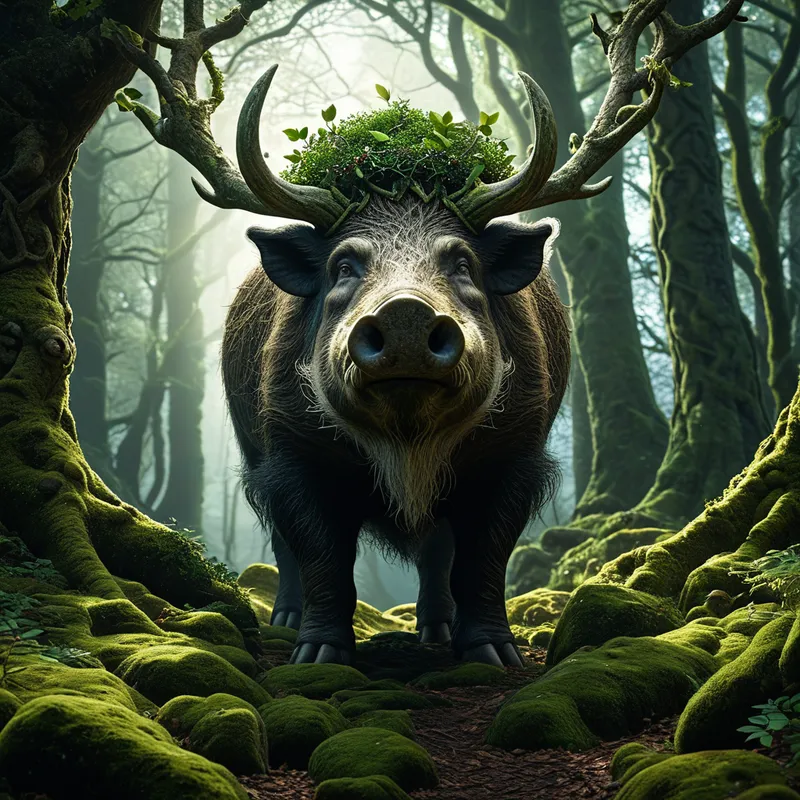
They call him Moccus. Not a man, not a beast, but a sovereign force. His hide is the color of storm-cloud and wet earth, etched with scars that tell of battles with thorns and rival kings. His tusks are curves of yellowed ivory, sharper than any smith’s blade, tools for rooting up the secrets of the underworld. He is the lord of the tangled places, the master of the provocation. He does not hide; he invites.
The challenge begins not with a roar, but with a sign. A village finds its fences shattered at dawn. The sacred nemeton is upturned, the soft soil ravaged as if by a plow of fury. The people feel it—a presence that tests the boundaries of their order. The king knows the language of this sign. It is a summons. A hunt is not merely a pursuit of meat; it is a conversation with the wild soul of the world. To ignore the call is to admit weakness, to let the untamed chaos creep into the hearth.
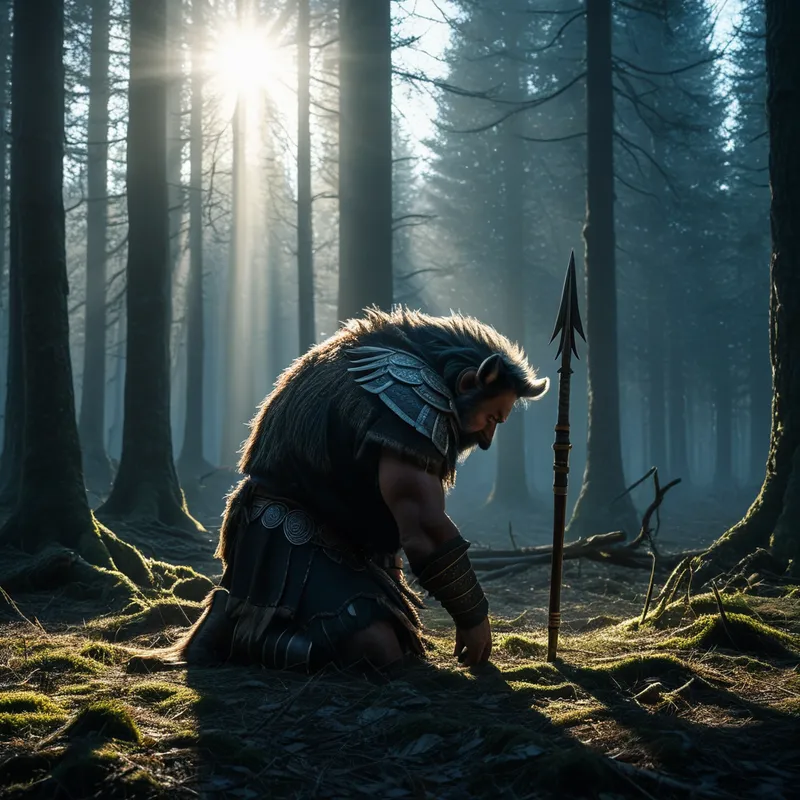
So the chosen one prepares. Not the loudest warrior, but the one who knows the weight of silence. He anoints his spear with oil, whispering promises to the spirit of the oak from which it came. He fasts. He dreams of running through root-choked darkness. At dawn, he steps across the threshold of the cleared land and into the green breath of the forest.
The chase is a labyrinth. Moccus leads him through briar and bog, under low branches that clutch like bony fingers. The air grows thick, time slows. The hunter’s breath becomes the only clock. He sees the boar not as a target, but as a fleeting shadow, a ripple in the ferns, a deep, guttural chuckle echoing from a ravine. Fatigue becomes a spirit clinging to his bones. Doubt whispers that he is the one being hunted.
Then, the clearing. A sudden space where the sun falls in a wide, golden pool. And there he stands, Moccus, turned to face his pursuer. No fear in those dark, liquid eyes—only a profound, unsettling recognition. This is the moment of the sacred contract. The air crackles. The hunter’s throw is not an act of aggression, but of release, of completing the circuit between human need and divine provision.
The great beast falls. There is no triumph, only a vast and hollow silence that rings in the ears. The hunter approaches, his rage and fear spent, replaced by a trembling awe. He places his hand on the still-warm flank, feeling the tremendous life force ebbing into the earth. He gives thanks. The meat will feed the tribe, the tusks will become talismans, the hide a cloak of authority. But the true prize is the knowledge, hard-won in the green cathedral: to take a life is to enter into a bond of responsibility. The hunter has touched the wild god, and the wild god has marked him forever. He returns to the village not just with food, but with a story that smells of damp soil and iron, a story that will bind the people to the land for another season.
Cultural Origins & Context
The whisper of Moccus reaches us not through epic poems, but through the silent language of archaeology and the fragmented echoes in later Mabinogion lore. His name is found inscribed on altars in what was once Gaul, often coupled with the Roman god Mercury, a fusion that speaks volumes. Mercury, the psychopomp, guide of souls and master of boundaries, finds a kindred spirit in Moccus, the sovereign force of the liminal forest.
This was a myth lived, not just told. It resided in the ritual of the hunt, a cornerstone of Celtic aristocratic and spiritual life. The boar was not merely game; it was a potent symbol of ferocity, nourishment, and sacred kingship. To successfully hunt the boar—to engage with the spirit of Moccus—was to prove one’s right to lead, to demonstrate a harmonious relationship with the chaotic, generative forces of nature that sustained the tribe. The myth was enacted by warriors and nobles, its story passed down in the feasting hall over shared meat, in the crafting of boar-crested helmets and carnyx trumpets. It functioned as a societal script, teaching the sacredness of the take, the ethics of the kill, and the profound connection between the ruler’s vitality and the land’s abundance.
Symbolic Architecture
At its core, the myth of Moccus is an elaborate map of a profound psychic equation: the relationship between the structured ego and the untamed, potent energy of the shadow.
The boar, Moccus, is the ultimate shadow archetype. He is not evil, but he is disruptive. He roots up the neatly planted fields of our conscious intentions. He represents unbridled instinct, raw courage, fertile chaos, and a sovereignty that answers to no human law. He is the explosive life force that, if ignored, destroys our fences; if engaged with honor, becomes the source of our strength and legitimacy.
The hunt is never for the beast, but for the part of the self that the beast guards.
The clearing in the forest is the critical symbol of the temenos, the sacred space where opposites meet. It is the moment of conscious confrontation. The hunter, representing the ego’s purposeful intent, finally stands face-to-face with the shadow he has pursued. The kill, then, is not a literal murder, but a symbolic integration. The ego does not annihilate the shadow; it acknowledges its power, takes responsibility for it, and translates its wild energy into a form that can nourish the whole psyche (the tribe). The tusks become talismans—the sharp insight of instinct now available to consciousness. The hide becomes a cloak—the resilient, protective power of the natural self worn with authority.
The Dreamer's Resonance
When the pattern of Moccus stirs in the modern dreamer, it announces a profound somatic and psychological process: the call to a necessary confrontation. You may not dream of a literal boar. Instead, you might dream of a formidable, unstoppable force invading your orderly home (a storm, a flood, a wild animal in your living room). You might dream of being relentlessly pursued through an unfamiliar landscape, or of finding yourself holding a weapon, knowing you must face something immense.
Somatically, this can manifest as a build-up of restless, aggressive, or fiercely protective energy with no clear outlet—a pressure in the chest, a clenched jaw, a readiness for a fight that hasn’t arrived. Psychologically, it is the feeling of being “rooted up”: old habits, complacent beliefs, or fragile self-images are being challenged by a surge of authentic, perhaps inconvenient, feeling or desire. The dream is the forest. The disruptive force is Moccus. The dream ego is the hunter, being forced out of its comfortable village and into a chase it may not feel ready for.
Alchemical Translation
The alchemical journey modeled by Moccus is the transmutation of raw instinct into conscious sovereignty. For the modern individual, the “village” is the persona, the adapted self we present to the world. The “shattered fence” is the symptom—the outburst of anger, the compulsive behavior, the depression that signals a powerful instinctual force is demanding recognition.
The first stage, nigredo, is the dark chase. We must consent to follow our disturbance into the murky, tangled parts of our own nature. This is the shadow work: feeling the rage, the hunger, the wild pride we have disowned.
The clearing is the stage of albedo, the illuminating confrontation. Here, in a moment of stark clarity, we face this disowned part not as an enemy to be destroyed, but as a sovereign aspect of our being. We see its power, its necessity.
The boar does not surrender; it confers. Its death is the birth of its essence into a new form.
The final act, rubedo, is the integration. The killing blow is the act of conscious choice and acceptance. We take the ferocity (the tusks) and use it to defend our true boundaries. We take the resilience (the hide) and wear it as self-possession. We take the nourishing life force (the meat) and feed our authentic growth. We return from the interior hunt no longer just a citizen of the persona-village, but a king or queen in our own right, our authority earned through a sacred contract with our deepest, wildest self. The myth of Moccus teaches that our power is not born in civility, but in the respectful, courageous engagement with the untamed god within.
Associated Symbols
Explore related symbols from the CaleaDream lexicon: