
Mnemosyne Myth Meaning & Symbolism
The Titaness of Memory, mother to the nine Muses, whose union with Zeus births all art and knowledge, reminding us that creation flows from recollection.
The Tale of Mnemosyne
Before the gods of Olympus claimed their dominion, the world was a raw and potent song, sung by the elder powers, the Titans. Among these primordial forces, one was not of fire or stone, not of churning ocean or vaulted sky. She was of a subtler, more profound substance: the fabric of what-has-been. Her name was Mnemosyne.
She dwelled not in a palace, but in the deep, silent places of the earth—in caverns where echoes never died, by springs whose waters were clearer than thought, and in the high, lonely meadows beneath the wheeling stars. Her realm was the invisible archive of the cosmos. Every fallen leaf, every concluded war, every whispered promise of love—its essence did not vanish. It flowed into the vast, still reservoir of her being. She was the keeper of the score, the rememberer of the world’s first dream.
Then came the thunder. The new order, led by the sky-father Zeus, had secured its rule after a cataclysmic war. But the world felt young, brash, and loud, lacking a voice to give its chaos meaning. Zeus, in his sovereign wisdom, looked beyond power for its own sake. He sought the source of meaning itself. His gaze fell upon Mnemosyne, who moved through time as others move through space.
For nine nights, beneath the ancient cypress trees in the sacred grove of Pieria, the god of the bright sky sought the goddess of the deep past. He did not come as a conqueror, but as a supplicant to a deeper truth. Each night, he would weave the raw events of the day—the clash of lightning, the shaping of a cloud, the justice delivered to a mortal—and she would receive them, not as facts, but as seeds. In the stillness of her presence, the raw data of experience was imbued with context, with connection, with the haunting beauty of precedent. Their union was not merely of flesh, but of event and echo, of action and its remembrance.
From this consecrated union, a miracle was born not once, but nine times over. Nine daughters, each a distillation of a different facet of remembered experience given voice and form. They were the Muses. Calliope with her tablet of heroic deeds, Erato with her lyre of longing, Urania with her celestial globe—each one sprang from the marriage of divine authority and timeless memory. They were the embodied truth that to create is first to remember—to remember a feeling, a pattern, a truth older than oneself. Mnemosyne, the silent wellspring, gave birth to all song, all story, all dance, and all inquiry. She taught the universe that before there can be inspiration, there must be recollection.

Cultural Origins & Context
The myth of Mnemosyne is a foundational stratum of Greek cosmology, recorded most authoritatively in the Theogony of the poet Hesiod. As an oral poet composing in the epic tradition, Hesiod was himself invoking the very power he describes; his recitation was an act of remembrance, channeling the Muses, the daughters of Memory. The myth functioned as a divine charter for the cultural practices of poetry, music, history, and science. It answered a profound question: where does human creativity come from? The answer was not merely talent or divine whim, but a sacred lineage tracing back to the faculty of Memory itself.
In ritual practice, Mnemosyne was invoked alongside her daughters. Initiates in mystery cults, such as the Eleusinian Mysteries, prayed to her for true remembrance of the sacred rites, which was believed to ensure a favorable fate in the afterlife. In this context, memory was not just about the past, but about retaining one's essential identity and wisdom beyond the dissolution of death. The myth thus served a societal function far beyond entertainment; it was a metaphysical framework that linked cultural production, personal identity, and spiritual salvation to the primordial power of anamnesis—the unforgetting of the soul.
Symbolic Architecture
Mnemosyne represents the very ground of consciousness. She is not the active, narrating "I," but the vast, impersonal field from which the "I" draws its content. She symbolizes the unconscious in its collective and personal dimensions—the storehouse of all experience, both ancestral and individual.
Memory is not a library but an ecology; it is the fertile humus from which the flowers of thought and art grow.
Her union with Zeus is the archetypal marriage of the conscious ego (the kingly, ordering principle) with the unconscious matrix (the containing, remembering principle). Zeus represents focused will and present-moment authority, but without Mnemosyne, his actions are ephemeral, unrooted, and devoid of meaning. Their progeny, the Muses, symbolize the creative acts that can only emerge when the conscious mind respectfully engages with the depths of the unconscious. Each Muse is a specific mode of this engagement: history (Clio) is memory shaped into narrative; tragedy (Melpomene) is memory distilled into cathartic form. The myth posits that all culture, all meaning-making, is born from this sacred dialogue between the now and the then.

The Dreamer's Resonance
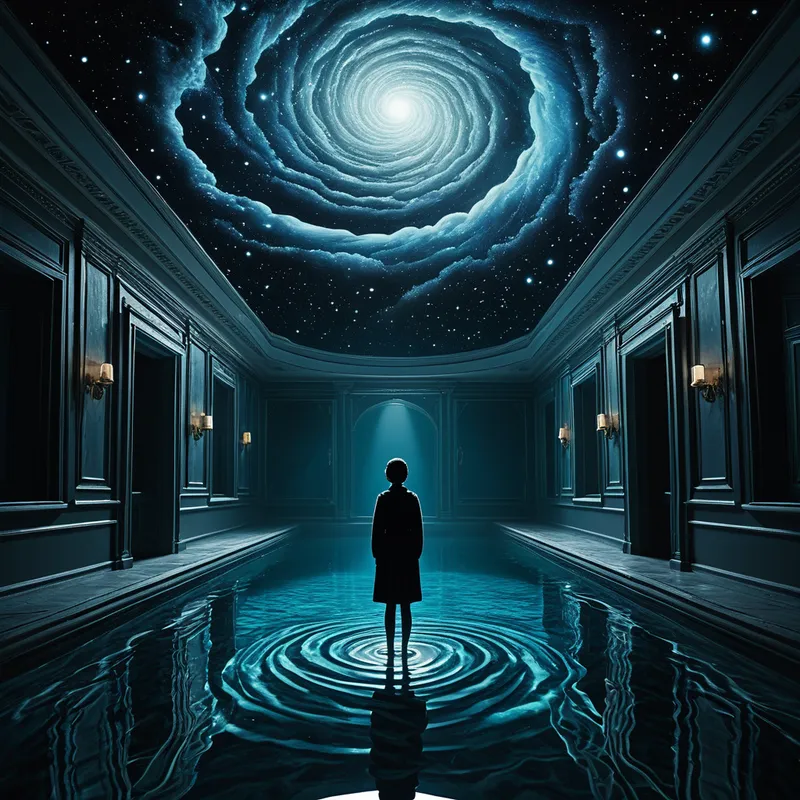
When the pattern of Mnemosyne stirs in the modern psyche, it often manifests in dreams of archives, libraries, vast databases, ancestral halls, or deep, still bodies of water. The dreamer may find themselves in a labyrinthine museum, tasked with finding a specific, obscure artifact. They may encounter a wise, silent figure (often feminine or genderless) who offers them a book, a key, or a drink from a spring.
Somnatically, this process feels like a deep, inward gathering. It is the psyche's movement away from centrifugal expansion and toward centripetal integration. The psychological process is one of recollection in the fullest sense: a re-collecting of scattered parts of the self. The dreamer undergoing this is often at a life stage where forward momentum has stalled because the foundation is unclear. The unconscious is insisting, "Before you can create your future, you must remember who you are." This is not nostalgia, but a profound somatic archaeology, where buried joys, traumas, and innate potentials are brought back into the light of awareness to be metabolized.
Alchemical Translation
The alchemical work modeled by Mnemosyne is the opus contra naturam of turning leaden, forgotten fragments into the gold of coherent selfhood. The first stage, nigredo, is the descent into the memory-cavern—the confrontation with all we have chosen to forget: our shames, our losses, our unmet potentials. This is the dark pool of the dream image.
The second stage, albedo, is the cleansing, moonlit work of Mnemosyne's springs. It is the washing of memories, not to erase them, but to see them clearly, stripped of later judgment and distortion. This is the process of differentiation, where memory is separated from the toxic emotional charge that may have accompanied it.
The goal of psychic transmutation is not to live in the past, but to let the past live in you, fully digested, as wisdom and creative potential.
The final stage, rubedo, is the birth of the Muses—the red, living dawn of creation. This is the fruit of the work: the forgotten pain becomes a poem; the ancestral pattern becomes a conscious choice; the buried talent finds its voice. The individual no longer has memories; they are a living tapestry woven from them. They achieve a form of immortality, not by escaping time, but by becoming a conscious vessel for it, capable of generating new meaning—new myths—from the raw material of all that they have been and remembered. In this, the modern soul echoes the primordial act: from the union of present consciousness with deep memory, the creative spirit is born anew.
Associated Symbols
Explore related symbols from the CaleaDream lexicon:
- Video
- Previous
- Photo
- History
- Recent
- Museum
- Since
- Earlier
- Smell
- Journal
- File
- Lived
- Librarian
- Account
- Memorable
- Occurred
- Dvd
- Hvergelmir
- Elephant Memory
- Faded Wallpaper
- Picture Frame
- Chalkboard
- Blockchain
- Data Server
- Unsaved Document
- Nostalgic Reverie
- Mosaic of Memories
- Distant Relative
- Forget-Me-Not
- Rosemary Sprig
- Dried Bouquet
- Velvety Silverfish
- Amber Insect
- Trusty Silverfish
- Fossilized Beetle
- Locket of Memories
- Snow Globe Village
- Fairy Tale Library
- Vintage Typewriter
- Secret Archive
- Librarian's Bookshelf
- Vintage Accordion
- Rusted Piccolo
- Retro Console
- Scrapbook
- Vinyl Records
- Collectible Stamps
- Antique Collectibles
- Mechanical Music Box
- Sculpted Echoes
- Vintage Film Reel
- Retro Poster
- Faded Photograph
- Lush Folktale
- Faded Storybook
- Ephemeral Sentence
- Chronicles of Time
- Chronicle of Dreams
- Tattered Novel
- Spiral Notebook
- Leather Journal
- Faded Scrapbook
- Retro Side Table
- Faded Sofa
- Aged Cookbook
- Pantry Shelf
- Cookbook
- Plush Keychain
- Personalized Keychain
- Vintage Charm Bracelet
- Engravable Tag
- Victorian Cameo
- Fossil Jewelry
- USB Flash Drive
- Vinyl Record Player
- Whirring Hard Drive
- Rewound Music Tape
- Action Camera
- Compact Camera
- Digital Sketchpad
- File Cabinet
- Faded Office Supplies
- Whiteboard
- Pocket Notebook
- Document Scanner
- Transcendent Filing Cabinet
- Clipboard Paper
- Sheet Music
- Vinyl Record
- Historical Museum
- Vintage Parlor
- Attic of Memories
- Time Capsule Room
- Memory Lane Room
- Outdoor Movie Screen
- Echoes of the Past
- Glimmering Photo
- Legacy Stone
- Torn Pages
- Forgotten Notes
- Thought Cloud
- Wave of Understanding
- Mind Palace
- Chronicle of Thoughts
- Ocean of Knowledge
- Faded Mosaic
- Cave Painting
- Fossilized Shells
- Cave Drawing
- Cinders of Memory
- Fable of Ancestors
- Memory Palace
- Password Reset
- Digital Memory
- Etymology
- Subjunctive
- Evocative
- Anniversary
- Flashback
- Homage
- Narration
- Moraine
- Sediment
- Stratum
- Database
- Archive
- Snapshot
- Patchouli
- Nostalgic Prologue
- Memory