
Mímisbrunnr Myth Meaning & Symbolism
Odin sacrifices an eye to drink from Mímisbrunnr, the Well of Wisdom guarded by the head of Mímir, gaining cosmic knowledge through profound loss.
The Tale of Mímisbrunnr
Beneath the groaning root that stretches toward the land of the frost giants, in a place where the light of the sun dares not linger, lies a well. This is no ordinary spring. Its waters are blacker than the space between stars, stiller than a held breath, and deeper than time itself. This is Mímisbrunnr.
And beside it sits a head. Not a skull, but a living head, with skin like ancient bark and a beard woven from the roots of the earth. This is Mímir, the rememberer, the keeper. His eyes, when they open, hold the light of all that has been and the shadow of all that will be. He guards the well, for its waters are memory, are wisdom, are the very pattern of the cosmos.
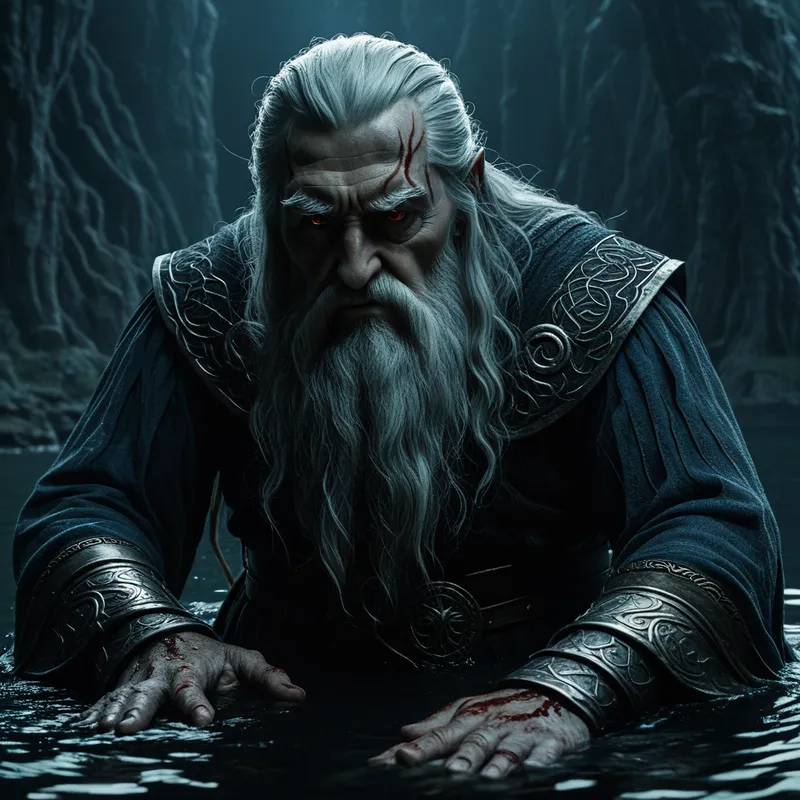
To this silent, sacred place came the All-Father, Odin. He did not come with thunder or with a host of warriors. He came alone, his single eye burning with a hunger no feast could sate. He had hung on the windswept gallows of Yggdrasil for nine nights, a sacrifice to himself, and gained the secret of the runes. But the runes were a language; he sought the speaker. He sought the source.
He stood before Mímir, and the air grew thick with the weight of the unasked question. The well did not ripple. Mímir did not speak. Odin knew the price. The well’s wisdom was not given. It was traded. The ultimate barter.
With a hand that did not tremble, Odin reached to his own face. There was no grand ceremony, no pleading to the heavens. There was only the terrible, wet sound of severing, the gasp of the world tree itself, and the offering held out in his palm: his own right eye, a sphere of sight still gleaming with the light of Asgard. He let it fall. It pierced the black mirror of the well’s surface without a splash, sinking into the infinite dark.
Then, and only then, did Mímir stir. The great head nodded, a movement of continents. The waters of the well swirled, not with water, but with visions—the birth of worlds, the threading of fates, the silent march of giants, the desperate glory of gods, and the final, quiet whisper of Ragnarök. Odin knelt. He cupped his hands, broke the surface, and brought the dark water to his lips.
He did not drink water. He drank time. He drank sorrow. He drank the answer to every question, which is the weight of all questions yet to be asked. When he stood, he was no longer just Odin the spear-shaker. He was Odin the Terrible, the One-Eyed, the Lord of the Hanged. He saw the threads, and he saw the shears. He gained the wisdom to rule the gods, and with it, the profound, unending grief of knowing how their story must end.
Cultural Origins & Context
The myth of Mímisbrunnr is preserved primarily in the Prose Edda of Snorri Sturluson and referenced in the older, poetic fragments of the Poetic Edda. It was not a tale for children or a simple explanation of natural phenomena. This was deep lore, the secret history of the gods themselves, likely shared among skalds (poets), scholars, and perhaps within the inner circles of pagan cultic practice before the Christianization of Scandinavia.
Its function was multifaceted. On one level, it was an etiological myth explaining Odin’s distinctive one-eyed visage, a core part of his iconography. On a deeper, societal level, it modeled a profound cultural value: that true wisdom, the kind necessary for leadership and survival in a harsh, fatalistic universe, is not free. It is purchased with a piece of the self. This resonated in a world where kings sought the counsel of seers, where knowledge of weather, tides, and strategy meant the difference between life and death for a community. The myth legitimized the idea of the wise leader as one who has paid a terrible personal cost for their insight, making their guidance both sacred and tragic.
Symbolic Architecture
At its heart, Mímisbrunnr is an image of the unconscious itself—the dark, reflective pool containing all memory, all potential knowledge, and the patterns of destiny. It lies at a root of the World Tree, symbolizing its foundational, nourishing, yet hidden role in the psyche’s structure.
The well is the unconscious mind; the eye is the conscious perspective. To know the depths, one must surrender the safety of a single, fixed point of view.
Mímir, the severed yet living head, is the archetype of objective consciousness detached from the body—pure intellect, memory, and timeless awareness. He is the guardian at the threshold, the psychopomp who ensures the seeker is serious. Odin’s sacrifice represents the ultimate paradox of consciousness expansion: to see more of the whole, one must willingly blind oneself to a part of it. The physical eye represents outward, sensory perception and a unitary, ego-centric viewpoint. Sacrificing it is an act of radical humility, acknowledging that the ego’s sight is insufficient. What is gained is not better physical vision, but insight—the ability to perceive the hidden connections, the causes beneath effects, the tragic and beautiful architecture of fate.
The Dreamer's Resonance
When this myth stirs in the modern dreamer, it often manifests not as a literal well or giant’s head, but as a profound somatic and symbolic pattern. The dreamer may find themselves in a situation where they must choose between keeping something precious, familiar, and defining (a relationship, a career identity, a cherished belief) and surrendering it to gain access to a deeper truth or a new phase of life.
The somatic experience can be one of acute pressure behind the eyes, a feeling of being “blinded” by insight, or a visceral dream-sensation of removal or loss. The “well” in the dream might be a mirror that becomes a portal, a computer screen displaying infinite, overwhelming data, or a loved one whose eyes suddenly hold ancient, frightening knowledge. The psychological process is one of ego-death in miniature. The conscious, adapting self (the ego) is being asked to relinquish a fundamental way of perceiving and navigating the world to make room for a wisdom that comes from the deeper, impersonal Self. It is a crisis of meaning, where old maps fail, and the only way forward is to pay a price for a new one.

Alchemical Translation
The journey of Odin to Mímisbrunnr is a perfect allegory for the Jungian process of individuation—the psychic transmutation of the individual into their whole, authentic Self. The first step is the nigredo, the descent into darkness. Odin leaves the bright halls of Asgard for the shadowy roots of the world. This is the conscious engagement with the shadow and the unconscious.
The sacrifice itself is the mortificatio, the killing of a prized part of the old identity. The ego’s primary tool—its singular, judging, differentiating perspective—is offered up. This is not destruction for its own sake, but a sacred trade.
Individuation is not about adding more to the self, but about sacrificing the partial self to redeem the whole.
Drinking from the well is the albedo and rubedo—the illumination and integration. The dark water (the unconscious contents) is taken in, purified, and assimilated into the conscious mind. Odin returns transformed, bearing both terrible knowledge and the authority that comes from it. For the modern individual, this translates to the moments when, after a period of intense suffering, loss, or voluntary relinquishment, a deeper, non-personal understanding dawns. You don’t just solve a problem; you understand your place in a larger pattern. You gain the wisdom of Mímir—the ability to see objectively, beyond personal desire—but you wear the wound of Odin, the permanent reminder of the cost of that sight. The goal is not to become a detached head, but to become a one-eyed king who rules his inner kingdom with the hard-won wisdom of the depths.
Associated Symbols
Explore related symbols from the CaleaDream lexicon: