
Mímir's Well Myth Meaning & Symbolism
Odin, the Allfather, sacrifices his eye to drink from the Well of Wisdom, gaining the knowledge of the past, present, and future.
The Tale of Mímir's Well
Beneath the groaning weight of the worlds, in the deepest, darkest root of the Yggdrasil, there lies a place of profound silence. It is not a silence of emptiness, but of immense depth, the quiet of a mind that holds all things. Here, where the root drinks from the primal waters of Ginnungagap, bubbles the Well of Mímir. Its waters are not clear, but dark as polished obsidian, dark as the space between stars, and in them swims all that was, all that is, and all that may yet be.
The guardian of this place is Mímir himself, a being of such ancient knowing that his thoughts are the roots of history. He is the memory of the cosmos. To this sacred, somber place came the Allfather, Odin. He walked with the weight of kingship and the terror of prophecy upon him, for he had seen the shadow of Ragnarök stretching across the threads of fate. His one eye, which saw the plains of Asgard and the struggles of men, was not enough. He needed the sight that sees through time itself.
He stood before Mímir, and the air grew thick with the presence of unspoken truths. "Guardian," Odin's voice was a low rumble, like distant thunder. "I seek a draught from your well. I seek wisdom."
Mímir's gaze was fathomless. "The water of my well is not given freely, Wanderer. All who drink here must pay a price. For you, Odin, keeper of the hanged and master of the spear, the price is dear. What will you give?"
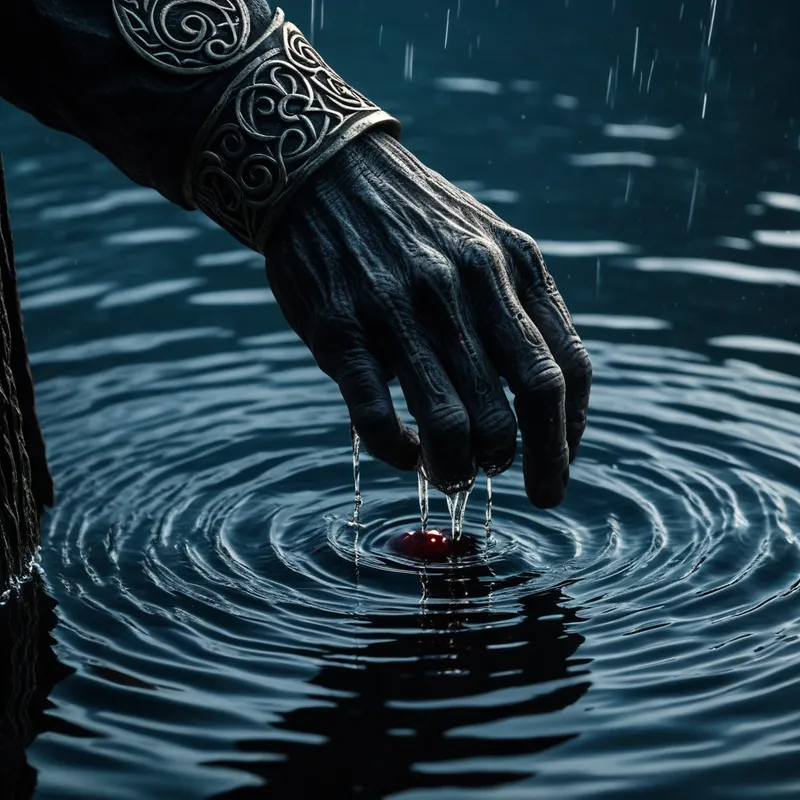
Odin did not hesitate. He knew the cost whispered in the winds of Jötunheimr. His hand went to his face. There was no cry, only the terrible, final sound of sacrifice. He plucked out his own right eye, the eye that saw the sunlit world, and held it forth. It gleamed, a wet and terrible jewel.
"Let this be my payment," he said, his voice steady though his face was a mask of agony and resolve.
Mímir accepted the offering. He took the eye and, with a reverence reserved for the most sacred of exchanges, lowered it into the black waters of the well. The eye sank, a fading star, and the waters shimmered with a cold, inner light. Then, Mímir filled a drinking horn from the now-rippling well and passed it to the one-eyed god.
Odin drank. The water was cold, colder than the deepest winter, and it burned with the fire of a thousand suns. In that draught, he did not taste water. He tasted the birth of stars and the silence of graves. He saw the past unspool—the forging of the world from the flesh of Ymir, the first breath of the first man and woman. He saw the present in all its tangled glory—the scheming of Loki, the valor of Thor, the sorrows of every mortal hearth. And he saw the future, inevitable and grim—the final battle on the Vígridr plain, the fall of gods, and the swallowing of the sun.
When the vision passed, Odin was changed. He was no longer just the king of gods; he was the god who knew. He rose, his face now bearing the hollow of sacrifice and the terrible depth of hard-won wisdom. He left the well, carrying the burden of all he had seen, a price paid in blood and sight for the power to guide the worlds toward their destined end.
Cultural Origins & Context
This profound myth comes to us from the rich tapestry of Old Norse poetry and prose, primarily preserved in the 13th-century Icelandic texts known as the Poetic Edda and Snorri Sturluson's Prose Edda. These works, compiled centuries after the Christianization of Scandinavia, are our best windows into a pre-Christian worldview where wisdom was not merely intellectual but a hard-won, often dangerous, commodity.
The myth of Mímir's Well was not a simple bedtime story. It functioned as a foundational narrative for a culture that valued cunning (seidr), foresight, and the acceptance of harsh fate (wyrd or ørlög). It was told by skalds and poets, individuals who themselves were seen as vessels of inspired knowledge, much like Odin, the patron god of poetry. The story served multiple purposes: it explained the iconic one-eyed depiction of the chief god, it established the supreme value of wisdom over mere physical wholeness, and it modeled the ultimate sacrifice a leader must be willing to make for the sake of their people's survival. In a world perceived as fundamentally hostile, governed by cycles of creation and destruction, Odin's act was the ultimate strategic gambit—a willing descent into personal loss to gain the intelligence needed to navigate an apocalyptic future.
Symbolic Architecture
At its core, the myth is an alchemical map of consciousness. The Yggdrasil represents the structured totality of the psyche, with its realms of conscious identity (Asgard), instinct and chaos (Jötunheimr), and memory (the roots). Mímir's Well, at the deepest root, symbolizes the wellspring of the unconscious—the collective and personal memory that holds the patterns of the past and the potentials of the future.
To drink from the well of wisdom, one must offer the eye that sees only surfaces. True knowing requires the sacrifice of a partial, outward-facing perspective.
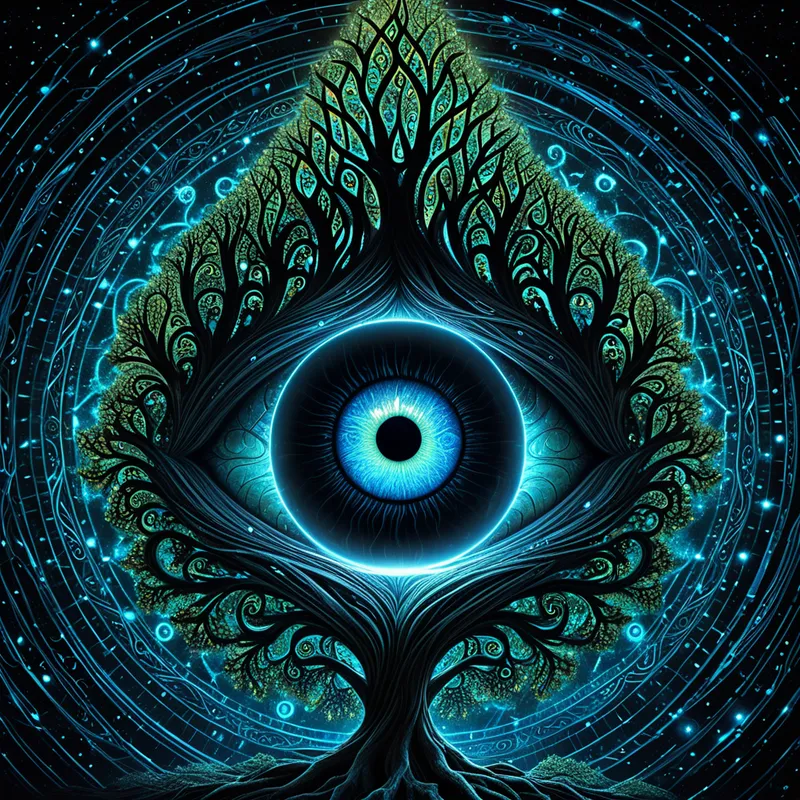
Odin's eye is the symbol of directed, conscious perception. It is the ego's way of seeing—focused, selective, and oriented toward the external world. To pluck it out is the ultimate act of ego-sacrifice. It is a willing surrender of a comfortable, "sunlit" worldview to gain access to the darker, more complete truths of the deep self. Mímir, the severed head (in later myths), is the archetype of objective consciousness—wiself detached from the body's passions, existing purely as knowing and memory. The water is the fluid medium of the unconscious itself, where all opposites—past and future, life and death—swim together undifferentiated.
The Dreamer's Resonance
When this myth stirs in the modern psyche, it often manifests in dreams of profound searching and costly exchange. A dreamer may find themselves in a labyrinthine library where they must trade a cherished possession for a single, forbidden book. They may stand before a mirror that reflects not their face, but a swirling vortex of ancestral memories and future anxieties. The somatic experience is one of visceral tension—a pressure behind the eyes, a feeling of something vital being offered up.
Psychologically, this signals a critical juncture in the process of individuation. The dream-ego is being confronted with the limitations of its current consciousness. It is being called to relinquish a long-held viewpoint, a cherished self-narrative, or a comfortable identity ("the eye") to gain a deeper, more unsettling form of understanding. The dream is the psyche's dramatization of the price of growth. The terror and awe felt in the dream are direct echoes of Odin's sacrifice, indicating that the dreamer is grappling with a truth that cannot be integrated without personal cost.

Alchemical Translation
The journey to Mímir's Well is the quintessential model of psychic transmutation. The first stage is the nigredo—the blackening. This is Odin's descent into the murky roots of the world tree, a conscious confrontation with the shadow and the depths of the personal and collective past. It is a movement away from the brightly lit halls of the persona and into the dark waters of the unconscious.
The sacrifice of the eye is the mortificatio—the killing of a part of the old self. In alchemical and psychological terms, this is the dissolution of the ego's rigid perspective. The ego must willingly de-integrate, surrendering its claim to total, one-eyed control, to make space for a more complex form of perception.
The wisdom gained is not a simple answer, but the capacity to hold the tension of opposites—the vision of both creation and destruction, hope and doom, within a single, unified awareness.
Finally, the draught from the well and Odin's transformation represent the albedo and rubedo—the whitening and reddening. He emerges with a new, integrated consciousness. He is not "healed" in the sense of being made whole again physically; instead, his wound becomes the vessel for his new sight. The hollow socket is now a window to the unseen. For the modern individual, this translates to the hard-won wisdom that follows a life crisis, a profound loss, or a deep therapy process. One does not return to who they were before the sacrifice. They become someone new, bearing the scar of their offering and the unshakable, often burdensome, knowledge that it bought. They become, in their own sphere, a sage—one who sees not just with the eye, but with the mind's eye, informed by the dark waters of the deep self.
Associated Symbols
Explore related symbols from the CaleaDream lexicon:
- Vague
- Media
- True
- Awkward
- Forgotten Reptile
- Gemstone of Truth
- Nostalgic Photograph
- Surgeon's Scalpel
- Journalist's Notepad
- Boundless Anthology
- Forgotten Tales
- Vinyl Record Player
- Cracked crystal ball
- Fuzzy Memory
- Aletheia (Truth)
- Riddle of Existence
- Coastal Fog
- Muffled Noise
- Muffled Echo
- Memory Leak
- Encryption Key
- Digital Noise
- Whisper
- Thermometer
- Snapshot
- Amnesia