
Mímir's Decapitated Head Myth Meaning & Symbolism
Odin sacrifices an eye to drink from the well of Mímir, keeper of ancestral wisdom, whose severed head continues to whisper secrets from the roots of the world tree.
The Tale of Mímir's Decapitated Head
Listen, and hear the price of wisdom. In the dawn of the worlds, when the great tree Yggdrasil was young, there existed a well of terrible knowledge. It lay not in the shining halls of the gods, but in the deep, dark earth, cradled in the roots that drink from the primeval void. This was Mímisbrunnr, and its guardian was Mímir.
Mímir was no god of thunder or beauty, but a being of deep memory. He was the rememberer, the one who drank daily from the well’s dark waters and knew all that was, is, and might be. His counsel was sought by the All-Father himself, Odin. Yet Odin’s hunger was a ravening thing. He knew that to steer the fates of gods and men through the coming twilight, he needed more than counsel. He needed to drink from the source itself.
So Odin journeyed down, past the realms of light, into the whispering gloom where the roots of the World Tree grip the cold clay. There he found Mímir, ancient and still as stone beside the well that mirrored the stars of forgotten skies. “Grant me a drink from your well, Mímir,” Odin said, his voice echoing in the hollow. “I thirst for the wisdom to see.”
Mímir’s eyes, deep as the well itself, regarded the king of the gods. “The waters are not given,” he rumbled, his voice like roots grinding against rock. “They are earned. All who drink from Mímisbrunnr must leave a pledge. What will you give, Odin All-Father?”
And Odin, without hesitation, did the unthinkable. He plucked out his own right eye—a sphere of divine sight—and let it fall, a bloody jewel, into the dark water. A ripple spread, and the well accepted the pledge. Then, and only then, did Mímir lift a horn, fill it with the luminous, ink-black water, and offer it. Odin drank, and the cosmos poured into him—a searing, silent flood of past and future, of sorrow and song. The price was paid; the wisdom was won.
But this is not where the tale ends. It deepens. When the great war between the Æsir and the Vanir was settled with an exchange of hostages, Mímir was sent to the Vanir. They, distrusting his counsel, saw only silence and secrecy. In their fear of what they could not understand, they did a brutal, final thing: they severed Mímir’s head from his body and sent it back to Odin.
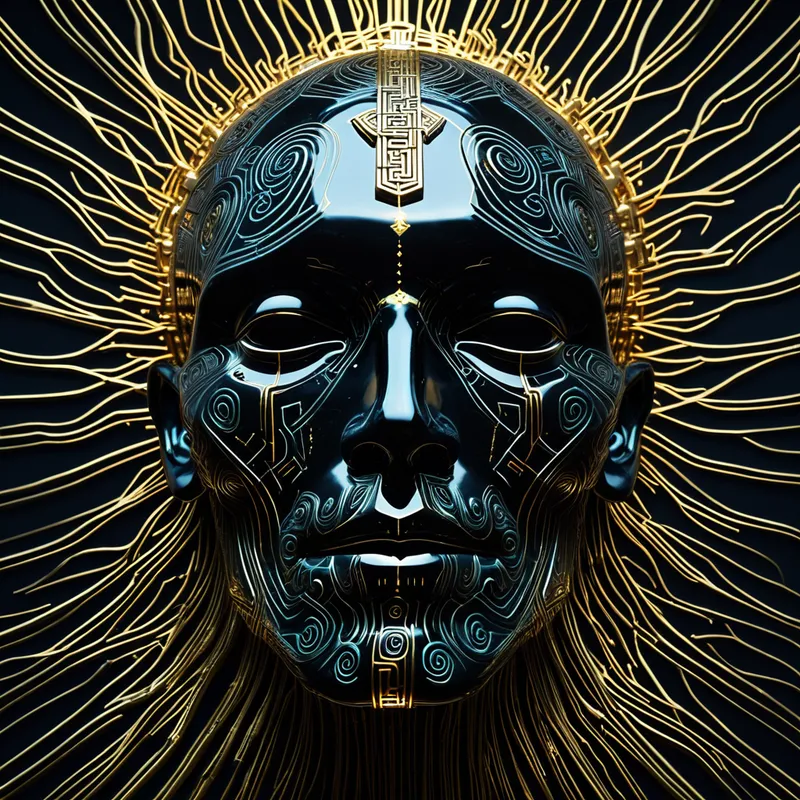
A lesser god would have buried it. Odin, the master of runes and the rider to the edge of death, saw another use. He performed rites of preservation, chanting spells over the pale flesh, anointing it with rare herbs to ward off decay. The head did not rot. It lived. Odin placed it beside the very well it once guarded. And there, at the root of the world, Mímir’s decapitated head retained its voice. It whispered. It counseled. It spoke secrets of the unseen world to the one-eyed god who had paid the ultimate price to listen. The rememberer became the remembered, a severed oracle singing from the threshold of life and death.

Cultural Origins & Context
This myth reaches us through the fragmented, potent verses of the Poetic Edda and the later, prose narratives of the Prose Edda, penned by the Icelandic scholar Snorri Sturluson in the 13th century. These texts are our primary windows into a worldview that was already fading, preserved by a Christian writer with one foot in the old faith. The story of Mímir is not a simple folk tale; it is a core cosmological narrative.
It functioned within a culture that viewed wisdom not as a passive accumulation of facts, but as an active, hard-won, and often traumatic acquisition. Knowledge was tied to sacrifice, to ordeal. The myth was likely told by skalds and elders to illustrate a fundamental, sobering truth: true understanding comes at a great cost, and it often resides in dark, uncomfortable places—in the roots, not the branches. Mímir, and his fate, represent the ancestral memory of the tribe, the deep, often unsettling knowledge of the past that must be consulted, even in a fragmented state, to navigate the future. The head retained at the well symbolizes the preservation of oral tradition and ancestral voice, a critical practice in a pre-literate society facing the existential threat of Ragnarök.
Symbolic Architecture
At its core, this myth is an intricate map of the psyche’s relationship to consciousness and the unconscious. Mímir’s Well is the collective unconscious itself—the deep, nourishing, and terrifying source of all potential knowledge. Mímir is its guardian, the personification of objective wisdom, memory, and the ancestral psyche. He is not “good” or “evil”; he is a function of reality.
To gain wisdom, one must offer a piece of one’s current worldview in exchange. One must sacrifice a familiar way of seeing.
Odin’s sacrifice of his eye is the quintessential act of symbolic payment. The eye represents a mode of perception—outward-looking, focused, daylight consciousness. To gain inner, intuitive, and prophetic sight (the wisdom of the well), he must surrender a part of his ordinary sight. It is a move from binocular, surface vision to a monocular, depth vision—a seeing into the dark.
The decapitation and preservation of the head is the myth’s most profound alchemical image. The head, the seat of intellect and consciousness, is severed from the body, the seat of instinct and life. This is not a destruction of wisdom, but its distillation. The raw, living wisdom (Mímir alive) is too much for the conscious ego (the Vanir) to handle; it is destroyed. But the essential, oracular principle of wisdom (the preserved head) can be integrated by a psyche prepared through sacrifice (Odin). The head at the root becomes a bridge, a dialogic partner between the conscious mind and the deep, impersonal wisdom of the unconscious.
The Dreamer's Resonance
When this myth stirs in the modern dreamer, it signals a profound initiation into a deeper layer of self-knowledge. To dream of a talking head, especially one that is severed, ancient, or oracular, is to encounter the Mímir archetype. The somatic feeling is often one of eerie awe, a chill of sacred dread. The dreamer may feel they are at a threshold, being offered counsel from a place that feels both deeply personal and utterly alien—the voice of their own ancestral psyche, their inner sage.
Psychologically, this dream pattern emerges when the conscious ego is being called to pay a price for greater awareness. Perhaps a long-held belief (an “eye”) must be relinquished. A comfortable identity may need to be “severed” from its old connections to allow a more essential truth to speak. The dream is a sign of the psyche’s own preservative magic at work: even through trauma, loss, or radical change, the core voice of wisdom is not lost. It is being prepared to counsel from a new, more integrated place—no longer taken for granted in the body of daily life, but consciously consulted at the root of one’s being.

Alchemical Translation
The journey of Odin and Mímir is a perfect model for the Jungian process of individuation, the psychic transmutation of the base metal of ego into the gold of the Self. It outlines a non-negotiable sequence.
First, the Call to the Deep: The conscious personality (Odin) feels an insatiable hunger for meaning that surface life cannot satisfy. This leads to a descent into the unconscious (the roots of Yggdrasil).
Second, the Sacrificial Transaction: Here, the ego must offer up a treasured part of itself—a prejudice, a self-image, a source of security. This is the mortificatio, the necessary death. Odin’s eye is this payment. One cannot gain new consciousness without surrendering old consciousness.
The preserved head is the symbol of the transcendent function—the new, guiding principle born from the union of conscious sacrifice and unconscious wisdom.
Third, the Brutal Severance: The raw wisdom received (Mímir sent to the Vanir) often provokes a crisis. The immature or frightened aspects of the psyche reject it, attempting to destroy it. This is the painful fragmentation that often follows insight.
Finally, the Sacred Preservation: The conscious ego, now initiated (Odin), must perform the work of integration. It must take the severed, seemingly lifeless insight and, through careful attention (the preserving spells), give it a place at the source. The wisdom is not revived as it was; it is transformed into an internal oracle. The talking head is no longer an external figure but an inner voice, a constant counsel from the depths. The individuated person learns to drink from their own well, consulting the preserved wisdom of their sacrifices and ordeals, becoming both Odin and Mímir in one being—the seeker and the sage, forever in dialogue at the root of the world tree.
Associated Symbols
Explore related symbols from the CaleaDream lexicon: