
Mímir Myth Meaning & Symbolism
The god Odin sacrifices his eye to drink from Mímir's well of wisdom, gaining cosmic insight at a terrible, transformative cost.
The Tale of Mímir
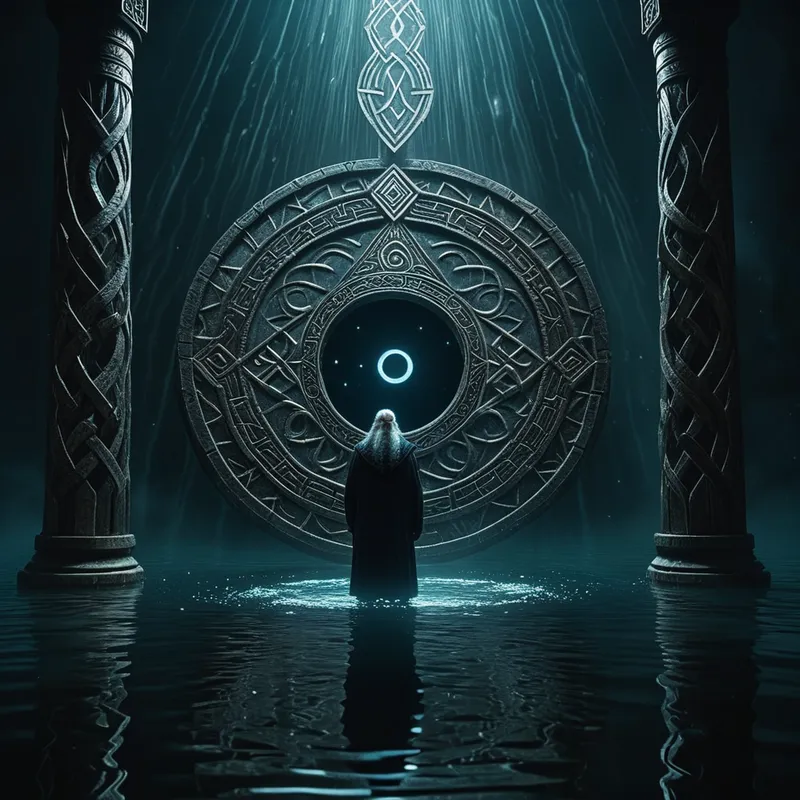
Listen, and hear a tale not of muscle and might, but of mind and memory. In the time before time, when the Ginnungagap still echoed, there existed a well. Not of water, but of knowing. It lay in the deepest, darkest root of the Yggdrasil, in the cold realm of the frost-giants, a place called Mímisbrunnr.
Its guardian was Mímir, a being of such profound understanding that the very roots of the World Tree seemed to whisper their secrets to him. He was ancient when the gods were young, a watcher who drank daily from the well’s dark waters, and in doing so, remembered everything that was, is, or could be.
In Asgard, a shadow grew in the heart of the All-Father, Odin. He who had hung himself on the windswept branches of Yggdrasil for nine nights to win the runes now felt a deeper hunger. The runes gave power, but the well gave context—the memory of all patterns, the source of all foresight. He saw the looming threads of Ragnarök, a tapestry of fire and ice, and knew his hard-won knowledge was but a single thread. He needed to see the whole weave.
So Odin, the wanderer, journeyed down the great trunk, past realms of light and into the chilling mist of Jötunheimr. He found Mímir sitting in silence by his well, its surface black and perfect as polished obsidian, reflecting not faces, but fates.
“Guardian,” Odin said, his voice low. “I have come for a drink from your well.”
Mímir’s eyes, deep as forgotten caverns, regarded him. “The price is high, Son of Bor. This is not water for the thirsty, but sight for the blind. You have given much for knowledge before. What more can you give?”
Odin did not hesitate. He knew the economy of the cosmos: to gain one thing, you must lose another of equal value. “What is the price?”
“An eye,” Mímir said, the words hanging in the frigid air. “Your outward sight for inward sight. A piece of your perception for perception itself.”
And so, in that gloom under the tree, Odin reached into his own face. There was no grand battle, only a terrible, intimate sacrifice. A gasp that misted in the cold, a offering dropped into the well’s waiting darkness. The well drank it, and the water stirred.
Then, and only then, did Mímir take a horn, fill it with the now-awakened waters, and hand it to the one-eyed god. Odin drank. The cosmos flooded into him—not as information, but as being. He saw the past not as a story, but as a lived memory. He felt the present not as a moment, but as a convergence of infinite threads. The future’s grim shape became horrifyingly, beautifully clear. The price was agony; the reward was a burden no mortal could bear.
But this was not the end of Mímir’s tale. When the war between the Æsir and the Vanir finally ended in an uneasy truce, hostages were exchanged. The wise Mímir was sent to the Vanir. They, distrusting his counsel, saw not wisdom but cunning. In fear and fury, they struck his head from his shoulders and sent it back to Odin.
The All-Father did not bury it. He did not burn it. He anointed the head with herbs and sang charms of preservation over it. Mímir’s head lived on, its wisdom undimmed, its eyes seeing still. Odin kept it near, consulting it in times of direst need, whispering to the severed head that knew all. The guardian became the oracle, his well now forever in his mind.
Cultural Origins & Context
The fragments of Mímir’s story reach us through the later medieval texts, primarily the Prose Edda of Snorri Sturluson and allusions in the older poetic lays. Snorri, an Icelandic scholar writing in a Christianized era, was our reluctant bard, preserving a cosmology his world was leaving behind. The myth likely stems from a deep, pre-Christian Germanic stratum concerning the sacredness of springs, heads, and oracular wisdom.
In a culture that valued blunt strength and heroic action, the myth of Mímir presents a profound counter-narrative. It was a story told not to inspire battle-lust, but to instill a sacred awe for the cost of true understanding. It functioned as a cultural metaphor for the value of the elder, the advisor, the one whose power lies in memory rather than might. Mímir represents the institutional memory of the cosmos itself, and Odin’s desperate need for him underscores a terrifying Norse truth: even the gods are not omniscient; they must pay, and pay terribly, for their foresight. The myth legitimized the role of the seer (the völva) and the skald (the poet) in society—those who, like Odin, traffic in hidden knowledge.
Symbolic Architecture
At its core, the myth of Mímir is an alchemical diagram of consciousness. The well is not a location but a state—the collective unconscious, the vast, dark reservoir of ancestral memory, archetypal patterns, and non-personal knowledge. Mímir is its guardian, the personification of the objective psyche, the ancient, impersonal wisdom that exists independently of the ego.
To drink from the well of Mímir is to consciously integrate the unconscious, a process that always demands a sacrifice of the ego’s previous orientation.
Odin’s eye is the sacrifice. The eye represents focused, directed, ego-consciousness—how we choose to see the world. To gain the all-seeing wisdom of the well (unconscious insight), he must surrender his one-pointed, personal perspective. He trades literal sight for symbolic sight, daylight logic for moonlit intuition. The resulting one-eyed vision is a unified vision: one eye for the outer world, one “eye” (the inner sight) for the hidden world.
The decapitation and preservation of Mímir’s head is the ultimate symbol of detached consciousness. The body, the seat of instinct and emotion, is gone. What remains is pure mind, intellect divorced from physicality, memory preserved beyond death. It becomes an oracular device, a talking head—a perfect metaphor for the psyche consulting its own deepest, most objective layer, which often seems to speak to us from a place of alien, timeless intelligence.

The Dreamer's Resonance
When this myth stirs in the modern dreamer, it signals a profound psychological crossroads. To dream of a wise, disembodied head or a silent, deep well is to feel the call of Mímisbrunnr. The somatic sensation is often one of a “heady” pressure, a sense of being too much in your head, yet simultaneously feeling that this cerebral activity is touching something vast and ancient.
This dream pattern manifests when the conscious mind (the Odin-ego) is being compelled to pay a price for deeper knowledge. The dreamer may be in a situation requiring impossible wisdom—a life decision, an ethical dilemma, a creative block. The psyche is stating that the old way of “seeing” (current attitudes, biases, logic) is insufficient. Something cherished—a cherished belief, a comfortable self-image, a literal life plan (the “eye”)—must be offered up. The dream is the negotiation. The anxiety is the price being weighed. The feeling of speaking to a part of yourself that seems ancient, detached, and frighteningly clear? That is the dreamer consulting the preserved head of Mímir, their own inner oracle.

Alchemical Translation
The alchemical process modeled here is the solve et coagula—dissolve and coagulate—applied to the psyche. Odin’s journey is the individuation quest.
First, the descent: The conscious ego (Odin) must leave its high seat in Asgard (its identified persona) and journey downward into the cold, giant realm (the neglected, often frightening depths of the unconscious).
Second, the sacrifice (solve): At the well, the ego must willingly offer a piece of its own structure. This is the dissolution of a part of the personality deemed essential. In therapy or self-work, this is the painful release of a defense mechanism, a narcissistic injury, a long-held narrative. It feels like losing a part of one’s sight, one’s very self.
Third, the integration (coagula): Drinking the waters is the assimilation of the unconscious content. The ego does not become the unconscious; it is irrevocably changed by it. It gains a new, sobering perspective—the wisdom that sees cycles, consequences, and connections. This is not “happy” knowledge; it is often burdensome foresight, the weight of reality.
Finally, the ongoing consultation: The preserved head of Mímir signifies that this is not a one-time event. The connection to deep wisdom must be maintained. The mature individual must regularly “anoint the head”—through reflection, art, meditation, or dialogue with the self—to keep the channel to objective wisdom open. The goal is not to become a disembodied head, but to become a one-eyed king who rules his kingdom with the whispered counsel of the ancient, severed sage within.
The ultimate alchemy is not turning lead to gold, but turning the pain of sacrifice into the vessel that holds the waters of memory, creating a self that is both sovereign and eternally in dialogue with the source.
Associated Symbols
Explore related symbols from the CaleaDream lexicon: