Mjölnir Pendant Myth Meaning & Symbolism
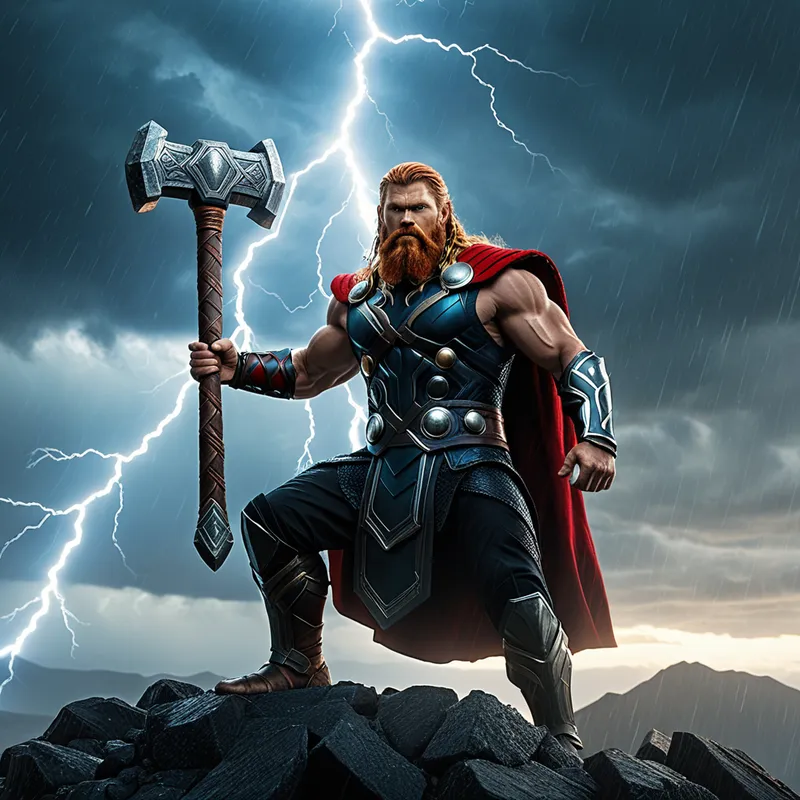
The story of the dwarf-forged hammer, Mjölnir, a weapon of divine might and sacred consecration, wielded by the thunder god Thor to protect the worlds.
The Tale of Mjölnir Pendant
Listen, and hear the tale of the Forging, a story told in the crackle of hearth-fire and the rumble of the distant storm. It begins not with a god, but with a god’s folly. Loki, silver-tongued and restless, severed the golden hair of Sif, wife of the mighty Thor. In her weeping, the very wheat fields of Asgard seemed to blight. Thor’s rage was a tempest contained in a man, and Loki, facing annihilation, swore an oath: he would journey to the realms of the dvergr, the dwarf-smiths, and procure replacements more magnificent than the lost locks.
To the caverns of Sindri and his brother Brokkr he went, into the world of stone, heat, and echoing hammer-falls. There, he bargained and boasted. From the forges came gifts beyond imagining: hair of spun gold that grew upon Sif’s head, the ship Skidbladnir that always found wind, and the deadly spear Gungnir. Drunk on his own cunning, Loki wagered his head with Brokkr that the brothers could not craft gifts to match these. The dwarf’s eyes glinted in the furnace light. “A wager it is. Your head will adorn our hall.”
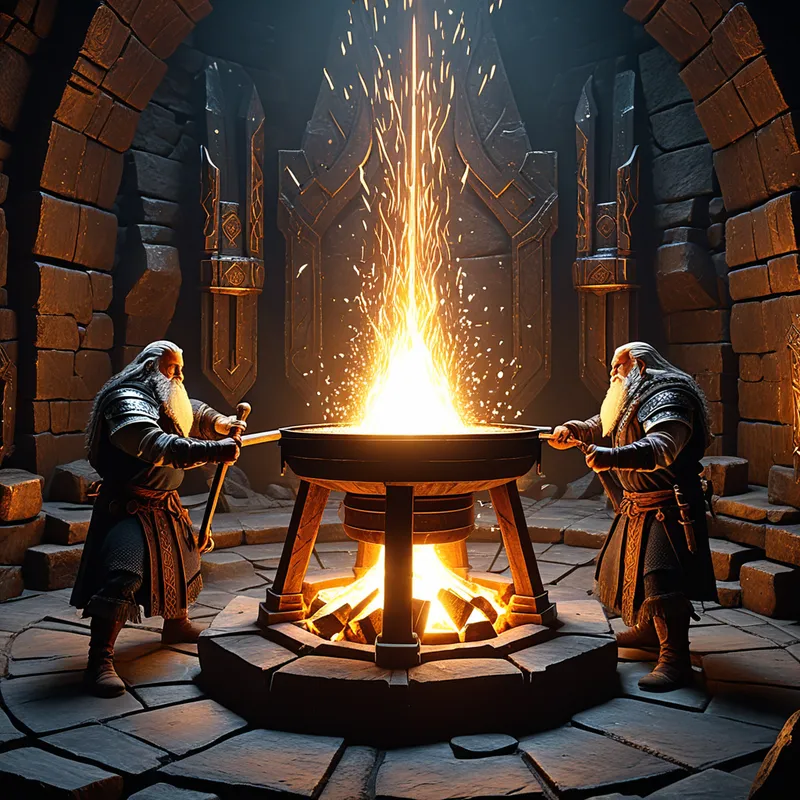
Sindri set to work. He laid pig-skin in the hearth, the great bellows named Brokkr worked by his brother. “Blow without cease,” he commanded, “until I return.” As Sindri left to gather his arts, a gadfly, sharp and persistent, stung Brokkr’s hand. He did not falter. From the fire, Sindri drew Gullinbursti, a living boar of gold that lit the darkest paths. Next, he cast gold into the flame. Again the gadfly came, biting Brokkr’s neck until blood flowed, but the bellows roared. From the coals, Sindri drew Draupnir, a ring of multiplying wealth.
For the final forging, Sindri placed iron in the hearth. “Now, brother,” he hissed, “do not fail. This shall be our greatest work.” The fire roared. The gadfly, now a fury of Loki’s magic, drove itself into Brokkr’s eyelid, blood blinding him. With a cry, he swatted at the pain—the bellows stuttered for a single, fateful heartbeat. Sindri returned, his face grim as he pulled the creation from the ashes. It was a hammer of immense, terrible beauty, its head blocky and dense, inscribed with primal runes of binding and breaking. Its power to level mountains and slay giants was unquestionable. But the handle was short, too short, a flaw born from that single interrupted breath.
They brought the gifts to Asgard. The gods judged. The hammer, despite its flaw, was proclaimed supreme, for in a world bounded by the Yggdrasil and besieged by chaos, what need had they for more beauty or wealth compared to a weapon that could defend? It was named Mjölnir. To Thor it was given, and with it, a sacred duty: the protection of the ordered worlds. Loki, his trickery turned against him, lost his wager, saved only by his silver tongue, not his honor. And so the hammer was born—not in perfection, but in a moment of strain, a tool of ultimate defense, destined to be swung in the thunder’s voice until the end of all things.
Cultural Origins & Context
This myth, preserved primarily in the Prose Edda of Snorri Sturluson, is not merely a fantastical origin story. It was a vital cultural nerve. In the Viking Age, the small hammer pendant—the Mjölnir amulet—was worn widely, a tangible echo of this myth. Its function was multifaceted: a protective talisman against all forms of chaos (spiritual, physical, and social), a symbol of dedication to the community’s defense, and a marker of identity in a world where Christianity’s cross was becoming a rival symbol.
The story was likely told in halls, serving as both entertainment and sacred instruction. It reinforced a worldview where order (örlög) was not a given, but a wall constantly under construction and siege by the forces of entropy (Jotun). The myth explained why the ultimate weapon of the gods was flawed—because perfection is not of this world. Struggle, improvisation, and the acceptance of limitation are woven into the fabric of even divine power. The smiths, the dvergr, represent the transformative power of culture and craft, turning raw elements (iron, folly, conflict) into sacred objects that define a civilization.
Symbolic Architecture
At its core, Mjölnir is not first a weapon; it is a tool of consecration. In myth, it is used to hallow, to bless, and to sanctify—as well as to destroy. This dual nature is its primary symbolic architecture.
The hammer does not ask if the material is sacred or profane; it makes it so through the application of focused force.
Psychologically, Mjölnir represents the focused, conscious will of the ego (Thor) that can intervene in the chaotic, unconscious dynamics (the giants, the trickster Loki). The short handle signifies the inherent limitation of this conscious will—it requires the wielder to get close, to engage directly, to risk themselves. It cannot be thrown from a safe distance without consequence. The hammer’s creation, born from a wager, a flaw, and a trickster’s interference, symbolizes that our greatest strengths often emerge from our conflicts and imperfections, not in spite of them.
The myth maps the psyche’s need for a boundary-setting function. Loki represents the unbound, amoral libido or shadow—creative but destructive. The forging of the hammer is the psyche’s act of crafting a structure (the ego’s capacity for focused action) to manage and direct that raw energy, transforming chaotic potential into protective power.
The Dreamer’s Resonance
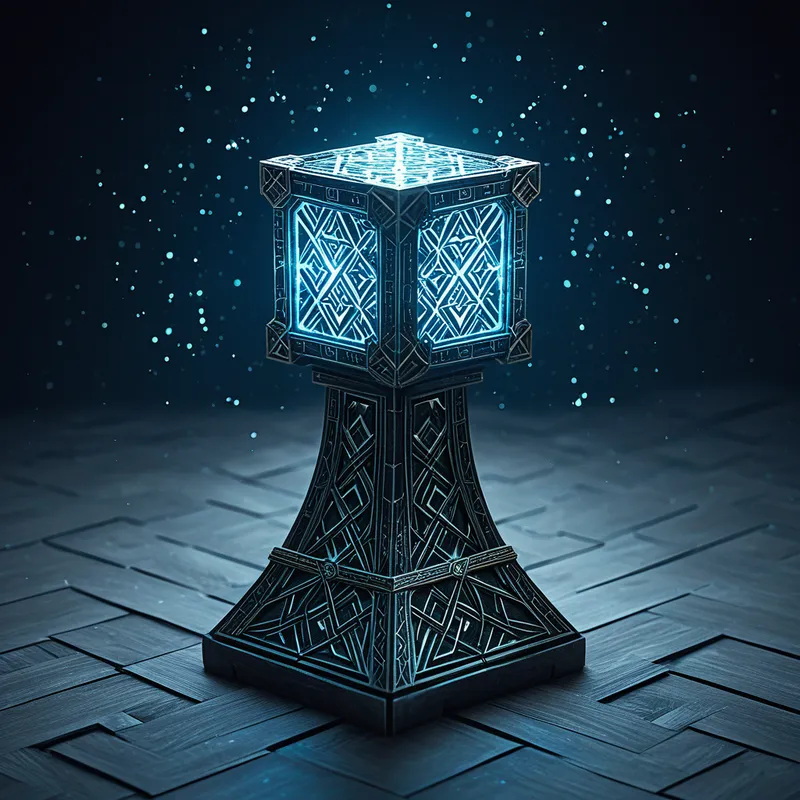
When the symbol of Mjölnir appears in a modern dream—perhaps as a pendant that grows heavy, a tool found in an unexpected place, or a feeling of thunderous potential in the hands—it signals a critical moment in the dreamer’s psychological process. Somatic sensations may include a tightening in the grip, a feeling of density in the chest (the “hammer” of the heart), or an alert, defensive posture.
This is the psyche activating the protector archetype. The dreamer is likely facing a situation that feels invasive, chaotic, or threatening to their personal integrity—a boundary being crossed, a responsibility that feels overwhelming, or a creative force (their own “Loki”) that is running rampant and causing damage. The dream presents the symbol as both a question and an offer: Do you recognize the need to defend your sanctum? Do you have the will to grasp the tool, flawed as it may be, and take a stand? The short handle in the dream is crucial; it insists the solution requires personal engagement, courage, and acceptance of imperfect power.
Alchemical Translation
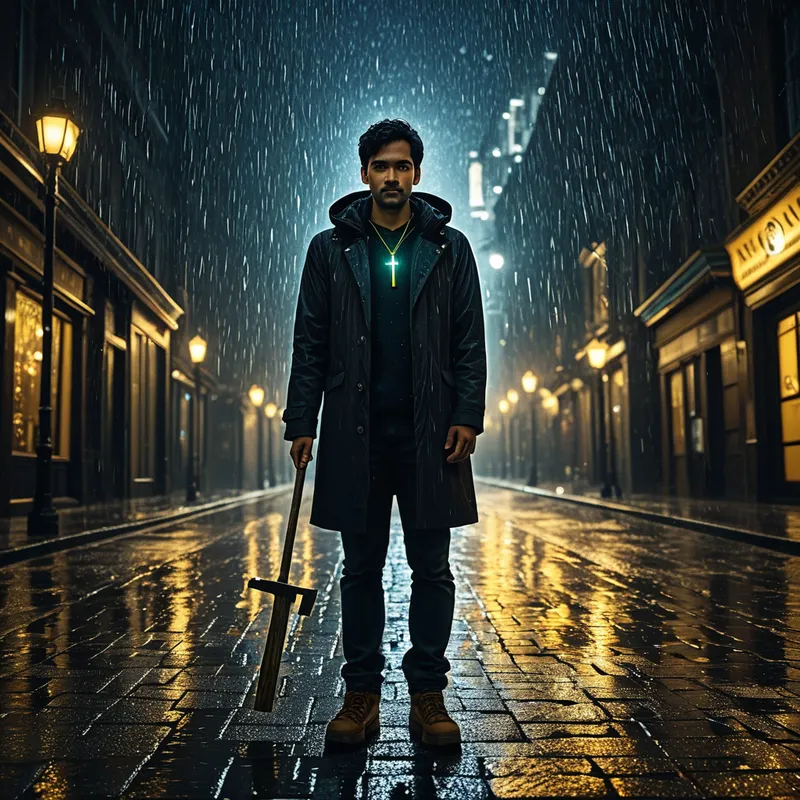
The alchemical journey modeled by the Mjölnir myth is that of coagulatio—the process of taking diffuse, volatile, or chaotic elements and condensing them into a solid, potent, and usable form. Loki’s chaotic trick (the nigredo, or blackening) sets the process in motion, creating the necessary tension.
The dwarf-forge is the vessel of transformation, the focused heat of introspection and craft. The flawed hammer is the lapis, the philosopher’s stone not of perfection, but of practical, earth-bound power. For the modern individual, the alchemical translation is this:
Individuation is not about becoming a perfectly balanced, conflict-free being. It is about forging a conscious will strong enough to engage with your own chaos, a tool that can both destroy outdated patterns and consecrate the new space you claim for your authentic self.
The “pendant” is the symbol made personal, carried close to the heart. It reminds us that our protective power—our ability to say “no,” to set boundaries, to act with conviction in defense of our values and our loved ones—is a sacred craft. It was born from our personal history of mistakes (Loki’s wagers), interruptions (the gadfly’s sting), and limitations (the short handle). To wield it is to accept the thunderous responsibility of your own existence, to become both the guardian and the consecrator of your own world. You are not waiting for a perfect weapon. You are learning to swing the one you have already forged in the fires of your experience.
Associated Symbols
Explore related symbols from the CaleaDream lexicon: