Mithra the Sun God Myth Meaning & Symbolism
The myth of Mithra, a solar deity of truth and contract, whose slaying of the primordial bull catalyzes the creation and sustenance of all life.
The Tale of Mithra the Sun God
Hear now the tale that is carved not in stone, but in the very light of dawn. In the time before time, when the world was a field of potential waiting for its form, there strode a being born of the infinite sky itself. His name was Mithra. He was not the blazing, consuming fire of noon, but the first, unwavering light that parts the darkness—the light of oath, of truth, of the unbreakable bond.
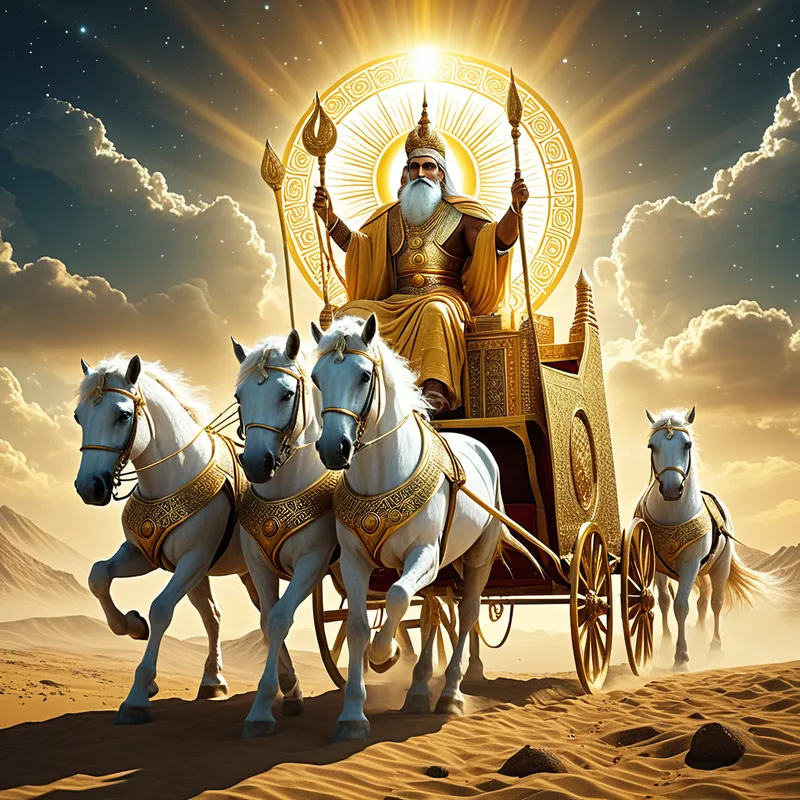
From the highest vault of heaven, he descended, a warrior of radiance clad in the colors of the sunrise. His chariot, drawn by four immortal steeds white as cloud and swift as thought, traced the path of the sun across the dome of the world. His gaze was justice; his presence, the very principle of order. Yet, his great task was not to rule from on high, but to engage in a sacred, terrible struggle upon the earth.
For in the wild, untamed depths of the world roamed the First Bull, a creature of immense, primal vitality. It was not evil, but pure, undirected life force—chaotic, fecund, and boundless. The cosmos held its breath. Mithra pursued this magnificent beast across the face of creation, through valleys and over mountains, in a chase that spanned epochs. It was a divine hunt, not of malice, but of necessity.
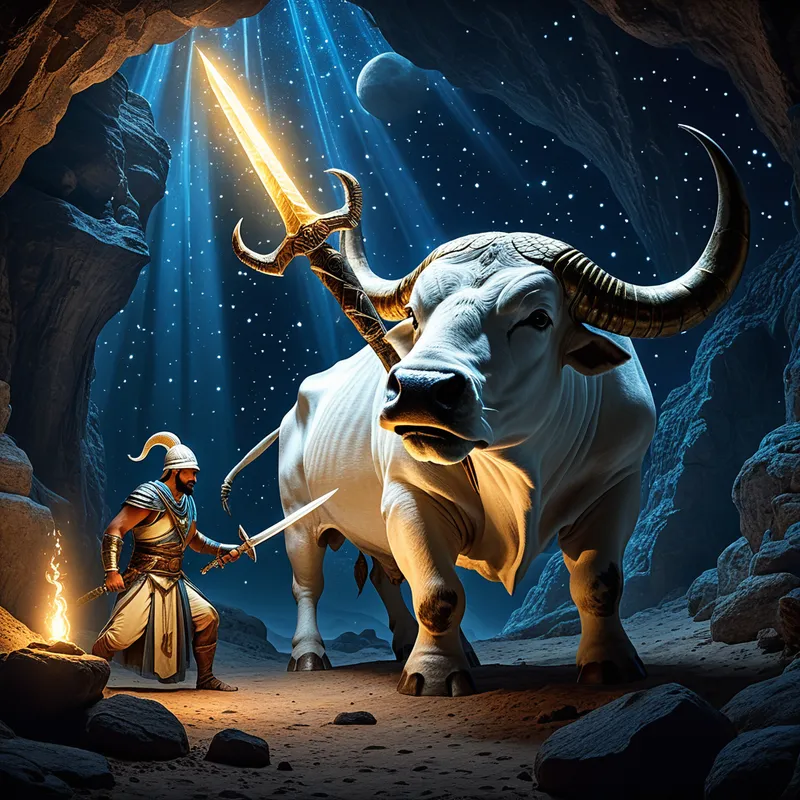
The climax came not on an open plain, but within the secret heart of the world: a sacred cave. There, beneath a ceiling painted with the constellations, Mithra confronted the great Bull. The air was thick with the scent of earth and animal musk, charged with the electricity of impending transformation. With a mighty effort, born of duty rather than wrath, Mithra seized the beast. In an act that was both violent and profoundly merciful, he plunged his dagger into the Bull’s shoulder.
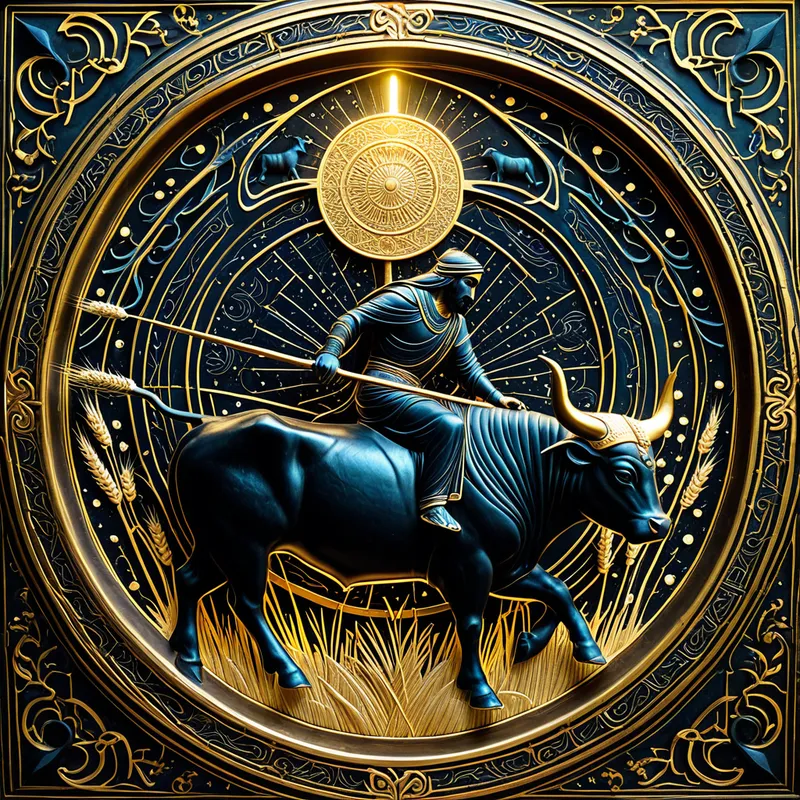
This was no mere death. It was a sacred release. From the wound flowed not just blood, but the very substance of creation. From the Bull’s life force sprang all wholesome plants: wheat for bread, vines for wine, herbs for healing. The scorpion and the snake, creatures of the earth, came to draw forth the last of its potency, while the faithful dog lapped at the sacred flow, a companion in the moment of transmutation. The Bull’s soul ascended to the lunar sphere, becoming the guardian of all herds, and from its purified seed came all beneficent animal life.
And Mithra, his covenant fulfilled, partook of a last meal with the Sun God himself before ascending in the Sun’s own chariot. He became the mediator, the watchful eye of the contract, forever ensuring the cosmic order his sacrifice had made possible. The light of dawn, henceforth, was the light of his enduring promise.
Cultural Origins & Context
The figure of Mithra is one of immense antiquity, originating in the common Indo-Iranian heritage long before the rise of the Persian Empires. He is a central deity in the Rigveda and the Avesta, the sacred texts of Zoroastrianism. Here, he is Mithra, a yazata (a divine being worthy of worship) of covenant, oath, friendship, and the light that precedes the sunrise.
This myth was not merely a story for entertainment; it was a foundational social and cosmic technology. In a culture where oral contracts and sworn alliances were the bedrock of society—from trade agreements to treaties between kings—Mithra was the divine witness and enforcer. To break an oath was to violate asha (cosmic truth and order) and invoke Mithra’s wrath. His myth provided a divine template for the necessity of sacrifice—the sacrifice of the chaotic, untamed, and personal—for the creation of communal order, sustenance, and spiritual fertility. The story was passed down through priestly recitation and ritual, embedding itself not just in religion, but in the very legal and ethical consciousness of ancient Persian society.
Symbolic Architecture
At its core, the myth of Mithra is an alchemical drama of consciousness imposing meaningful form upon raw, unconscious vitality. The Bull represents the untamed libido, the sheer life force of the instinctual world, full of power and potential but lacking direction. It is the psyche in its primordial, undifferentiated state.
The hero’s task is not to destroy the instinct, but to engage it in sacred combat, to sacrifice its chaotic autonomy so that its boundless energy may be transformed into the sustenance of a conscious life.
Mithra represents the solar principle of the ego-consciousness, the part of the psyche that seeks order, truth, and contract with both the outer world and the inner self. The sacred cave is the temenos, the protected ritual space of the psyche where this profound inner work must occur. The act of slaying is not murder, but a necessary separatio—the difficult, often painful psychological act of differentiating conscious will from compulsive instinct. The resulting creation—the plants, the animals—symbolizes the fruits of this inner labor: the cultural, creative, and spiritual products that nourish the individual and the community. Mithra’s final ascent signifies the integration of this conscious principle (the ego) with the supreme guiding principle of the Self (the Sun), achieving a state of psychic order and mediation.
The Dreamer's Resonance
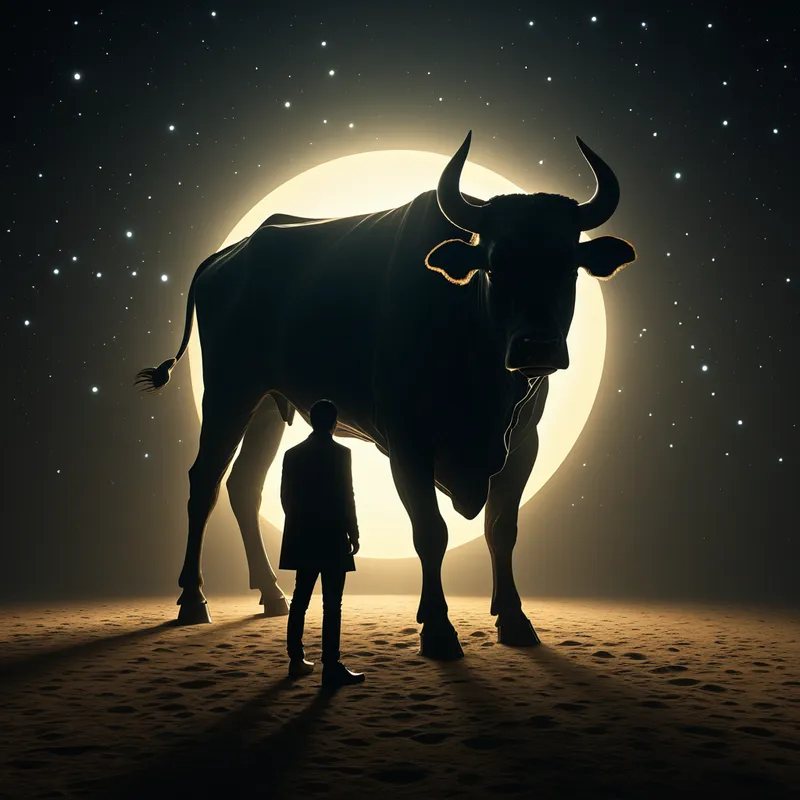
When this myth stirs in the modern dreamer, it often signals a critical juncture in the process of self-regulation and commitment. To dream of a powerful, untamed bull may point to a surge of instinctual energy—a raw ambition, a passionate drive, or a primal fear—that feels overwhelming and uncontained. Dreaming of a chase or a confrontation with such a force suggests the psyche is mobilizing its "Mithraic" function: the part of us that must establish inner covenants, make conscious choices, and direct that wild energy toward a purposeful end.
The somatic experience can be one of tense anticipation, a feeling of being tasked with a great but solemn duty. The dreamer may feel they are in a liminal, cave-like space—perhaps a basement, a tunnel, or any enclosed, symbolic interior—preparing for a necessary but daunting act of "slaying." This is the psychological process of sacrificing an old, automatic way of being (the chaotic bull) to generate new "life" in the form of psychological structure, creative output, or a renewed sense of personal integrity. The appearance of helping animals (dog, snake) can symbolize instinctual allies that assist in this transformative process.
Alchemical Translation
For the individual on the path of individuation, the Mithraic myth is a precise model of psychic transmutation. The first stage is the recognitio: becoming aware of the "Primordial Bull" within—the identification with one’s unchecked impulses, inflated power, or chaotic emotional states. This bull must be engaged, not ignored.
The chase is the stage of conscious effort and differentiation, where the ego (Mithra) must develop the strength and resolve to confront this autonomous complex. The cave represents the deliberate turning inward, the creation of a sacred, focused space for introspection and difficult inner work.
The slaying is the mortificatio, the essential death of an old attitude. It is the moment of saying "no" to an unconscious compulsion, of sacrificing immediate gratification for a higher order of being.
The flowing blood and generative plants are the solutio and coagulatio: the dissolution of the old form and the coagulation of its essence into something nourishing and life-giving. The creative energy once bound in chaos is liberated for art, relationship, work, and spiritual growth. Finally, the shared meal and ascent symbolize the coniunctio: the ego, having performed its heroic duty, is not glorified in isolation, but is received by and aligned with the greater, guiding Sun of the Self. The individual becomes a mediator of their own inner cosmos, upholding the covenant between their instinctual depths and their conscious life in the world.
Associated Symbols
Explore related symbols from the CaleaDream lexicon:
- Sun — The supreme symbol of consciousness, the Self, and divine order, which Mithra serves and ultimately joins, representing the goal of psychic integration.
- Bull — The primordial life force, instinctual energy, and untamed potential that must be engaged and transformed through conscious sacrifice to create order and sustenance.
- Sacrifice — The central, sacred act of surrendering a lower, autonomous form of energy (the bull) to generate a higher, life-nourishing reality, modeling essential psychological transformation.
- Cave — The inner sanctum of the psyche, the ritual space where the most profound and transformative confrontations between consciousness and the unconscious must occur.
- Contract — The binding principle of truth, oath, and cosmic order that Mithra embodies, representing the necessity of inner and outer commitments that structure a meaningful life.
- Light — The dawn light of Mithra, symbolizing the illuminating power of truth, awareness, and the conscious principle that separates order from chaos.
- Hero — Mithra as the archetypal figure who undertakes a necessary, world-renewing task, representing the ego's journey to confront and integrate the powerful forces of the unconscious.
- Order — The cosmic principle of asha, the truth and right arrangement that Mithra's act establishes and protects, both in the universe and within the individual psyche.
- Stone — The enduring, foundational nature of the covenant and the myth itself, often referenced in the iconography and altars dedicated to Mithra.
- Blood — The sacred, life-giving fluid that flows from the bull's wound, representing the vital essence released through sacrifice, which becomes the source of all creation and nourishment.
- Dog — The faithful companion in the myth, symbolizing instinctual loyalty and an ally from the natural world that participates in and benefits from the sacred transformation.
- Journey — The epic chase of Mithra across the world, representing the long, purposeful pursuit and engagement with a core aspect of the self that must be transformed.