Mirine the Blue Dragon Myth Meaning & Symbolism
A celestial blue dragon descends to become a river, sacrificing her form to heal a cursed land and its people, embodying profound transformation.
The Tale of Mirine the Blue Dragon
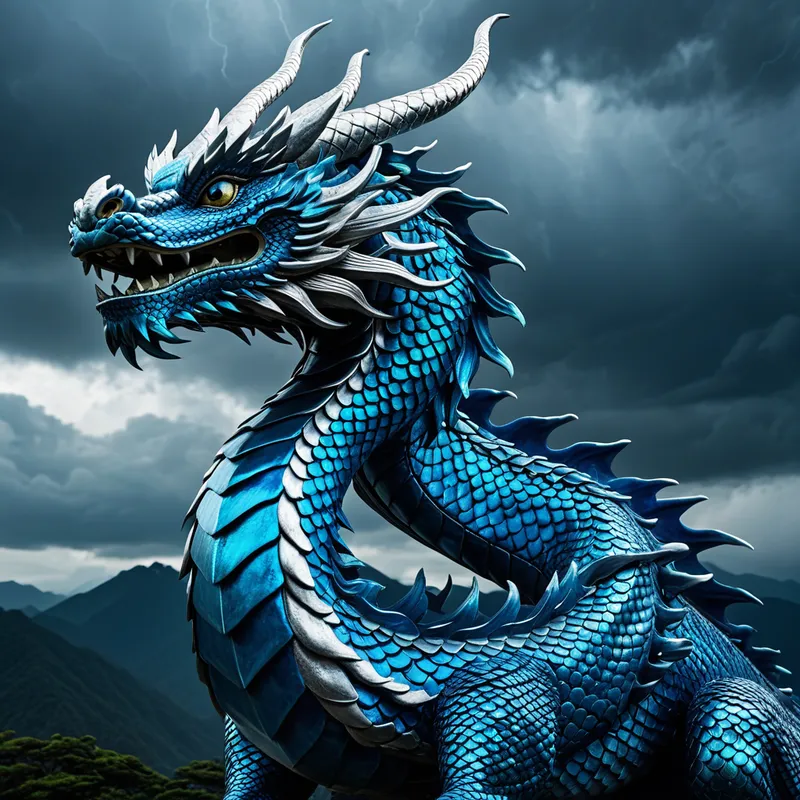
Hear now a tale from when the world was younger, when the mountains were still speaking to the clouds and the rivers remembered their names. In the high, mist-wrapped peaks of the Baekdu, where the sky touches the earth, there lived a dragon of the most profound blue. She was Mirine, whose scales held the color of the deepest lake under a midnight sky, and whose breath was the cool mist that heralds the gentle rain.
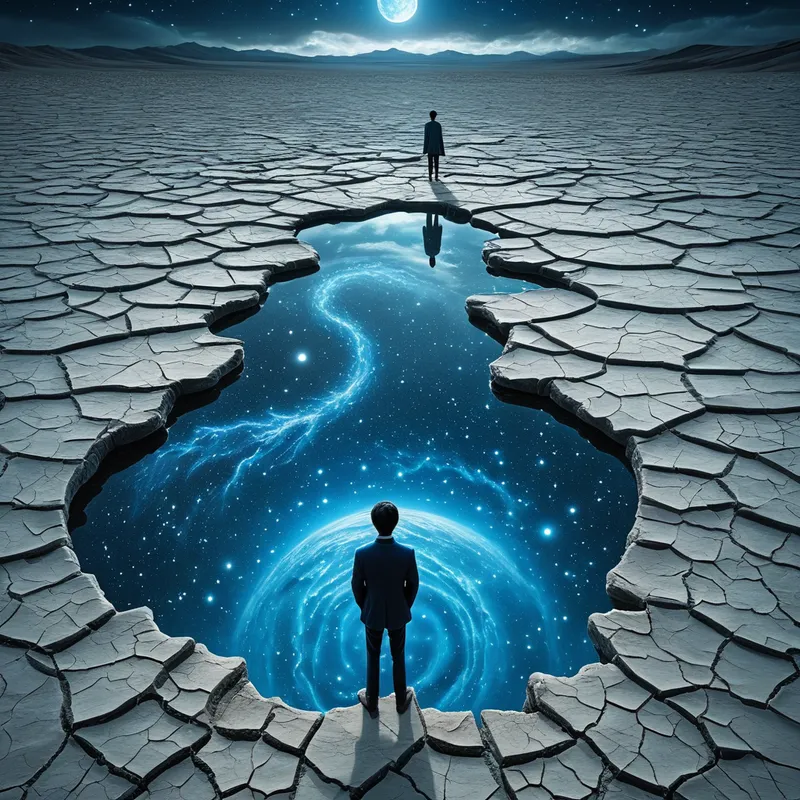
For centuries, she danced in the high airs, a guardian of the celestial balance, weaving the threads of cloud and storm. But her gaze was often drawn earthward, to a valley cradled between two great spines of rock. This valley, once lush and singing with life, had fallen silent. A great curse had settled upon it—not of malice, but of a deep, forgotten grief. The earth cracked like old pottery. The riverbeds lay empty, their stones bleached white by a relentless sun. The people, the children of that valley, moved as shadows, their hearts as parched as their fields. Their songs had dried up; their hope was dust.
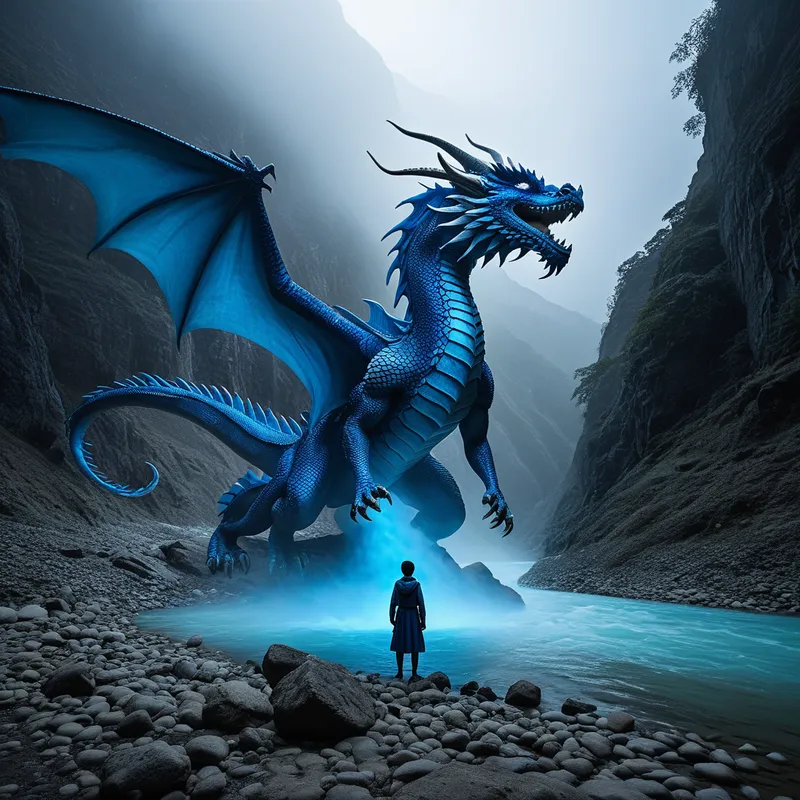
Mirine watched their suffering, and a strange, heavy feeling, unknown to the free dragons of the air, settled in her spirit. It was a pulling, an echoing ache that mirrored the valley’s thirst. One fateful day, as she watched a mother weep over a withered stalk, the feeling became a resolve. She descended from her celestial realm, her vast form casting a cool, blue shadow over the scorched land.
The people looked up in terror and awe. But Mirine did not roar fire. She spoke, and her voice was the sound of water flowing over smooth stone. “The water you seek is not lost,” she murmured, the words vibrating in the very air. “It sleeps in the memory of the land, and in the forgotten depths of your own hearts. But the channel is broken. The river cannot remember its course.”
She moved to the head of the great, dead gorge—the place where the ancestral river once burst from the mountain. “A river needs a body,” she said, her great eyes holding the reflection of the barren valley. “To give life, one must become the conduit of life.”
And then, she began to change. Not with a cry of pain, but with a sigh of release, like a cloud consenting to become rain. Her luminous scales softened, losing their hard edges, transforming into a rushing, cerulean torrent. Her long, serpentine spine became the main channel, her claws the branching tributaries, her beating heart the deep, sustaining spring at the source. She poured her very essence, her dragon-being, into the shape of the forgotten river. Where there was stone, there now flowed water—clear, cold, and vibrantly blue, carrying the faint, shimmering memory of scales within its current.
The miracle echoed. Where the new waters touched, green shoots pierced the cracked earth. The people, hesitantly at first, then with cries of joy, knelt at the riverbank. They drank, and the water tasted of clarity and courage. Their tears, finally, could fall, and they did, mingling with Mirine’s gift. The valley awoke. The dragon was gone, yet she was more present than ever before—not in the sky, but in the lifeblood of the land, a perpetual, flowing sacrifice.
Cultural Origins & Context
The myth of Mirine finds its roots not in the centralized courtly pantheons, but in the local, animistic Muism and the folk traditions of Korea’s mountainous regions. It is a chonsol, an origin myth for a specific place. Such tales were likely told by Mudang and village elders, used to explain the sacredness of a local river and to encode ecological and social principles.
The story functioned as a moral and spiritual compass. In a culture deeply tied to agrarian cycles, water was divinity itself. Mirine’s myth taught that life-sustaining resources were not merely utilities, but embodied, conscious sacrifices. It framed the local landscape as a relational field, where humans lived within a covenant with sentient nature. The river was not just water; it was a transformed dragon, a divine being who had chosen perpetual service. This fostered a posture of profound respect, gratitude, and custodianship toward the natural world, reinforcing the Confucian and indigenous values of harmony and reciprocal care.
Symbolic Architecture
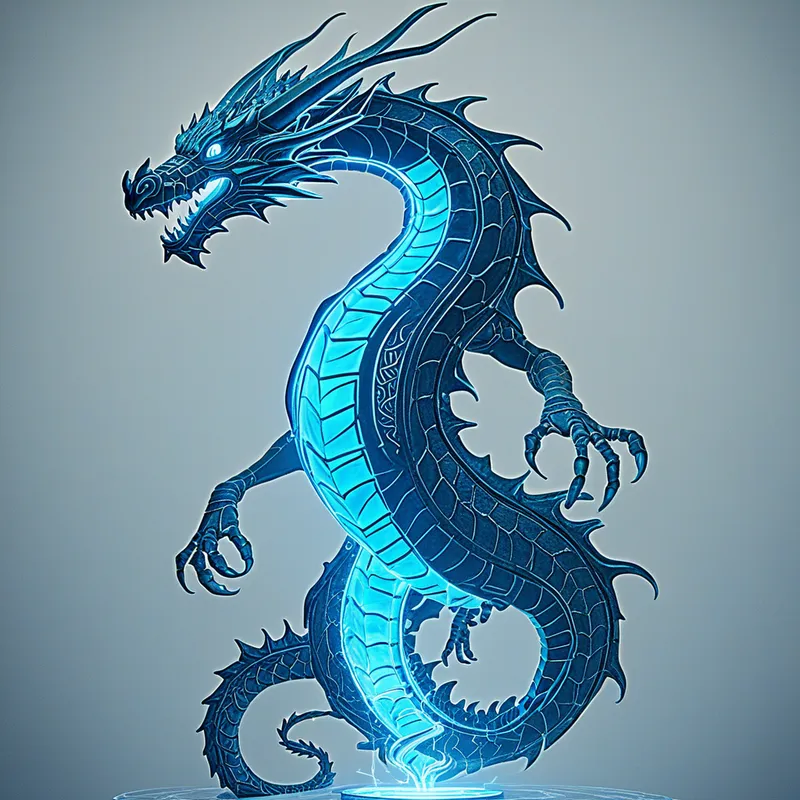
At its core, Mirine’s tale is a supreme allegory for the principle of compassionate transformation. The Dragon represents untamed, celestial potential—the powerful, autonomous spirit. The River represents connection, nourishment, and directed purpose.
The highest power is not that which dominates from above, but that which consents to flow through the depths, giving its form to the service of life.
Mirine’s descent symbolizes the incarnation of spirit into matter, of ideal into action. Her transformation is an alchemical process: the fiery, airborne nature of the dragon (Sulfur) is dissolved and fixed into the flowing, receptive nature of water (Mercury), creating the "living water" that heals. The cursed valley represents a state of psychic or communal stagnation, where the natural flow of emotion, creativity, or vitality has been blocked by unprocessed "grief."
Psychologically, Mirine embodies the archetype of the Caregiver, but elevated to a cosmic scale. Her sacrifice is not a loss of self, but a metamorphosis into a more interconnected, generative state of being. She becomes the Bridge between the celestial and the earthly, between the divine will to help and the tangible act of healing.
The Dreamer's Resonance
When the pattern of Mirine’s myth stirs in the modern dreamer, it often signals a profound call to a necessary, yet daunting, self-transformation. To dream of a benevolent Dragon who approaches or speaks may represent an encounter with a powerful, guiding aspect of the Self. To dream of a parched landscape reflects a conscious feeling of emotional or creative drought.
The pivotal dream image is the transformation itself: watching a majestic form dissolve into a life-giving flow. This can manifest somatically as a feeling of release, of "melting" tension, or psychologically as the dissolution of a long-held identity or ego position that, while impressive or autonomous (like the dragon), has become disconnected from the nourishing needs of the dreamer’s inner or outer "valley." The process is one of moving from a state of isolated potential to one of engaged, vulnerable service. The dream may evoke both grief for the form that must be relinquished and profound relief at the ensuing flow.
Alchemical Translation
For the individual, Mirine’s journey is a map for individuation through altruistic surrender. We all possess inner "dragons"—potent energies, talents, or spiritual insights that can feel majestic but remain aloof, circling in the realm of potential. The "cursed valley" is the neglected, suffering, or sterile areas of our own lives or our relationships that we feel powerless to heal.
The alchemical work is not to slay the dragon, but to persuade it to become the river—to translate raw power into sustainable grace.
The first stage is recognition: feeling the empathetic pull toward the suffering within or around us. The second is descent: the conscious decision to bring our celestial potential (ideas, love, strength) down into the gritty reality of the situation. The third and most critical is transmutation: the voluntary de-structuring of our prized form—our self-image, our preferred mode of operation, our hoarded resources—to serve a greater life principle.
This is the creation of the Philosopher's Stone in psychological terms. The "gold" produced is not personal glory, but the healing water of restored connection, creativity, and community. The individual does not vanish; they are re-purposed. Their essence becomes a medium for life, finding a more enduring and integrated existence within the network of being. One ceases to be a separate figure bestowing gifts, and becomes the very conduit through which grace flows.
Associated Symbols
Explore related symbols from the CaleaDream lexicon:
- Dragon — The autonomous, celestial spirit and raw potential that must undergo transformation to realize its deepest purpose of service and connection.
- Water — The element of life, emotion, the unconscious, and healing flow into which the dragon's form is sacrificially transmuted.
- River — The embodied result of the sacrifice, representing the continuous, nourishing flow of spirit into the world and the path of destiny.
- Sacrifice — The voluntary surrender of a higher, autonomous form for a lower, interconnected one, which is paradoxically the path to true power and integration.
- Healing — The core purpose and outcome of the myth, representing the restoration of flow, life, and vitality to a parched and suffering system.
- Bridge — Mirine herself becomes the living bridge between the celestial and earthly realms, spirit and matter, potential and manifestation.
- Mountain — The sacred, elevated space (Baekdu) where the dragon resides, symbolizing the heights of consciousness and spiritual insight.
- Grief — The unnamed curse that desiccates the valley, representing the blocked, unprocessed emotion that halts the natural flow of life and creativity.
- Heart — The internal seat of the empathetic pull that moves Mirine to act, and the metaphorical source of the healing waters for the people.
- Transformation — The central, alchemical process of the myth, the metamorphosis of essence from one state of being into another for a higher purpose.
- Spirit — The essential, conscious being of Mirine that persists through and animates her transformation from dragon to river.
- Dream — The mythic pattern that resonates in the modern unconscious, guiding the dreamer through their own processes of psychic transmutation and compassionate descent.