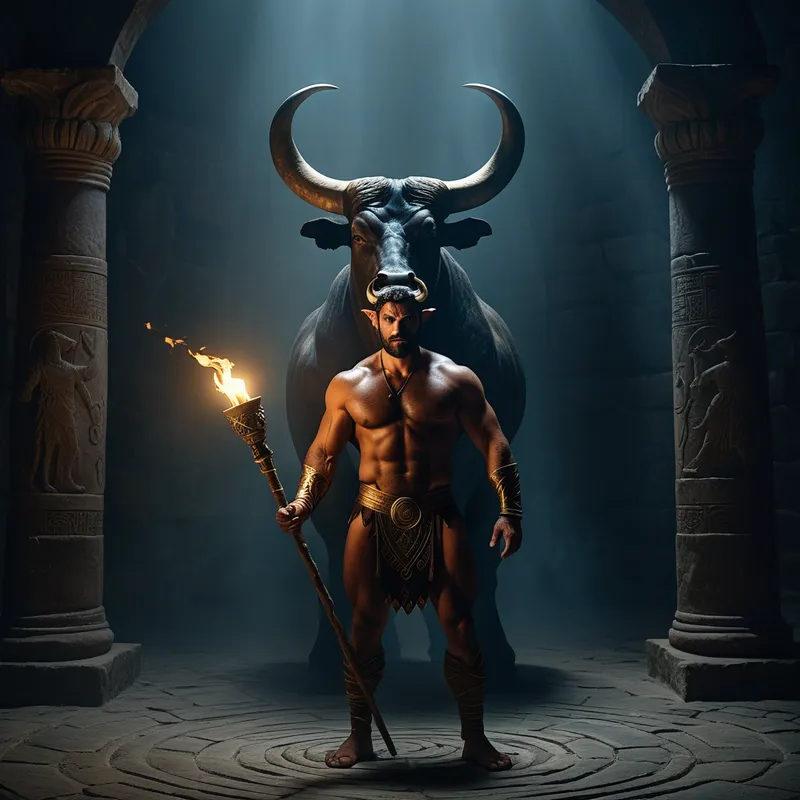
Minotaur Myth Meaning & Symbolism
A monstrous half-man, half-bull born of divine wrath, imprisoned in a labyrinth, and confronted by a hero who must navigate the maze within and without.
The Tale of Minotaur
Hear now a tale of stone and sorrow, of a curse woven from arrogance and paid for in blood. It begins not in a labyrinth, but in the sun-drenched court of Minos. When the gods granted him sovereignty over the seas, he was to sacrifice a magnificent white bull sent by Poseidon. But its beauty was too great. Minos’s greed swelled; he kept the bull for himself and sacrificed another in its place.
The sea does not forgive deceit. Poseidon’s wrath was a subtle, terrible poison. He inflamed Pasiphaë, the queen, with an unnatural, consuming passion for the very same bull. Daedalus, the master craftsman bound to Minos’s service, built for her a hollow wooden cow, a deceptive shell. From this monstrous union was born a creature of nightmare and profound pathos: a son with the body of a man and the head and tail of a bull. They named him Asterion, but the world would know him as the Minotaur.
The king’s shame was a living, breathing thing in his palace. He could not kill it, for it was, in its horrific way, of his own royal line. So he commanded Daedalus once more: build a prison from which there can be no escape. And so the Labyrinth was born at Knossos—a vast, winding maze of stone, a confusion made solid, a brain of passages with a monstrous heart. Here the Minotaur was cast, and here he remained, fed on a gruesome tribute.
For Minos’s son, Androgeos, had been killed in Athens. In his grief and fury, Minos laid siege and demanded a price: every nine years, seven Athenian youths and seven maidens were to be sent into the Labyrinth, a sacrificial feast for the beast within. The black-sailed ship became an omen of despair.
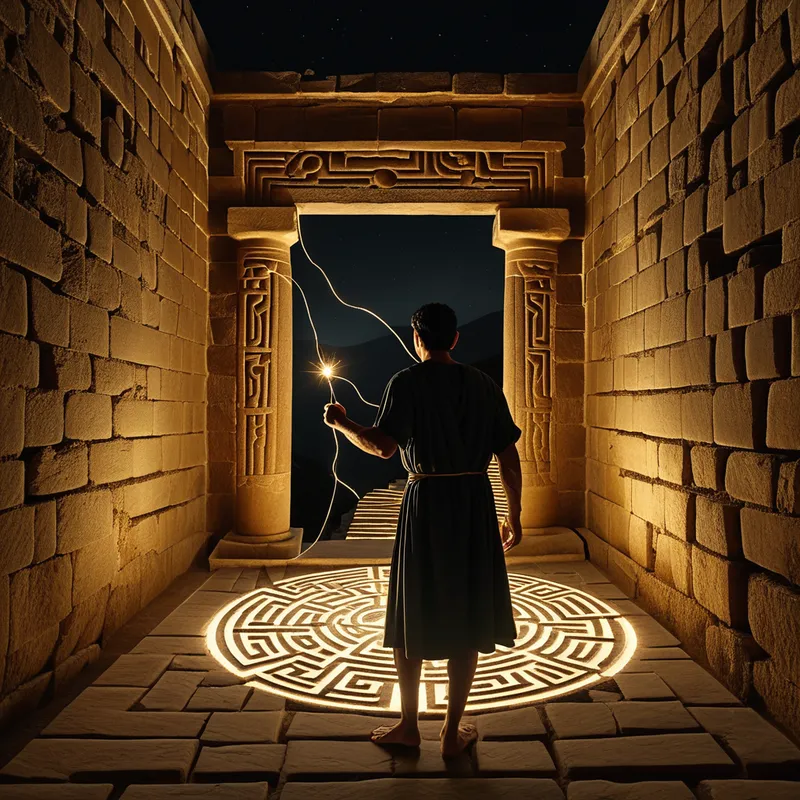
Until one cycle, a prince stepped forward. Theseus, son of Aegeus, volunteered to be among the tributes, vowing to slay the monster and end the terror. In Crete, Ariadne saw him and her heart was ensnared. She went to Daedalus, who gave her the answer to the maze: a simple skein of thread. That night, she found Theseus and offered him the means of salvation—a ball of thread to tie at the entrance and unravel as he went in, so he might find his way back through the twisting dark.
Theseus entered the mouth of the Labyrinth. The air grew cold and still, thick with the smell of damp stone and old fear. The only sounds were his own breath, the scrape of his sandals, and the distant, echoing snort from the depths. He followed the thread into the heart. And there, in a chamber where the torchlight fought a losing battle with the shadows, the Minotaur stood. Not a mindless beast, but a powerful, tragic figure, embodying a king’s sin and a god’s cruel joke. The fight was brutal, primal. With strength and fate, Theseus prevailed. He followed the lifeline of Ariadne’s thread back through the stone intestines of the maze, leading the surviving Athenians to the open air and the waiting ship, their freedom bought with the death of a monster that was never meant to be.
Cultural Origins & Context
This myth is not a simple fireside story; it is a foundational narrative deeply embedded in the Bronze Age consciousness of the Aegean. It originates from the island of Crete, the seat of the sophisticated, palace-centric Minoan civilization, which was later conquered by the Mycenaean Greeks. The myth likely represents a cultural memory of this conquest—the Mycenaean (Athenian) hero overcoming the powerful, labyrinthine complexity of Minoan Crete, symbolized by the bull, a central sacred animal in Minoan frescoes and rituals.
The story was propagated through the oral epic tradition, later crystallized by poets like Hesiod and dramatists. Its societal function was multifaceted. It explained Athenian tributes to Crete, established Theseus as the great unifying hero of Athens, and served as a powerful parable about the consequences of broken oaths to the gods (Minos’s deceit) and the perils of hubris. The Labyrinth itself may echo the sprawling, multi-leveled palace complexes of Knossos, which to invading Greeks would have seemed like impenetrable mazes.
Symbolic Architecture
The Minotaur is not merely a monster; it is a symbol of the unassimilated hybrid. It is the unacceptable offspring of a transgressive desire, the living consequence of a broken sacred contract. It represents what happens when natural order is violated—the repressed returns, not as a ghost, but as a flesh-and-blood reality too awful to behold, yet too intimately connected to the self to destroy.
The Labyrinth is the genius of this myth. It is not just a prison for the monster, but a physical manifestation of a psychic state: confusion, entrapment, the convoluted pathways of a troubled mind or a repressed secret.
The Labyrinth is the mind turned against itself, a architecture of avoidance designed to contain what we fear to face.
Theseus represents the conscious ego embarking on the heroic journey into the unconscious (the Labyrinth) to confront the shadow (the Minotaur). He is not pure strength; he requires aid—Ariadne’s thread, a symbol of intuition, connection, and the guiding principle of logos (reason, word, pattern) that can navigate the chaos of the mythos.
The Dreamer's Resonance
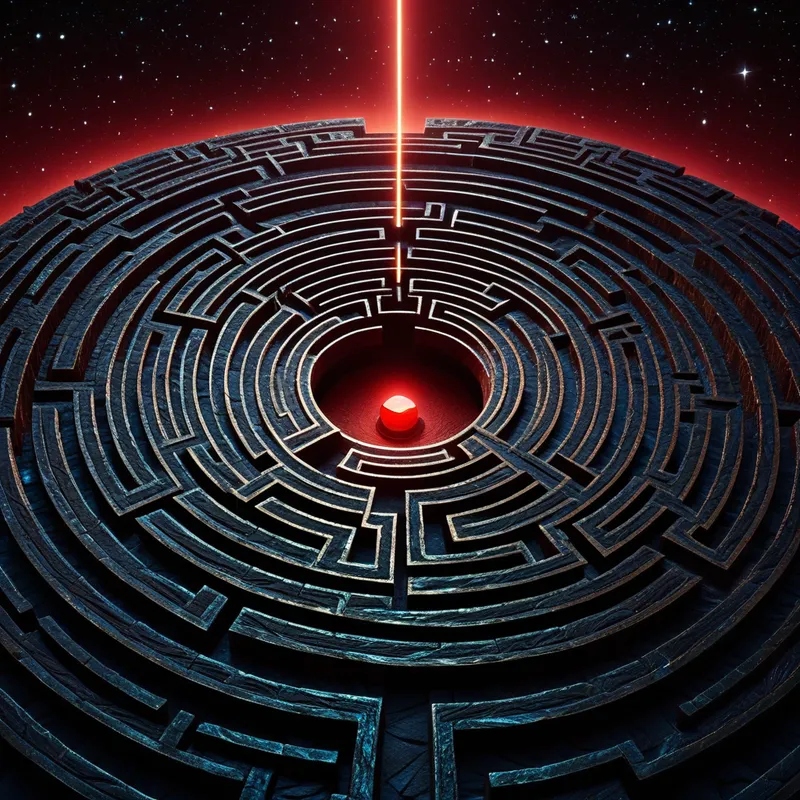
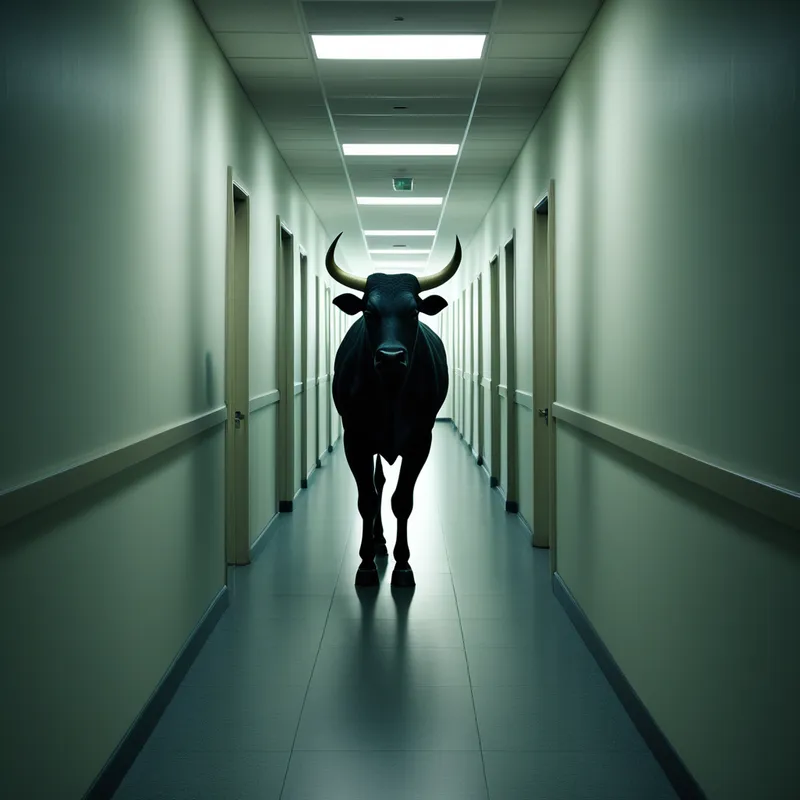
When the pattern of the Minotaur myth arises in modern dreams, it signals a profound encounter with the personal shadow. To dream of being lost in a labyrinth—be it of office corridors, endless hallways, or tangled forests—speaks to a state of psychological confusion, of feeling trapped by one’s own choices, patterns, or a complex problem with no clear solution.
The Minotaur in the dream is rarely a literal bull-man. It may be a frightening figure, a threatening presence, a repressed memory, or a powerful emotion like rage or shame that feels “monstrous” and alien. The somatic experience is one of dread, a tightening in the chest, a quickening pulse—the body recognizing the shadow before the mind can name it. This dream is an initiation. It indicates that something born of past actions or denied aspects of the self has grown in the dark and now demands confrontation. The dreamer is being called to their own heroic journey, to find their “thread” (perhaps therapy, creative expression, or honest dialogue) and venture inward.
Alchemical Translation
The alchemical process modeled here is the nigredo—the blackening, the descent into the chaotic, prima materia of the psyche. King Minos’s refusal to sacrifice the beautiful bull is the ego’s inflation, its refusal to surrender something prized (an ideal, a possession, a self-image) to a higher principle. The resulting “birth” of the Minotaur is the creation of the complex, a hybrid, autonomous entity in the unconscious that drains our energy (the Athenian tributes).
The construction of the Labyrinth is the psyche’s own defense: we build intricate rationalizations, distractions, and life patterns to avoid facing our core wound or flaw. But the tribute must be paid; the shadow demands its due, consuming our vitality (youths and maidens as symbols of potential and life force).
The heroic act is not the killing of the beast, but the willing descent into the maze of one’s own making, armed not with sheer will, but with the connecting thread of consciousness.
Theseus’s journey is the alchemical solutio (dissolution) and separatio (separation). He follows the thread (the enduring link to consciousness), confronts the monstrous material (the shadow), and integrates it by overcoming its autonomous, destructive power. He does not befriend it; he transforms his relationship to it. Slaying the Minotaur is the cessation of the complex’s tyrannical rule. Retracing the thread is the coagulatio—returning to the world with the gained insight, having transmuted the base, terrifying material of the shadow into the gold of self-knowledge. The monster is gone, but the maze remains as a testament to the journey, now a map rather than a prison.
Associated Symbols
Explore related symbols from the CaleaDream lexicon: