Mictlan Nine Levels of the Dead Myth Meaning & Symbolism
The perilous nine-level descent of the soul to Mictlan, ruled by the skeletal lords, a journey of dissolution and ultimate release from the mortal coil.
The Tale of Mictlan Nine Levels of the Dead
Hear now the journey that awaits all who depart the world of the Fifth Sun, not by blade or flood, but by the slow, cold hand of age or the quiet, creeping illness. This is the path to Mictlan, the Place of the Dead, a realm of profound silence and absolute shadow, ruled by the Lord and Lady of Bones.
The soul, a wisp of breath and memory called the teyolia, finds itself not in a field of light, but at the mouth of a cavern that breathes a wind smelling of damp earth and forgotten things. Before it stretches the first of nine descents. This is not a journey of walking, but of unraveling. The guides are the dead themselves, your ancestors who have made this passage, their whispers a chilling breeze at your back.
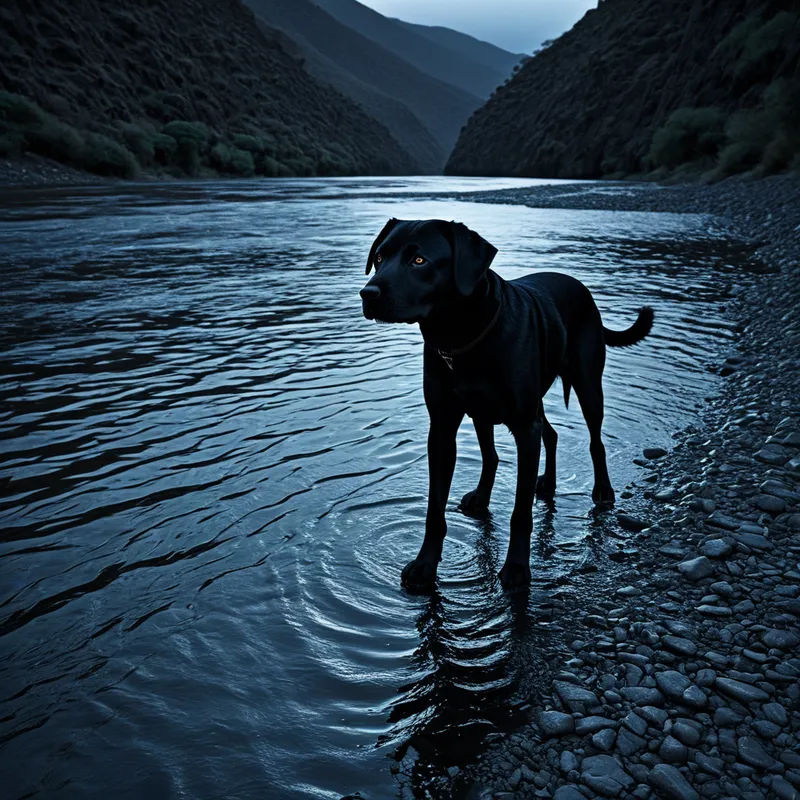
The first trial is the river, Apanohuaya. Its waters are not water, but the cold flow of separation, and you must cross it. To do so, you must call upon the spirit of a dog, buried with you for this purpose—a loyal, yellow-coated Itzcuintli. It alone can bear you through the current that seeks to pull your essence apart.
Beyond the river, the path narrows into a place where two mountains clash together, eternally grinding. You must slip through their thunderous collision, a test of timing and courage where one misstep means being crushed into the very dust of the earth. Then comes the mountain of obsidian, Itztepetl, its slopes not of stone but of razor-sharp glass that cuts the soul’s attachments to the physical world.
The cold deepens. A wind of knives, the Itzehecayan, scours you. It is not a wind that moves air, but a wind that flays memory, stripping away the warmth of life, the sound of a loved one’s voice, the taste of maize. You are left shivering, a core of identity amidst a storm of forgetting.
Next, you are pierced. Arrows fly from the unseen dark, the missiles of the Lord of the Dead himself. They do not kill, for you are already dead. They pin you—pinning regret, pinning unfinished deeds, pinning the last clinging fragments of your earthly will.
Now you must pass among the wild beasts, jaguars and coyotes of shadow, who devour not flesh but the raw energy of the heart. Then, you plunge into the deepest dark, where even the memory of light is extinguished. Here, you must cross the final, nine-churning rivers of the underworld, the Chiconahuapan, a torrent of pure oblivion.
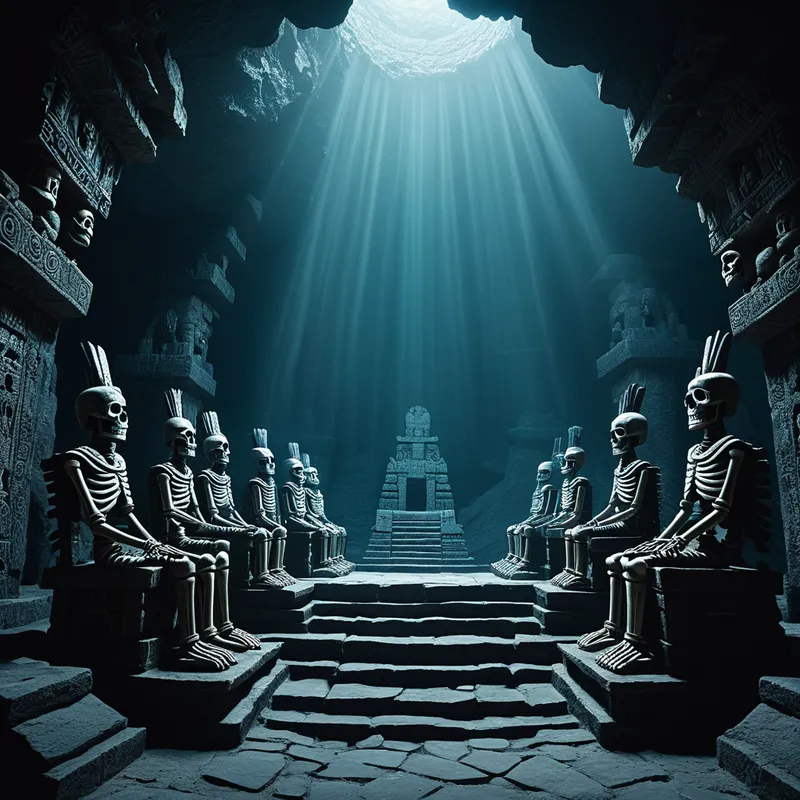
Having shed your body, your memories, your heart, and your will, you arrive at the ninth and deepest level. Before the bone-thrones of Mictlantecuhtli and his consort Mictecacihuatl, you are nothing but a bare, silent spark. The Lords of Bones offer no welcome, no punishment. They simply are, the end of all things. In their silent presence, your final spark is extinguished, not into nothingness, but into the great, still pool of the cosmos itself. The journey is complete. The self is dissolved. This is the end, and the only peace Mictlan offers.
Cultural Origins & Context
This myth was not mere story but a foundational map of cosmology and destiny for the Mexica (Aztec) people. Recorded in post-Conquest texts like the Florentine Codex, compiled by Bernardino de Sahagún from Nahua elders, it served a critical societal function. It prescribed the elaborate funerary practices—bundling the corpse in a crouching position, placing a jade stone in the mouth, and burying a dog—as essential provisions for this arduous four-year journey.
The tale was likely recited during funeral rites, guiding the living in their duties and the dead in their posthumous navigation. It reinforced a worldview where death was not a moment but a lengthy, active process of dissolution. By detailing this universal fate (for those who died ordinary deaths), it created a shared cultural destiny, binding the community through a common understanding of what lay beyond. The journey to Mictlan democratized the afterlife, making profound spiritual effort the lot of every soul, not just warriors or nobles.
Symbolic Architecture
The nine levels are not a physical geography but a profound symbolic architecture of psychic deconstruction. Each level represents a stage in the stripping away of the earthly persona.
The journey through Mictlan is the soul’s alchemy in reverse: not the creation of gold from lead, but the reduction of the complex alloy of a life back into its primordial, base elements.
The rivers symbolize the necessary crossings, the points of irreversible transition where one state of being is left behind. The clashing mountains represent the crushing pressures of fate and the narrow passage of choice that remains. Itztepetl and the Itzehecayan are tools of psychic surgery; obsidian, the ultimate cutting tool, severs the soul’s attachments to the sensory world and the personal past. The arrows of Mictlantecuhtli pin down the lingering psychic complexes—the regrets and unresolved energies—that prevent final release. The final dissolution before the bone lords is the ultimate surrender of individual consciousness back into the undifferentiated ground of being.
The Dreamer's Resonance
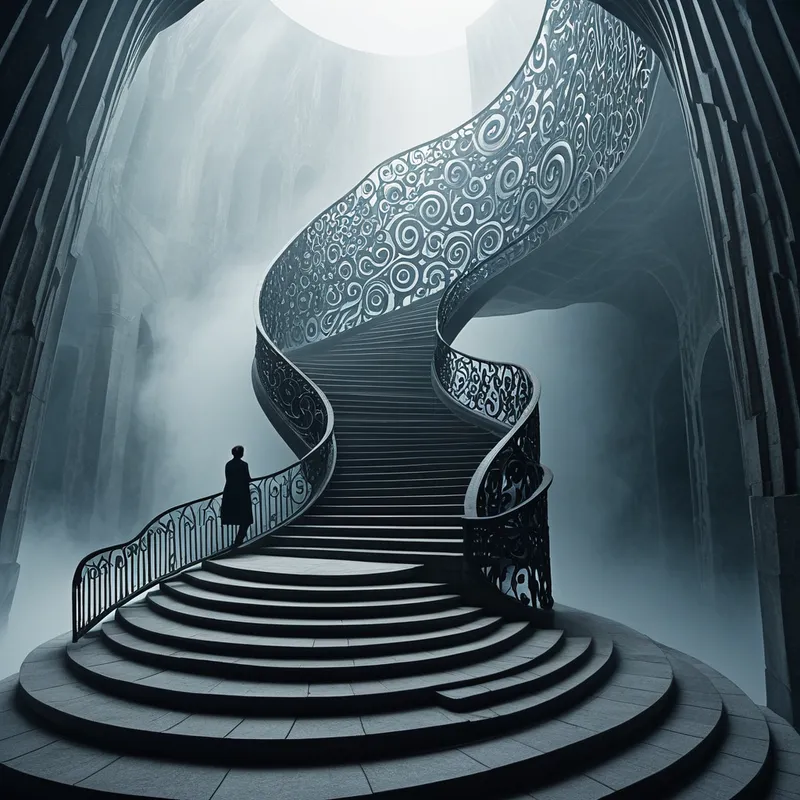
When this myth pattern arises in modern dreams, it seldom appears as literal Aztec iconography. Instead, it manifests as the experience of a protracted, difficult descent. The dreamer may find themselves in endless basements, descending broken elevators, navigating decaying, multi-level parking garages, or lost in a series of increasingly dark and complex caves.
Somatically, this can feel like a profound heaviness, a chilling cold, or a sense of being stripped bare. Psychologically, it signals a necessary encounter with the Shadow and a deep, often painful, process of letting go. It is the psyche’s way of modeling a major life transition—the end of a career, a relationship, an identity, or a period of grieving—where the old self must be systematically dismantled before any new growth can begin. The dream is a map for navigating a voluntary or involuntary descent into one’s own underworld.
Alchemical Translation
For the modern individual, Mictlan models the indispensable, if terrifying, process of individuation through dissolution. Our ego, like the soul arriving at Mictlan, is a complex bundle of attachments: to our achievements (the body), our stories (the memories), our passions (the heart), and our will to control (the will).
The alchemical nigredo, the blackening, finds its perfect mythic analogue in the ninefold descent into the absolute blackness of Mictlan. One must be reduced to ash before the new form can be revealed.
The conscious undertaking of this “journey to Mictlan” means voluntarily facing each level within ourselves. We cross the river of separation from outworn identities. We pass through the crushing pressure of life’s demands. We allow the obsidian winds of truth to cut away our self-deceptions and narratives. We let the arrows of insight pin down our hidden shames and pride. This is not suicide of the self, but its purification. The goal is not to become nothing, but to become clear. To stand before the Lords of Bones within our own psyche—the archetypal reality of Death itself—and offer up our ego’s final claim to sovereignty. In that surrender, in that silent extinction of the personal will, lies the potential for a rebirth not into another life, but into a more authentic, grounded, and liberated mode of being in this one.
Associated Symbols
Explore related symbols from the CaleaDream lexicon:
- Journey — The central structure of the myth, representing the soul's mandatory, transformative passage from one state of being to a state of non-being or pure essence.
- River — Symbolizes the multiple points of irreversible transition and the soul's need for a guide (the dog) to navigate the currents of separation and oblivion.
- Dog — Represents loyalty and guidance beyond death, the necessary instinctual companion (Itzcuintli) that enables the first and most critical crossing into the underworld.
- Mountain — Embodies the immense, crushing obstacles (the clashing mountains, the obsidian mountain) that test and pare down the soul's resolve and attachments.
- Wind — The Itzehecayan is the agent of erasure, scouring away the sensory memories and emotional warmth that tether the soul to life.
- Death — The ultimate ruler and destination, not as a villain but as an absolute, impersonal principle of ending and dissolution that must be faced without intermediary.
- Bone — The final, stripped essence; the throne and form of the underworld lords, representing the last, enduring structure after all else has been removed.
- Shadow — The entire realm of Mictlan is a projection of the cultural and psychological Shadow, the land of the forgotten, the repressed, and the ultimately inevitable.
- Ritual — The myth directly informed and was enacted through funeral rites, showing how narrative becomes a prescribed technology for navigating psychic and cosmic transitions.
- Key — The knowledge of the journey and its trials acts as a metaphysical key, without which the soul would be lost forever in the labyrinth of the underworld.
- Door — Each level is a door or threshold that, once passed, cannot be re-crossed, marking the irreversible stages of deconstruction.
- Soul — The teyolia, the animating force, is the protagonist undergoing this arduous process of purification and return to the source.