
Metis Myth Meaning & Symbolism
The story of Metis, the primordial Titaness of cunning wisdom, swallowed by Zeus to prevent a prophesied overthrow, birthing Athena from his head.
The Tale of Metis
Before the world settled into the order we know, when the air still hummed with the raw potential of the first things, there was Metis. She was not a goddess of grand temples or loud proclamations, but of the deep, quiet knowing. Her voice was the whisper in the reeds, the cunning plan that forms in the shadow before the dawn, the perfect strategy born of seeing all threads at once. She was the counsel in the dark, the wisdom that wins not by force, but by foresight.
She stood beside Zeus in the great and terrible war against the old Titans, her mind a weapon sharper than any thunderbolt. It was her advice that crafted the ruse, her cunning that showed Zeus how to free the monstrous Cyclopes and the hundred-handed Hecatoncheires from the belly of the earth. With her wisdom, the new order was forged from the chaos of the old. In gratitude and recognition, Zeus took Metis as his first wife, and for a time, the universe was governed by the union of raw power and profound, strategic mind.
But the air carries whispers even gods cannot silence. A prophecy, ancient and cold as stone, wound its way to Olympus. It spoke of the children of Metis: a daughter of surpassing wisdom and a son of unassailable power. And this son, it was foretold, would one day wield the thunderbolt and depose his father, just as Zeus had deposed Cronus, and Cronus had deposed Ouranos.
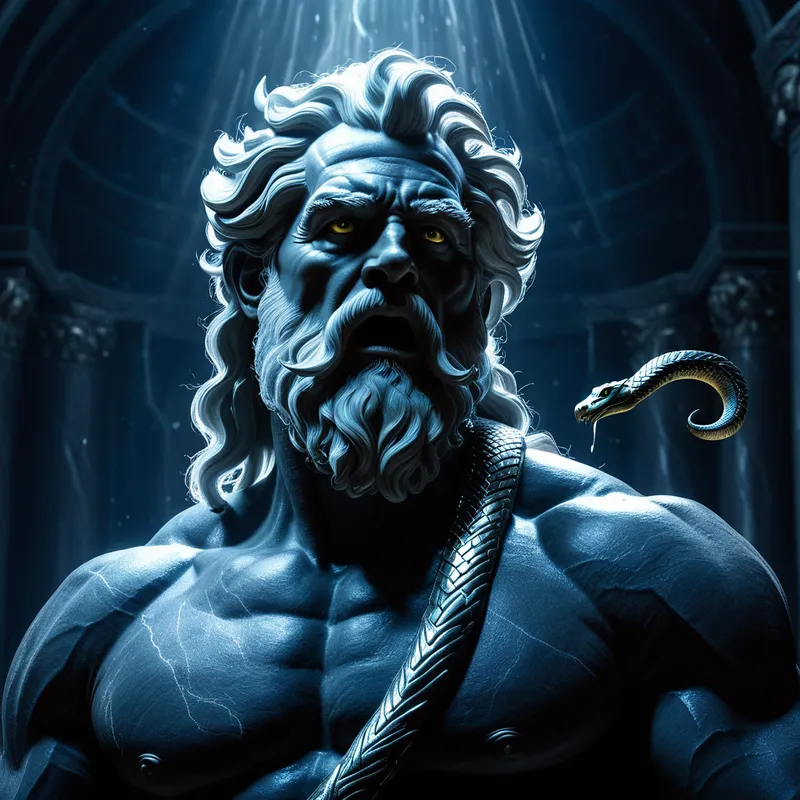
Fear, that great corrupter of kings and gods alike, coiled in Zeus’s heart. The memory of his own violent ascent was a ghost that would not rest. He could not bear the seed of his own downfall. So, when Metis was with child, he spoke to her with honeyed words, praising her mutable, fluid nature. “My wise one,” he said, his voice like distant thunder, “show me your magic. Transform for me.” Trusting in their bond, Metis shifted shape—from goddess to lioness, to serpent, to a drop of morning dew. And in that moment of ultimate vulnerability, as she became a shimmering bead of water, Zeus opened his mouth and swallowed her whole.
She was gone. Consumed. The deep, cunning wisdom of the world was now imprisoned within the king of the gods. For a time, there was only silence where her counsel had been. But wisdom, once integrated, cannot be silenced. A great pounding began within Zeus’s skull, a pain so fierce it felt as though the mountain itself was splitting. The god of blacksmiths, Hephaestus, took up his axe and, with a blow that echoed through the heavens, cleft open the divine brow. And from that wound, not in blood but in a burst of brilliant light and clashing arms, sprang Athena, fully grown and armored, her grey eyes holding the ancient, unblinking knowledge of her mother. Metis was gone, yet her essence had been transmuted, reborn from the very mind of the one who had sought to contain her.
Cultural Origins & Context
The myth of Metis comes to us primarily from the Theogony of Hesiod, composed around the 8th century BCE. This was not a bedtime story, but a foundational cosmogony, a map of power and order. Hesiod’s work functioned as a divine genealogy and a political treatise, justifying the supremacy of the Olympian order under Zeus. The swallowing of Metis is a critical pivot in this narrative. It marks the moment Zeus definitively breaks the cycle of patriarchal overthrow by internalizing the very source of the threat: prophetic, generative wisdom.
In a culture deeply concerned with metis (the cunning intelligence of practical skill, adaptability, and strategic deception), this myth served a profound societal function. It explained why Zeus’s reign was permanent and just. He did not merely defeat his rivals; he assimilated the principle of cunning itself, making it a permanent, internal aspect of his sovereignty. The myth also provided an etiological explanation for Athena’s unique birth and her role as the embodiment of “wise strategy” (prometheus), distinct from but born of raw cunning (metis). It was a story told to validate a hierarchical, patriarchal order while acknowledging that true, stable power requires the integration of feminine-coded wisdom.
Symbolic Architecture
At its core, the myth of Metis is a profound allegory for the psychic act of integration, particularly the integration of a threatening, transformative wisdom. Metis represents the deep, instinctual, and often subversive intelligence—the “trickster” wisdom that operates outside established rules. She is the shadow of pure, linear power.
To swallow wisdom is to make the external internal, to transform a threat into a resource. The act of consumption is the first, brutal step toward wholeness.
Zeus’s fear is the ego’s fear of the unconscious. The prophesied son symbolizes the terrifying potential of unintegrated wisdom to eventually overthrow the conscious ruling principle. By swallowing Metis, Zeus performs a desperate, defensive act of psychic incorporation. He does not listen to her; he consumes her. This is not yet integration, but imprisonment. The resulting headache is the symptom of this unresolved, pressurized content within the psyche. The birth of Athena is the symbolic resolution—the painful but glorious emergence of a new, synthesized consciousness. Athena is not Metis reborn, but Metis transformed: cunning wisdom now fully aligned with patriarchal authority, strategic intelligence in the service of lawful order and civilization.
The Dreamer's Resonance
When this mythic pattern stirs in the modern dreamer, it often signals a profound process of psychological digestion. To dream of swallowing something alive and potent—a glowing stone, a live fish, a swirling light—speaks to the somatic reality of trying to integrate a piece of knowledge or an aspect of the self that feels too large, too powerful, or too dangerous to acknowledge openly.
The dreamer may experience sensations of fullness, pressure in the head or chest, or even a symbolic pregnancy. This is the “Metis phase”: a period where a deep insight, a traumatic memory, or a creative impulse has been taken in but not yet processed. It sits within, causing anxiety, somatic tension, or a sense of being haunted by one’s own potential. The subsequent “headache” or crisis in waking life—a period of intense mental struggle, confusion, or creative block—is the labor pains of this unborn content. The dream invites the dreamer to find their Hephaestus: the therapeutic tool, the artistic practice, or the courageous act of introspection that can “split the skull” and allow the new consciousness to emerge.

Alchemical Translation
The alchemical journey modeled by the Metis myth is the transmutation of threat into faculty. For the individual, it maps the path of individuation when faced with a piece of shadow wisdom that promises both liberation and dissolution.
The initial state is one of recognition and fear. The ego, like Zeus, encounters a potent, often “feminine” or intuitive aspect of the self (the anima or the shadow) that carries prophetic power—it knows the ego’s limitations and its eventual end. The primitive defense is to attempt to negate it by force or, symbolically, to swallow it—to repress it, to intellectualize it away, to make it a hidden prisoner.
The alchemical vessel is not the stomach, but the entire psyche. The prima materia is the swallowed wisdom, and the fire is the resulting psychic friction.
This repression is the first stage of the nigredo, the blackening, a state of depression, confusion, and intense pressure. The “headache” is the necessary crisis. The individual must endure this tension without resorting to expulsion (projection) or further repression. The Hephaestus blow is the conscious, often painful, act of analysis, surrender, or creative expression that breaks open the hardened shell of the ego-complex.
The birth of Athena is the albedo, the whitening, and the arrival of the transcendent function. What emerges is not the original, raw cunning (Metis), but a new, adapted capacity: a wise, strategic intelligence (Athena) that serves the now-more-complex Self. The individual does not “become” their shadow wisdom; they give birth to a new faculty from its integration. The power that once threatened to overthrow them now arms them for a more conscious, authentic, and resilient engagement with the world. The prophecy of overthrow is fulfilled, but not literally; the old, rigid ego-king is deposed by a wiser, more inclusive form of consciousness.
Associated Symbols
Explore related symbols from the CaleaDream lexicon: