Metamorphoses Myth Meaning & Symbolism
A mythic tapestry where gods and mortals are reshaped by passion and transgression, revealing the soul's fluid nature and the inevitability of change.
The Tale of Metamorphoses
Listen, and let the air grow heavy with the scent of olive groves and salt. This is not a story of one, but of the world itself in flux, a whispering through the pines that speaks of a time when the boundary between flesh and form was as thin as a cicada’s wing.
It begins in the golden, unyielding light of the sun. Apollo, radiant and proud, fresh from slaying the great serpent Python, spied Daphne by her father’s stream. Her beauty was of the earth—dark hair like river silt, skin cool as shaded stone. He desired her with the certainty of a god. But Daphne, sworn to the wild freedom of Artemis, felt only the chill of a trap closing. She fled, her breath a ragged prayer against the pounding of his pursuit.
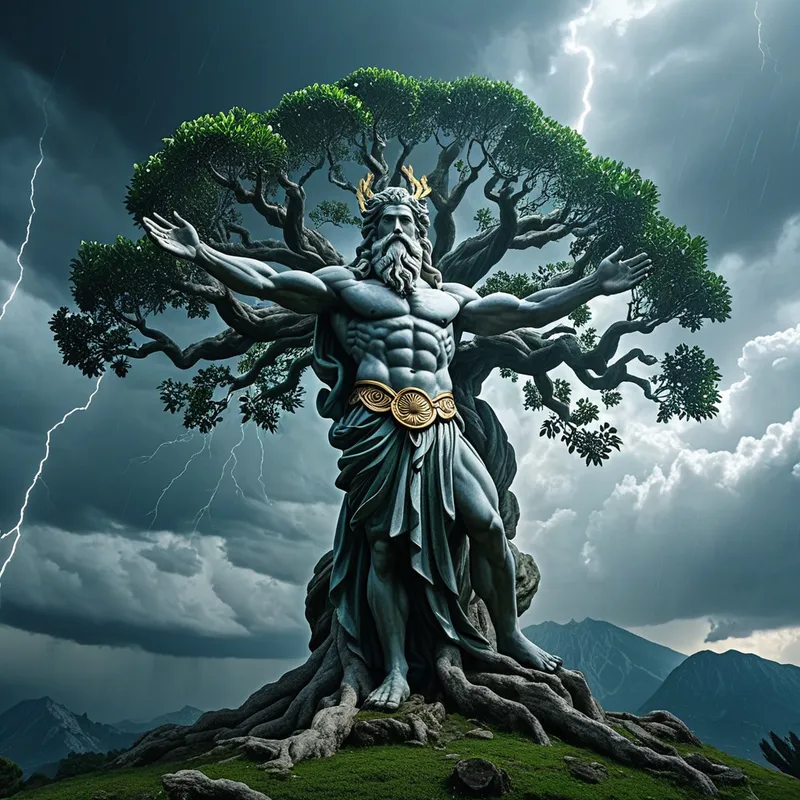
Through thicket and thorn she ran, the heat of his divine presence searing her back. As his fingers brushed her shoulder, she cried out to her father, the river. “Destroy this beauty that has brought me ruin!” The earth heard. A deep numbness climbed her legs. Her feet rooted, digging deep into the soil. Bark, rough and gray, encased her softening flesh. Her arms stretched and branched, her hair became a crown of trembling, evergreen leaves. Apollo arrived to embrace not a nymph, but the laurel tree, its leaves whispering a permanent refusal. From that day, the laurel became his sacred plant, a crown of victory born from eternal loss.
Elsewhere, the loom of fate wove other transformations. The proud weaver Arachne dared to challenge Athena herself. In a contest of sublime skill, Arachne’s tapestry depicted the gods’ deceptions with flawless, impious thread. Enraged by the perfection of the insult, Athena struck the loom and the weaver. Consumed by shame and fury, Arachne hanged herself. But the goddess, in a twist of cruel pity, did not let her die. She sprinkled her with the juices of aconite, and Arachne shriveled. Her body compacted, her fingers lengthened into many-jointed legs, and she was set to dangle and weave for all time—not tapestries, but webs, as the first spider.
And so it went, a cascade of becoming. The hunter Actaeon, stumbling upon the goddess bathing, was turned to a stag and torn apart by his own hounds. The grieving Niobe, turned to a weeping stone. Arethusa, fleeing a river god, dissolved into a sacred spring. Each story, a lightning flash illuminating a moment where passion, transgression, or grief became so immense it shattered the mortal shell, spilling the soul into a new, eternal shape.

Cultural Origins & Context
This vast corpus of transformation myths finds its most famous compilation in the Metamorphoses of the Roman poet Ovid, written in the first century CE. While Ovid was Roman, he drew deeply from the well of Hellenistic Greek mythology, synthesizing and poeticizing centuries of oral and literary tradition. These stories were not a unified religious doctrine but a fluid, collective mythology, told by bards at symposia, enacted in local cult practices, and depicted on pottery and in temple pediments.
Their function was multifaceted. They explained the origins of natural phenomena (why the laurel is evergreen, why the spider weaves). They enforced cultural norms, illustrating the catastrophic consequences of hubris (defiance of the gods), as with Arachne, or of violating sacred boundaries, as with Actaeon. Most profoundly, they served as a narrative technology for grappling with the fundamental, often terrifying, unpredictability of life. In a world ruled by capricious deities, metamorphosis was the ultimate metaphor for sudden, irreversible change—love turning to obsession, pride to ruin, life to death, and sometimes, through that very death, to a different kind of eternal life.
Symbolic Architecture
At its core, the myth of Metamorphoses is not about punishment, but about revelation. The external form is forced to align with the internal, essential truth. Daphne’s fierce desire for autonomy becomes the rooted, untouchable tree. Arachne’s defiant, artistic identity becomes the perpetual, web-spinning spider. The change is a brutal form of divine honesty.
The body is a language that the soul is forced to speak, and in moments of ultimate crisis, the grammar breaks, revealing the primal noun beneath.
The agent of change is almost always an encounter with a divine force—Zeus, Apollo, Athena. These deities represent overwhelming psychic realities: uncontrollable desire (Eros/Apollo), fierce intellect and pride (Athena), raw creative/destructive power (Zeus). The mortal who encounters them is an ego-consciousness confronted by a power of the unconscious so vast it cannot be integrated, only embodied in a new, symbolic form. The transformation is the psyche’s last-ditch effort to preserve a core of being by translating it into the language of the eternal, the natural, or the archetypal.

The Dreamer's Resonance
When a modern dreamer encounters metamorphic imagery—their own body melting, sprouting leaves, turning to stone, or fragmenting into animal aspects—they are not dreaming of Greek gods. They are dreaming the process the myths describe. This is the somatic and psychological experience of a paradigm shift so deep the old identity cannot hold.
The somatic feeling is often one of paralysis (the rooting of Daphne), dissolution (Arethusa becoming water), or terrifying fragmentation (Actaeon feeling his antlers grow). Psychologically, this corresponds to moments of profound life transition: the end of a defining relationship, a career collapse, the onset of illness, or a spiritual awakening. The old “I” is dying, and the psyche, in its ancient, mythic language, depicts this death literally. The dream is not a prophecy of literal change, but a snapshot of the inner alchemy already underway. The ego is being compelled by the Self to relinquish its familiar shape.

Alchemical Translation
The alchemical opus, the journey of individuation, is precisely a guided metamorphosis. The base material of the leaden, confused ego must be dissolved (solutio—often symbolized by drowning or turning to water), putrefied, and reassembled into the golden, integrated Self. The Greek myths present this not as a serene meditation, but as a violent, often tragic, encounter with the numinous.
Individuation is not self-improvement; it is the ego’s consent to its own dissolution and reconstitution by a greater pattern.
The modern individual undergoing this process lives a version of these tales. The “Apollo” complex—the drive for brilliant, solar consciousness and achievement—may need to be rooted in the earthy, defensive autonomy of “Daphne” to find balance. The “Arachne” within—the defiant, shadowy creator who challenges internalized authorities—must be acknowledged and woven into the whole psyche, even if it changes one’s fundamental structure. The goal is not to avoid the transformative encounter, but to understand that the seeming catastrophe is the forge. The new form one takes—be it the steadfast tree, the cunning spider, or the lamenting spring—is not a demotion, but a testament. It is the soul’s indelible signature, carved not in fleeting flesh, but in the enduring substance of myth and meaning. We are all in a state of perpetual, if subtle, metamorphosis, our final shape a story yet to be fully told.
Associated Symbols
Explore related symbols from the CaleaDream lexicon: