Merrows Myth Meaning & Symbolism
The myth of the Merrows, seal-people of the Celtic sea, speaks of a profound longing between worlds and the perilous enchantment of the deep, unconscious self.
The Tale of Merrows
Listen now, and let the salt-spray fill your lungs. Let the wind that keens over the black cliffs of Connemara carry this tale to you. The sea here is not empty. It is a kingdom, and its people are the Merrows.
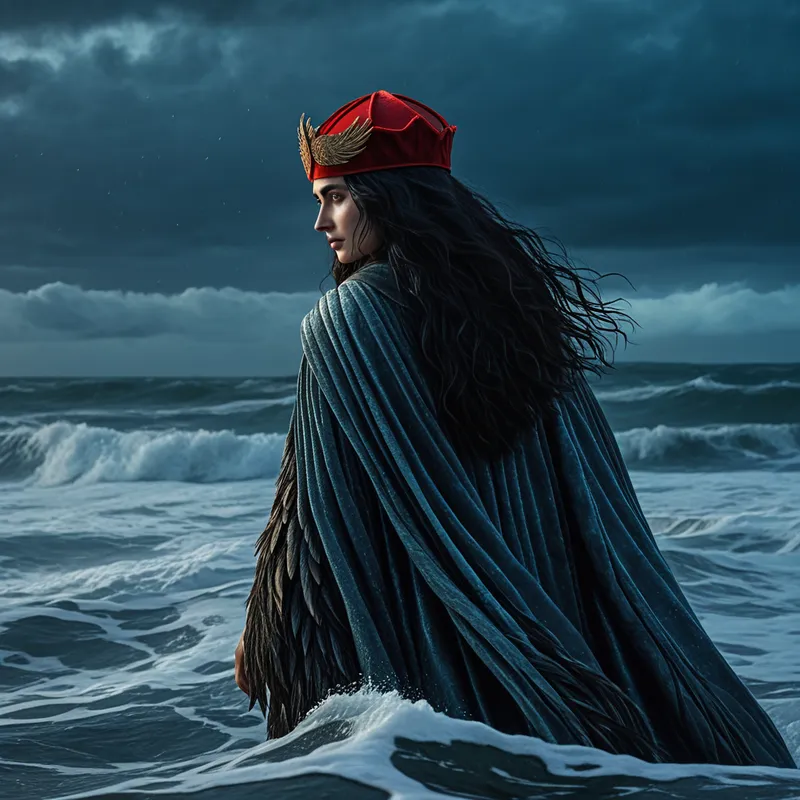
In the grey hour before dawn, when the world hangs between sleep and waking, they would come. Not as monsters, but as the sea’s own sorrow given form. The males were wild, green-haired, with sharp teeth and eyes like the deep trenches, but it is the females who haunt the hearts of men. They were of a beauty to stop the breath—hair dark as a moonless night at sea, skin pale as foam, and voices that held the echo of every wave that ever broke upon the shore.
But they were not whole upon the land. To walk among the rocks and heather, a Merrow woman needed her cohuleen druith, her enchanted cap or cloak. This was no mere garment; it was her soul’s other half, her pelt of seal-skin. With it, she could slip into the deep and swim to the glittering halls beneath the waves, where the currents play music on coral harps. Without it, she was trapped, a prisoner of the air, filled with a longing so deep it could drown a human heart.
It happened that a fisherman, a man of solitude and quiet thoughts, saw her one evening. She had laid her cohuleen upon a rock to dance in the silver path of the moon on the water. He watched, his own heart a stilled net, and when she turned her back, he crept forward and took it. He hid the sleek, dark skin in the thatch of his cottage roof.
She turned, and her cry was the sound of a soul torn in two. Without her skin, she could not return. Her eyes, which had held the light of drowned stars, now held only a human despair. The fisherman, his voice gentle with a love already turning to possession, offered her his home, his world. With no sea-road open to her, she went with him. They married. She bore him children, and her songs of the ocean became lullabies by the hearth. Yet, always, her gaze would drift to the window, to the line where the grey sky met the greyer sea. A part of her was always listening for a call only she could hear.
Years passed. The children grew. One day, playing in the loft, a daughter found a strange, supple hide tucked deep in the thatch. It smelled of salt and deep, old places. She brought it to her mother.
The Merrow’s hands did not tremble as she took it. She said nothing. But that night, after kissing her sleeping children, she walked to the shore. She placed the cohuleen upon her shoulders. With one last, lingering look at the cottage light—a tiny, warm star against the vast dark—she slipped into the waves. She did not surface again. The fisherman would walk the cliffs until the end of his days, listening, forever listening, for a song that would not return.

Cultural Origins & Context
The Merrow myth is not a singular tale but a living current within the oral traditions of Ireland, Scotland, and the Isle of Man, part of the broader family of selkie legends. These stories were not the fare of kings in great halls, but of communities whose lives were dictated by the sea’s bounty and brutality. They were told by firesides in crofters’ cottages, in the smoky warmth of fishing taverns, and by grandmothers mending nets.
The societal function was multifaceted. On one level, they were etiological, explaining the haunting, almost human cries of seals on rocky skerries. On another, they served as profound moral and psychological parables for coastal societies. They spoke to the dangers of the sea’s enchantment, literally and metaphorically. The Merrow represented the ultimate “other”—a being from a realm humans could not survive in, yet one upon which they depended utterly. The myth enforced a respectful, even fearful, relationship with the ocean. It also gave narrative form to very human tragedies: the fisherman lost at sea was sometimes said to have been taken to live with the Merrows below.
Symbolic Architecture
At its core, the Merrow myth is an exquisite map of the psyche’s relationship between the conscious and the unconscious. The Merrow herself is an anima figure of the deepest order—the soul-image from the watery, emotional, and instinctual depths.
The cohuleen druith is the symbol of wholeness and authentic being. To possess it is to have access to one’s native element, one’s complete soul.
The land represents the conscious ego: ordered, domesticated, safe, but ultimately limiting. The sea is the unconscious: vast, nourishing, creative, perilous, and the source of all life. The fisherman’s act of stealing the skin is the ego’s attempt to capture and possess a beautiful content from the unconscious—an inspiration, a passion, a soulful connection—and bring it permanently into the light of day. For a time, this seems to work. The creative impulse writes books, the passion builds a family, the soulful connection provides comfort.
But the unconscious does not suffer permanent captivity. The hidden skin, waiting in the thatch, is the repressed truth of that content’s nature. Its discovery is inevitable—often triggered by life’s natural cycles (the children growing). The return to the sea is not a betrayal, but a rebalancing. It is the recognition that the soul cannot live forever in exile from its own depths.

The Dreamer's Resonance
When this myth stirs in the modern dreamer, it signals a powerful movement between psychic territories. To dream of a seal or a Merrow is to encounter a messenger from the deep, instinctual self. The somatic feeling is often one of profound longing, a “Sehnsucht” for something nameless yet essential.
If you dream of finding a sealskin, you may be on the cusp of reclaiming a lost part of your native spirit—a talent you abandoned, a wildness you civilized out of existence, a deep emotional truth you locked away. The dream invites you to put it on, to remember who you are beneath the persona.
If you dream of hiding or stealing a skin, it may reflect a part of your psyche that is trying to control or domesticate a powerful, natural force within you (like creativity or sexuality), fearing its primal power. The dream warns of the melancholy that follows such an act of psychic theft.
If you dream of someone returning to the sea, it can feel like a heartbreaking loss. Psychologically, this often represents the necessary end of a phase where an unconscious content was made conscious. Its work in your waking life may be complete, and it must now return to the deep to be reconstituted. It is a dream of sacred release.
Alchemical Translation
The alchemical process mirrored here is the perilous operation of separatio followed by the longed-for coniunctio—but a coniunctio with the Self, not with an other. The initial “marriage” of fisherman and Merrow is a false union, based on possession rather than partnership. The true alchemical marriage happens within the individual.
The myth’s culmination is not a human marriage, but the Merrow’s reunion with her own essence. This is the model for individuation: becoming who you inherently are, not who you are told to be.
The modern individual’s journey begins in a state of division (the stolen skin). We live on “land,” identified with our roles, our histories, our conscious accomplishments, yet feel an inexplicable longing. The work is to search the “thatch” of our own psyche—the forgotten memories, the dismissed intuitions, the abandoned joys—to find that hidden, essential skin. This is the shadow work.
Retrieving it is frightening, for it demands we relinquish the safe, known identity (the cottage, the family of the old self). Putting it on and returning to the “sea” is the act of courage—the dive into the unconscious to reclaim our authentic nature. We do not become a seal; we realize we were always part seal. The triumph is not in keeping the soul, but in having the courage to let it lead you back to its source, integrating its depth into your being. You become the one who can walk on land, yet who knows the secret roads of the sea within. You are no longer a fisherman on the shore, longing. You are, at last, whole.
Associated Symbols
Explore related symbols from the CaleaDream lexicon: