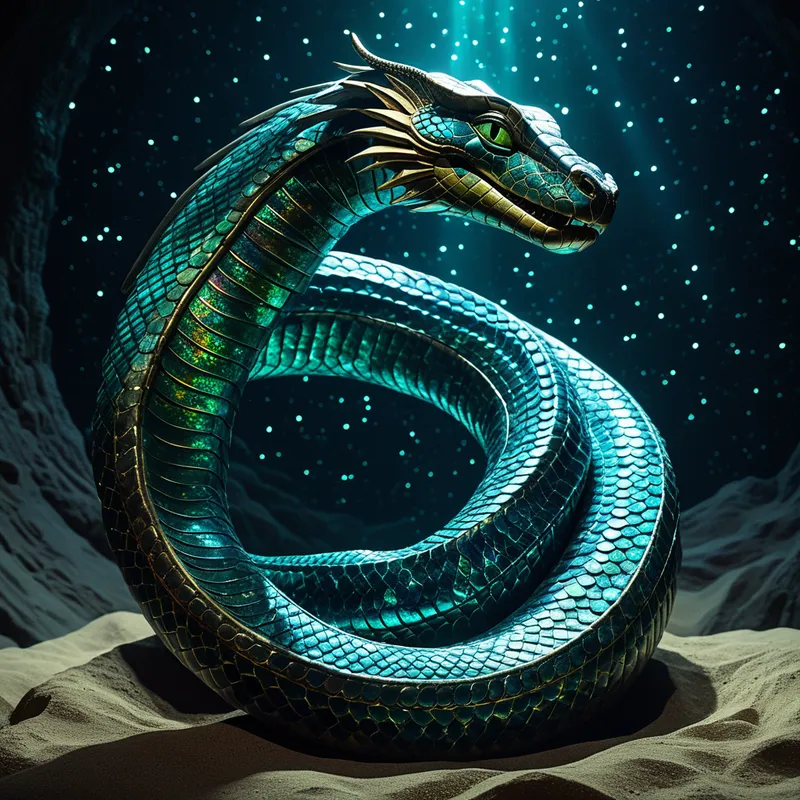
Mehen Myth Meaning & Symbolism
The myth of the serpent Mehen, who coils protectively around the sun god Ra during his perilous nightly journey through the underworld.
The Tale of Mehen
Before the first dawn, in the silent heart of the night, the great journey begins. The sun, Ra, grows weary. His light, which bathes the Two Lands in life and law, dims. His golden barque, the Mandjet, settles upon the western horizon. This is not an end, but a descent into the great, unseen realm: the Duat.
Here, in the belly of night, chaos reigns. The waters are not of the Nile, but of Nun—the dark, formless ocean that existed before creation. The air is thick with the whispers of the dead and the hungry silence of Apep, the great serpent of dissolution who wishes to swallow the sun and return all to void. Ra’s light is but a fragile flame in an infinite dark.
But Ra does not journey alone. From the depths of the Duat itself, a protector rises. Not with a sword or a shield, but with a coil. This is Mehen, the Encoiler. His body, scaled in patterns of earth and night, is immense. He does not attack; he encompasses. With deliberate, sacred motion, he wraps his powerful form around the entire solar barque. His coils become a living, breathing fortress—a spiral wall between the divine light and the pressing dark.
Through the twelve perilous hours of the night, the barque sails. Monstrous entities leer from the banks. Apep himself, a mile-long serpent of pure malice, rises from the murk to strike. But Mehen holds. His grip is the grip of the cosmos itself—order embracing its heart. He absorbs the psychic shock of chaos. He buffers the barque against the screams of the unworthy dead. His presence is a constant, low hum of vigilance, a vibration that says: This light shall pass.
As the barque approaches the eastern horizon, a change stirs. The oppressive weight of the Duat begins to lift. Mehen’s coils, which held so tight, begin to loosen. His task, fulfilled, reaches its zenith. He does not vanish, but recedes, sinking back into the fertile darkness from which he came, a guardian returning to his post. And as the first sliver of Ra’s renewed sun breaks the horizon, painting the sky in hues of lotus and flame, it is Mehen’s silent watch that made the dawn possible. The sun is reborn because it was never truly alone in the dark.

Cultural Origins & Context
The myth of Mehen is woven into the fabric of the most sacred Egyptian funerary texts: the Pyramid Texts, the Coffin Texts, and most extensively, the Book of the Dead. It was not a folktale for the market square, but a precise, ritual map of the afterlife journey, recited by priests and inscribed on tomb walls to guide and protect the soul of the deceased pharaoh, and later, worthy individuals.
In this context, Mehen served a dual function. For the sun god Ra, he was the essential protector of the cosmic cycle, ensuring the sun’s rebirth and thus the continuation of Ma'at—the fundamental order of the universe. For the deceased, identified with Ra in their own posthumous voyage, Mehen was a promised guardian. Spells exist to invoke his protection, to have the soul’s own barque "encircled by Mehen." His presence guaranteed safe passage through the terrifying, transformative landscape of the Duat, turning a journey of peril into one of ordained transition. He was the divine precedent for protection in the face of ultimate chaos.
Symbolic Architecture
Mehen is not a warrior who defeats chaos through conflict, but a guardian who neutralizes it through containment. This is a profound symbolic distinction. He represents the principle of enveloping protection. His spiral coil is the key symbol—a shape found in nature from galaxies to shells, representing containment, growth, and cyclical return.
The greatest strength is not in striking the darkness, but in creating a sacred space where light can endure it.
Psychologically, Mehen symbolizes the containing function of the psyche. He is the healthy ego, or the Self in its protective aspect, that can form a coherent boundary against the disintegrating forces of the unconscious (Apep) and the trauma of transformation (the Duat). He does not deny the chaos; he acknowledges it and creates a vessel stable enough to pass through it. He is the psychological "holding environment" that allows the core of identity (the sun/Self) to undergo a necessary dissolution and re-formation without being annihilated. The serpent, often a symbol of chthonic power and rebirth, here uses its primal energy not for attack, but for sanctuary.
The Dreamer's Resonance
When the pattern of Mehen stirs in the modern dreamer, it often manifests in times of profound psychological vulnerability or transition. This is not the drama of the hero’s battle, but the profound, somatic experience of being held.
One might dream of being inside a coiled shell or a circular fortress while a storm rages outside. One might dream of a benevolent serpent wrapping gently around one’s body during a night terror, instilling calm. The dream landscape itself may feel like a dark, watery passage, but the dreamer moves through it within a bubble of safety. These dreams point to an active, internal process of psychic containment. The psyche is mobilizing its own resources to create a buffer against overwhelming emotions—grief, anxiety, rage, or the fear of psychic death that accompanies major life changes. The dream is a testament to the Self’s innate, often overlooked, capacity for self-preservation and nurturing through darkness.
Alchemical Translation
The alchemical journey, like Ra’s voyage, requires a descent into the nigredo—the blackening, the chaotic prima materia of the soul. This stage is fraught with the danger of disintegration; the ego can be lost in the shadow. Mehen models the crucial phase that makes this descent survivable: the creation of the vas hermeticum, the sealed vessel.
The alchemist’s first task is not to transform the lead, but to forge the vessel that can withstand the fire of transformation.
For the individual pursuing individuation, the "Mehen work" involves consciously building this container. This is the practice of establishing boundaries, engaging in regular ritual (like journaling or meditation), seeking therapeutic holding, or cultivating a stable inner narrative. It is the disciplined, loving act of building a coherent identity strong enough to encounter the unconscious without being swallowed by it. One coils the resources of consciousness—insight, discipline, self-compassion—around the fragile, shining core of the emerging Self. The triumph is not in avoiding the night sea journey, but in completing it. The rebirth of a more integrated personality at dawn is only possible because the protective, caring function (the caregiver archetype) was activated to shepherd the light through its necessary encounter with the dark. In the end, Mehen teaches that true guardianship is an act of sacred embrace, making the circle whole so the center can hold.
Associated Symbols
Explore related symbols from the CaleaDream lexicon: