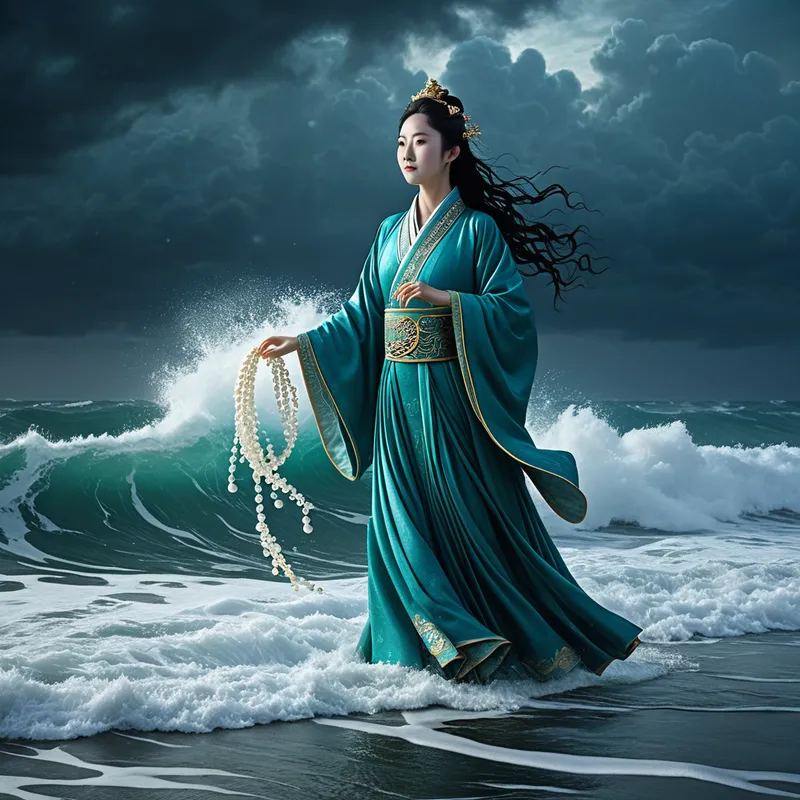
Mazu Myth Meaning & Symbolism
A mortal woman's boundless compassion transcends death, transforming her into a goddess who calms storms and guides all who journey through turbulent waters.
The Tale of Mazu
Listen, and hear the tale whispered on the salt wind, a story woven from storm and stillness.
In the tenth century, in the coastal village of Meizhou on the Putian shore, a child was born unlike any other. They named her Lin Mo. From her first breath, she did not cry, but observed the world with eyes that held the depth and calm of a sheltered cove. As she grew, the rhythm of the sea became her heartbeat. While other children played, Lin Mo would sit for hours, watching the fishermen mend their nets and set their sails, feeling the anxious prayers of wives and mothers as a tangible weight on the air.
She possessed a gift—a spirit unbound by the flesh. In deep meditation, her consciousness would slip its earthly moorings. Her body would remain, still as a statue in the family home, while her essence flew across the waves. In this state, she saw the hidden currents, the gathering squalls, and the precarious dance of wooden hulls on an indifferent sea.
One fateful night, a typhoon, born from the dragon’s wrath in the deep, fell upon the Taiwan Strait. Lin Mo’s father and brothers were among those at sea. At home, she fell into her trance, her spirit streaking across the raging black water. She found their vessel, timbers groaning, about to be swallowed by a mountain of wave. With all her will, she grasped the prow in her spectral hands. Back in her body, her physical form strained with the effort, holding an imaginary rope, pulling with a strength that drained her very life.
In the house, her mother, shaken by the tempest, entered the room. Seeing her daughter rigid, seemingly in a fit, she shook her desperately. The touch shattered Lin Mo’s concentration. The spiritual tether snapped.
At that moment, far out at sea, one boat foundered. Her father was lost.
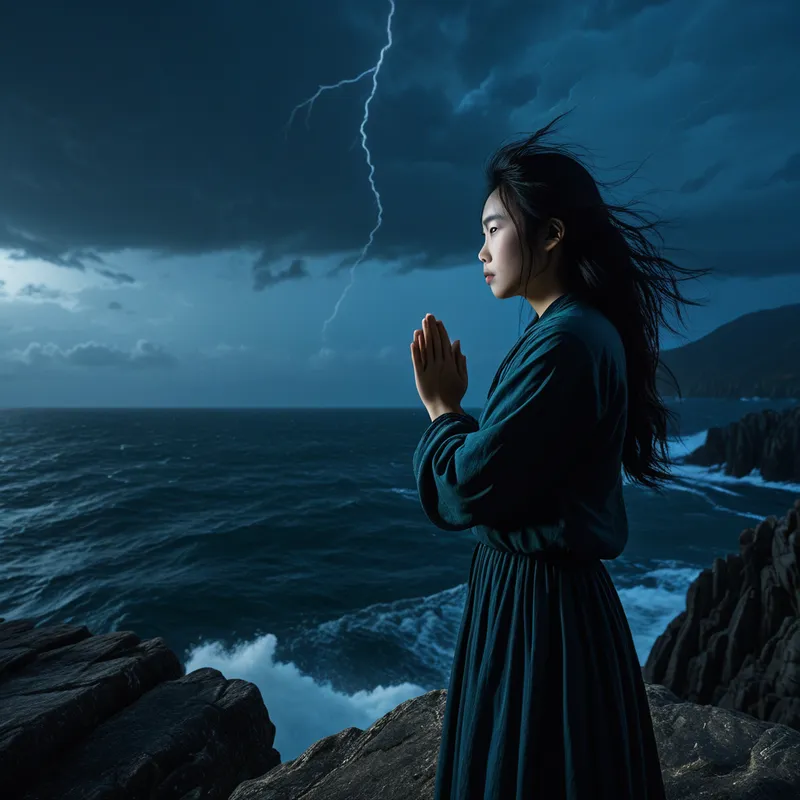
Lin Mo wept not with the rage of the bereaved, but with the profound sorrow of the protector who had almost succeeded. She redoubled her vigil, saving countless others, but the strain on her mortal frame was immense. Before she reached thirty, her body, a vessel too fragile for such a mighty spirit, could no longer contain her. She ascended the highest hill, looked once more upon the endless blue that was her true home, and passed from this world.
But the story does not end in death. For on the day she departed, fishermen across the region reported a miraculous sight. A figure in radiant red robes, standing upon a cloud or a cresting wave, guiding lost ships to safe harbor. Lin Mo was gone. Mazu, the goddess, was born. She who calms the winds and commands the waves, whose lantern pierces the deepest fog, became the eternal guardian of all who journey upon the uncertain sea.
Cultural Origins & Context
The myth of Mazu is not a fossilized tale from a forgotten age; it is a living, breathing tradition that grew from the soil of very real human fear and hope. It emerged during the Song Dynasty, a time of expansive maritime trade and fishing. The sea was the source of livelihood and the bringer of widowhood, a capricious deity that demanded respect and supplication.
Unlike many deities imposed by state orthodoxy, Mazu’s worship spread organically, from sailor to sailor, port to port, along the Maritime Silk Road. Her stories were told on decks during long voyages and in harborside temples smelling of incense and salt. She was a folk saint, a deified human whose compassion was so potent it breached the barrier between mortal and divine. This was her societal function: to provide a relatable, empathetic interface with the terrifying sublime of the ocean. She was a psychological anchor, a promise that someone who understood human fragility was watching over the vast, impersonal deep.
Symbolic Architecture
At its core, the myth of Mazu is a profound map of consciousness transcending its prescribed limits. Lin Mo’s ability for spirit travel symbolizes the capacity of the focused mind—the nous or shen—to operate beyond the constraints of the physical and societal body. Her mortal frame represents the ego, the necessary but limited vessel of individual identity.
The ultimate sacrifice is not of life, but of the isolated self. The ego must dissolve so that the archetype it carried may be born into the world.
The central, heartbreaking conflict—her mother’s interruption causing her father’s death—is not a simple tragedy. It is the critical rupture between the mundane world of social roles and duties (the daughter in the home) and the transcendent calling of the spirit (the savior on the waves). This rupture is the necessary catalyst for her full apotheosis. She could not become the universal goddess while still bound to a single family’s fate. Her physical death is the final shedding of the personal, allowing the archetype of the Caregiver to be fully realized in the collective psyche.
The Dreamer's Resonance
When this myth stirs in the modern dreamer, it rarely appears as a literal goddess over the sea. Its resonance is felt in the somatic landscape of our inner lives. To dream of Mazu is to be in a period of profound ethical tension and psychic expansion.
You may dream of trying to hold together something fragile—a cracking vessel, a fraying net, a crumbling wall—with a force of will that leaves you exhausted upon waking. This is the dream of the caregiver stretched beyond capacity, the healer whose own energy is depleted. The “storm” is often a emotional or relational turmoil, and the “boats” are loved ones, projects, or parts of your own psyche you feel responsible for saving.
Alternatively, you might dream of a serene, authoritative figure (often feminine, but not always) who appears during a dream of chaos or lostness, offering silent guidance or simply a calming presence. This is the emergent Mazu archetype within, the Self organizing the psyche’s turbulent waters. The dream signals that a part of you has developed the compassionate, witnessing consciousness necessary to navigate your personal storms without being drowned by them.

Alchemical Translation
The individuation process modeled by Mazu is not one of heroic conquest, but of compassionate transmutation. The base metal of our existence is the isolated ego, concerned only with its own survival and the narrow circle of the personal. The alchemical fire is the unbearable tension between limitless compassion and limited power.
The gold is not achieved by defeating the storm, but by becoming the still point within it. The psychic transmutation is from a person who feels responsibility into a consciousness that is a sanctuary.
First, we must recognize our “spirit travel”—our capacity for empathy, intuition, and projection beyond our skin. Like Lin Mo, we must learn to focus this ability. The “interruption” by the “mother”—the demands of convention, family expectations, or our own internal critics—will inevitably cause failures and losses. This is the nigredo, the darkening, where our best efforts seem to founder.
The alchemical secret lies in the aftermath. Instead of collapsing into guilt or resentment, we are asked to do the work of Mazu: to grieve the personal loss (the father/ego), but to let that very grief expand the boundaries of our care. The mortal identity that tried and failed must “die.” What is born is not a omnipotent superhero, but a grounded, transpersonal orientation. You cease to be just someone who helps, and you become a principle of guidance and calm in your own life and, by reflection, for others. You install an inner lighthouse. Your presence itself becomes the safe harbor, not because you control the ocean of fate, but because you have learned to stand, unwavering, upon its waves.
Associated Symbols
Explore related symbols from the CaleaDream lexicon: