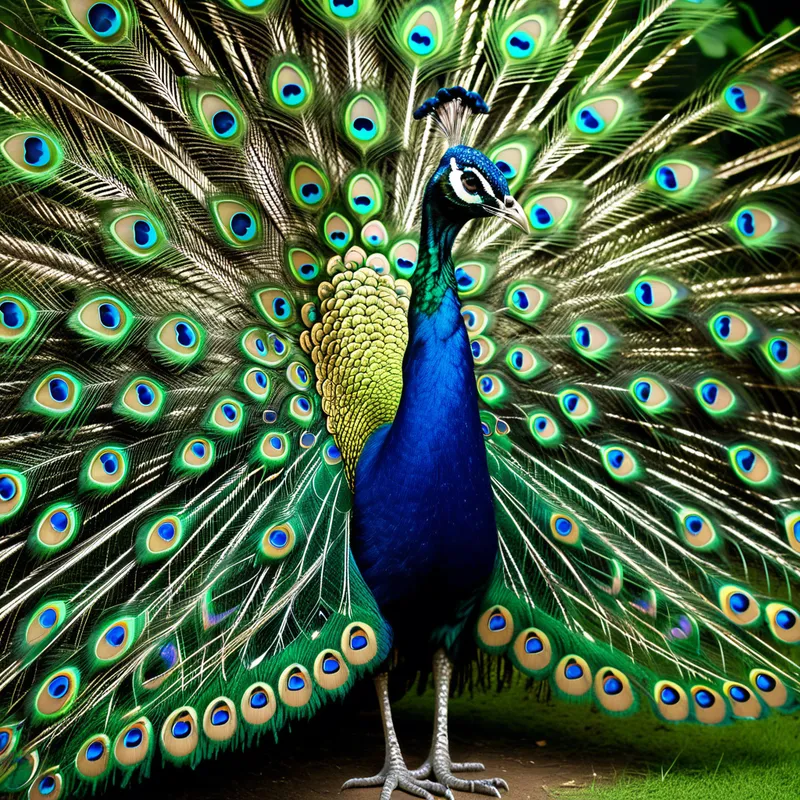
Mayura Myth Meaning & Symbolism
The myth of the peacock Mayura, who drinks poison to save the gods, embodying the alchemy of turning darkness into beauty and poison into grace.
The Tale of Mayura
Listen, and let the tale unfold, not in the dry pages of a tome, but in the vibrant theater of the cosmos, where the gods themselves held their breath.
In the beginning of an age, the Devas and the Asuras, the luminous forces of order and the potent forces of chaos, found a fragile truce. Their purpose was singular, yet monumental: to churn the cosmic ocean, the Kshirasagara, and from its depths, draw forth the nectar of immortality, the Amrita. They used the great serpent Vasuki as the rope and the mighty mountain Mandara as the churn. The churning was a cataclysm of creation, a groaning of universal sinews.
But from the depths, stirred by the violent friction of opposites, arose not only treasures but terrors. Before the Amrita could appear, the ocean vomited forth a substance of absolute negation: Halahala. This was no ordinary venom. It was a smoke of annihilation, a liquid darkness that threatened to unravel the fabric of creation itself, to extinguish the light of the gods and the vitality of the world. It spread, a choking, burning shadow, and panic seized all beings. The Devas cried out to Vishnu, but even he saw the scale of the calamity.
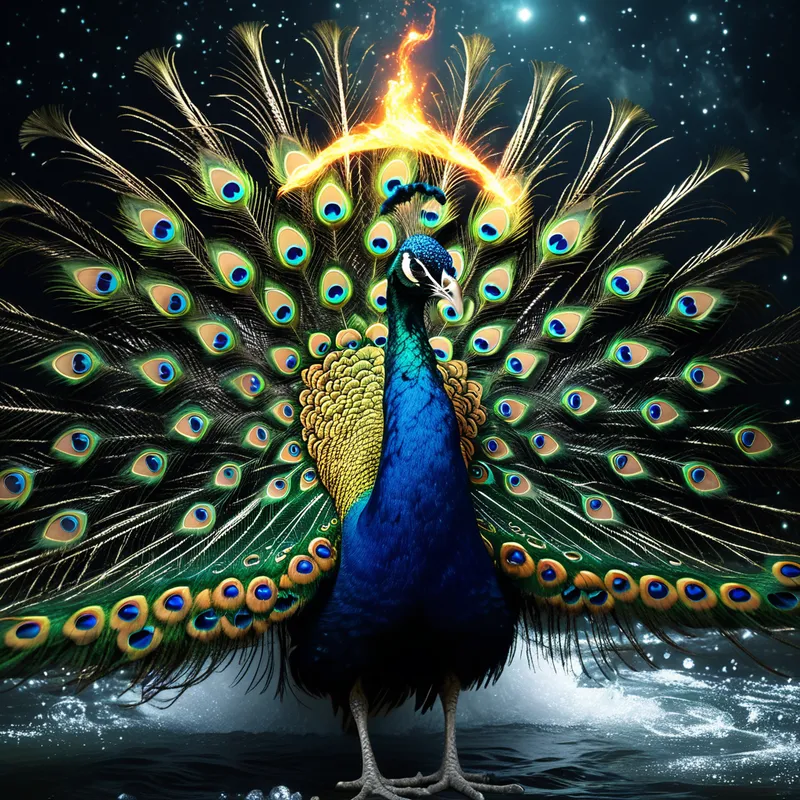
Then, from the abode of the great god Shiva, came a presence. It was not the god himself first, but his vahana, his sacred mount: Mayura, the peacock. This was no mere bird. Its plumage held the captured hues of a hundred dawns and the deep mysteries of twilight. With a cry that was both a challenge and a lament, Mayura descended into the heart of the spreading doom.
While the universe watched, paralyzed, the magnificent peacock did the unthinkable. It did not fight the poison. It did not scatter it. With a grace that belied the horror of its task, Mayura began to drink. It drank the Halahala, drawing the corrosive darkness into its very being. The poison, which could wither galaxies, flowed into the peacock’s throat. And there, within the sacred vessel of its body, a miracle of alchemy occurred. The poison did not destroy Mayura. Instead, it was transmuted. The inky blackness of Halahala transformed, becoming the brilliant, jewel-like patterns that adorn the peacock’s throat. The act of ingestion, of taking in the world’s darkest potential, became the source of its most breathtaking beauty.
Having contained the cataclysm, Mayura presented itself before Shiva. The great god, in his infinite compassion and power, took the contained poison into his own throat, holding it there forever, earning the name Neelakantha. But the first, willing vessel, the one who stepped into the abyss so the gods could continue their work, was the peacock. From that day, Mayura’s cry is said to herald the coming of rain, a reminder that after the swallowing of poison, creation can bloom once more.
Cultural Origins & Context
The myth of Mayura is woven into the grand narrative tapestry of the Mahabharata and the <abbr title="A genre of ancient Indian literature, often called the "fifth Veda," containing myths, legends, and lore">Puranas, particularly the Vishnu Purana and the epic's ancillary tales. It exists not as a standalone fable but as a crucial, transformative episode within the cosmic drama of Samudra Manthan. This context is vital; the story is about the necessary process of creation, which inevitably involves confronting and integrating destructive, chaotic elements.
Passed down through oral tradition by sages and storytellers, the tale served multiple societal functions. It explained natural phenomena—the peacock’s stunning plumage and its association with the monsoon rains. On a ritual level, it established the peacock as a sacred symbol of protection, its feathers used in ceremonies and its image guarding temples and homes. Most profoundly, it modeled a theological and philosophical ideal: that the divine is not only transcendent power but also compassionate containment, and that true guardianship often requires the courageous ingestion of darkness to preserve the light for others.
Symbolic Architecture
At its heart, Mayura is an archetype of the transformative container. The peacock does not defeat the poison through force but through a radical, vulnerable act of ingestion and alchemical change.
The most profound protection is not a shield that deflects, but a vessel that transmutes. The poison taken in becomes the pattern that beautifies.
The Halahala represents the unavoidable "shadow" of any creative or transformative endeavor. In striving for immortality (Amrita), one must first confront the lethal byproducts of ambition, fear, and chaos. Mayura symbolizes the part of the psyche—or the divine principle—that can consciously engage with this toxicity without being destroyed by it. Its beautiful feathers, specifically the eye-like patterns, symbolize the wisdom and awareness gained from this ordeal. The "eyes" see clearly because they have stared into the abyss.
Furthermore, Mayura, as the vahana of Murugan (and later associated with Saraswati), connects this symbolism to wisdom, victory, and artistic expression. The beauty that emerges is not frivolous; it is the hard-won pattern of integrated experience, a map of survival etched in iridescent color.
The Dreamer's Resonance
When the motif of Mayura arises in modern dreams, it often signals a profound process of psychological digestion. The dreamer may be in a life phase where they are confronting a toxic situation, a buried trauma, or a overwhelming emotional "poison"—grief, rage, or betrayal.
Dreaming of a peacock calmly drinking from a dark pool, or finding its feathers in a place of decay, suggests the unconscious is actively working to metabolize a difficult experience. The somatic sensation might be one of a tightness in the throat—the very site of the mythic ingestion—giving way to a feeling of release or unexpected beauty. The dream is not about avoiding the poison, but about finding the inner "Mayura," the psychic capacity to hold it, to let it change its form within you. It is the dream-ego learning that the most frightening aspects of one's experience can, through conscious containment, become sources of unique personal pattern and resilience.
Alchemical Translation
For the individual on the path of individuation, the myth of Mayura provides a masterful blueprint for psychic transmutation. The modern quest is not for literal Amrita, but for wholeness, self-realization, and authentic life. This quest inevitably churns up our own inner ocean, releasing repressed memories, shadow aspects, and emotional toxins (Halahala).
The instinct may be to reject these elements, to project them outward, or to be paralyzed by them. The alchemical instruction of Mayura is the opposite: to develop the capacity to take it in. This is the essence of shadow-work. It is the conscious, courageous act of acknowledging one's own capacity for jealousy, anger, pettiness, or fear—not to act it out, but to "drink" it, to bring it into the vessel of conscious awareness.
Individuation is the process by which the poison of the unlived life becomes the plumage of the authentic self.
The "beauty" that results—the iridescent feathers—is the integrated personality. It is the compassion born of knowing one's own darkness, the creativity sparked by redeemed pain, the unique "pattern" of a life that has not shied away from its own depths. Just as Shiva holds the poison in his throat, neutralizing its destructive power, the individuated ego learns to hold its complex history without being defined or destroyed by it. The cry of Mayura, then, becomes our own signal that a period of difficult integration is complete, and a new, more fertile season of the soul is about to begin.
Associated Symbols
Explore related symbols from the CaleaDream lexicon: