Maui Hawaiian
The audacious demigod of Hawaiian lore, Maui is a trickster and culture hero who performed impossible feats like fishing up islands and snaring the sun.
The Tale of Maui Hawaiian
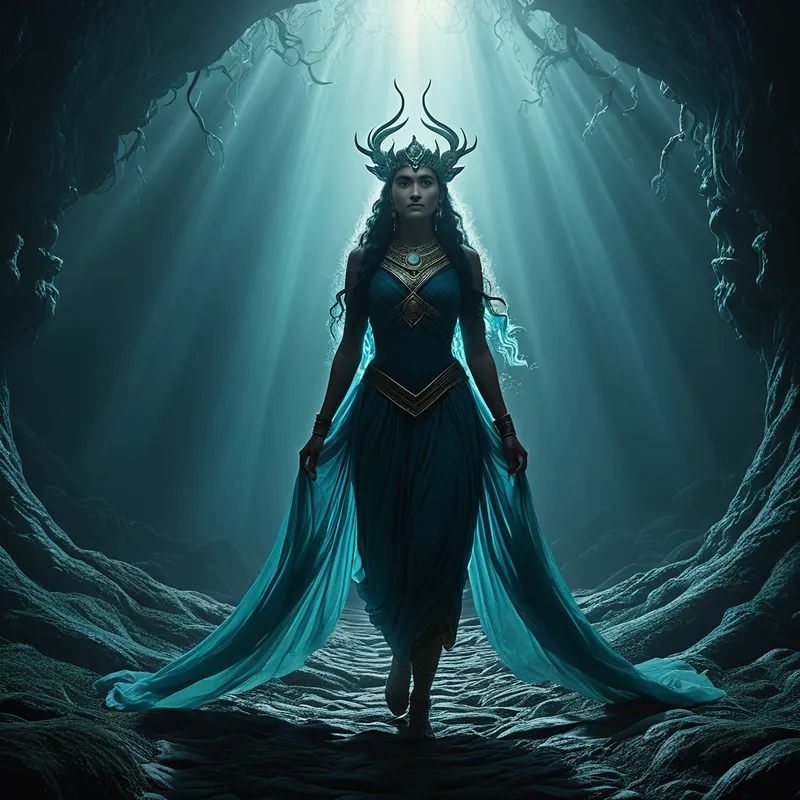
He was born of the earth and the divine, a child cast into the sea by his mother, Hina. Wrapped in a tress of her hair, he was found by the gods, raised to know the secrets of the deep and the sky. This was Maui, the last of Hina’s sons, the one who returned not with anger, but with a fire in his belly to reshape the world for those he loved. His story is not a chronicle of a king, but the song of a restless heart performing impossible surgeries on reality itself.
His first great feat was born of compassion. He saw his mother, Hina, struggling to dry her kapa cloth in the fleeting daylight. The sun, La, raced across the sky, selfish and swift, leaving the world in damp shadow. Maui would not abide this. He journeyed to the great mountain Haleakalā, the "House of the Sun," and there, with a mighty cord woven from his sister’s hair—a fiber of intimacy and strength—he fashioned a snare. As La climbed the slopes of the mountain, Maui ensnared the sun’s fiery legs. La roared and struggled, but Maui, with the leverage of the land itself, held him fast. He did not seek to destroy the sun, but to bargain. Life, he argued, required balance—time for work, time for drying, time for living. Beaten, the sun agreed to move more slowly across the sky for half the year, gifting humanity the long, generous days of summer. Maui had bent the fundamental rhythm of the cosmos to the needs of the hearth.
Then came the gift of fire. In the beginning, fire belonged only to the Moʻo, the great fire-keeping mud hens of the underworld. They guarded it jealously, leaving humanity in the cold and the dark. Maui watched, then schemed. He feigned injury, lying still until the curious birds approached. In a flash, he seized one, demanding the secret of fire. The mud hen, Alae, tricked him, giving him damp wood that would not light. Again and again she deceived him, until Maui, in a final act of persuasive force, threatened her life. Only then did she reveal the true secret: fire lay hidden in the veins of certain trees, the hau and the sandaltree, waiting to be coaxed out by friction. Maui learned the art of the fire-plough, and with it, he stole the primordial spark from the keepers of the dark and gave it to humankind, forever altering their destiny from mere survival to culture, warmth, and community.
But perhaps his most audacious act was an attempt to grant the ultimate gift: immortality. He sought to slay the great goddess of death, Hine-nui-te-pō, who dwelled in the deepest night. The path to her was guarded by fantastical birds and whispering shadows. The only way to kill her, the birds told him, was to enter her body as she slept and crush her heart. It was a journey into the very womb of darkness. Maui, armed with the magical jawbone of his ancestor, commanded his companions, the small birds, to maintain absolute silence. He transformed into a lizard and began his sacred, terrible invasion. As he disappeared into the goddess, one bird, the pīwakawaka (fantail), could not contain its awe and wonder. It burst into laughter. Hine-nui-te-pō awoke. Her obsidian teeth, sharp as stars, snapped shut. And Maui, the great transformer, was himself transformed—not into death, but into the first being to truly die. His quest for eternal life for humanity ended there, in the dark, defining the very limit he sought to erase.
Cultural Origins & Context
Maui’s stories are woven into the very fabric of Polynesian voyaging and identity. He is a pan-Polynesian deity, known from Hawaiʻi to Aotearoa (New Zealand) to Tahiti, with his exploits adapting to each island’s landscape. In Hawaiʻi, he is less the outright creator god and more the profound shaper and benefactor. His myths are moʻolelo—not mere fables, but foundational histories that explain the nature of the world and instruct in both audacity and humility.
He operates in a cosmos where the divine (akua) and the natural world are inseparable. His antagonists are not evil, but elemental forces—the selfish sun, the hoarding mud hens, the inevitable goddess of death. His interventions are acts of pono (righteous balance and order), even when achieved through hoʻopunipuni (deceit). He embodies the Polynesian voyager spirit: ingenious, resourceful, and willing to confront the vast unknown to secure a better life for his people. His failure to conquer death is not a tragedy but a crucial cosmological marker, a sacred boundary that gives meaning to life itself. He is the hero who makes life livable, not endlessly long.
Symbolic Architecture
Maui’s narrative is a complex structure built on the tension between boundless potential and sacred limitation. He is the archetypal agent of the pono, yet he achieves it through the winding paths of the trickster. His tools are never weapons of war, but instruments of craft and connection: his sister’s hair, a fishhook carved from an ancestor’s jawbone, the friction of wood.
His snaring of the sun is not a conquest, but a negotiation with time itself. He imposes a human rhythm upon a celestial body, creating the cycle of seasons—a divine agreement that structures agricultural and social life. It is the mythic ratification of culture’s pact with nature.
The theft of fire is the primal act of technological and cultural revolution. It is the moment pre-human existence ends. Fire, stolen from the chthonic keepers (the mud hens), represents consciousness wrested from the unconscious, light from dark, the cooked from the raw. Maui becomes the patron of all human industry and hearth.
His death in the womb of Hine-nui-te-pō is the ultimate, necessary failure. It is the hero confronting the one door even he cannot open, the one transformation he cannot force. This defines the human condition: we are the beneficiaries of his gifts, living in the elongated light and warmed by the stolen fire, yet forever bounded by the mortality he could not defeat.
The Dreamer's Resonance
To dream of Maui is to feel the stirring of the transformative impulse within the psyche. He represents that part of us that chafes against perceived limits, that sees a problem—the too-fast day, the cold night, the finality of death—and refuses passive acceptance. He is the embodiment of creative defiance.
In the inner landscape, Maui’s feats mirror the psychological work of individuation. Slowing the sun is the act of conscious deliberation, pulling a rushing, compulsive thought or emotion into the light of examination to integrate it. Stealing fire is the difficult, often deceptive process of bringing an unconscious complex, a buried passion or talent, into the service of the conscious ego. His final, fatal journey is the perilous descent into the deepest layers of the unconscious, the Great Mother archetype in her devouring aspect. The failure there is a profound teaching: some mysteries cannot be solved, only honored. The ego that seeks to conquer the unconscious entirely will be consumed by it. True wholeness includes accepting one’s limits, making Maui’s death as instructive as his life.
Alchemical Translation
Maui’s saga is a grand alchemical opus. He begins with the prima materia of a chaotic, unaccommodating world. His deeds are the stages of the magnum opus.
The snaring of the sun is the albedo, the whitening. He fixes the volatile, fleeing spirit (the sun) and gives it stable, regular form (the seasons). It is the imposition of conscious order (sol) on luminous, life-giving energy.
The theft of fire is the citrinitas, the yellowing. It is the acquisition of the divine spark, the scintilla. This fiery secret, hidden in the "veins" of the world-tree, is sulfur—the active, transformative principle. By mastering friction (the union of opposites), he liberates this principle for human use, moving the work from nature to culture.
His quest against Hine-nui-te-pō is the failed rubedo, the reddening. It is the attempt at the ultimate integration, to unite with and conquer the nigredo—the black, primal feminine, the matter of death itself. The laughter that shatters the operation is the premature eruption of the spirit, a fatal lack of containment. The result is not the philosopher’s stone of immortality, but the creation of the essential human condition: mortal beings gifted with divine fire. The alchemy is complete, but its product is our flawed, glorious, temporary existence.
Associated Symbols
Explore related symbols from the CaleaDream lexicon:
- Sun — The celestial force of life and time, which Maui dared to ensnare and negotiate with, transforming its raw, relentless speed into the measured rhythm of days and seasons.
- Fire — The primordial spark of technology and consciousness, stolen from the underworld keepers and gifted to humanity, representing the irreversible leap from nature to culture.
- Fish — Representing Maui’s other great feat of "fishing up" islands from the ocean depths, a symbol of pulling solid land (consciousness) from the formless sea (the unconscious).
- Trickster — The archetypal guise Maui wears, using cunning, deception, and cleverness to achieve ends that raw strength cannot, bending the rules of the cosmos itself.
- Hero — The demigod who ventures into the unknown on behalf of his people, performing feats that redefine the world, yet who is ultimately bound by a sacred, tragic limit.
- Transformation Cocoon — The entire mythic journey of Maui, who enters into confrontations with elemental forces and emerges having fundamentally transformed the conditions of life.
- Death — The great goddess Hine-nui-te-pō, who represents the ultimate, unconquerable boundary that defines life and gives Maui’s gifts their poignant, temporary value.
- Journey — The essential structure of Maui’s existence, from his castaway birth to his voyages to the house of the sun, the underworld of fire, and the realm of night.
- Mother — Hina, the sky goddess who casts him away yet for whom he performs his first great deed, representing the complex origin and ultimate motivation for his world-shaping actions.
- Ocean — The realm of his infancy and a constant presence, both as the source of islands and the vast, unknown space across which all his quests take place.
- Fires of Creation — The specific, catalytic fire Maui liberates, which does not destroy but initiates, enabling cooking, craft, ceremony, and the very warmth of human community.