Matsya Myth Meaning & Symbolism
The first avatar of Vishnu, a fish who saves the seed of all life and sacred knowledge from a cosmic deluge.
The Tale of Matsya
In the age when the world was younger, when the deeds of gods and men were written in the same breath, there lived a king named Manu. He was a man of severe piety, whose austerities were as deep as the ocean’s trench. One day, as he performed his ritual ablutions in a clear river, cupping the sacred water in his palms, he felt a tiny, desperate movement. A small fish, no larger than his thumb, leapt into his hands and spoke with a voice like the murmur of reeds.
"O righteous one," it pleaded, "the great ones of these waters seek my life. Save me, and I shall save you in turn."
Moved by compassion, Manu placed the fish in his water jar. But by morning, the fish had grown, filling the jar to its brim. "This vessel is too small for me," said the fish. "Take me to a larger place." Manu carried it to a pond, then a lake, then the mighty Ganga herself. Each time, the fish outgrew its home in a single day, its form shimmering with an impossible, burgeoning light.
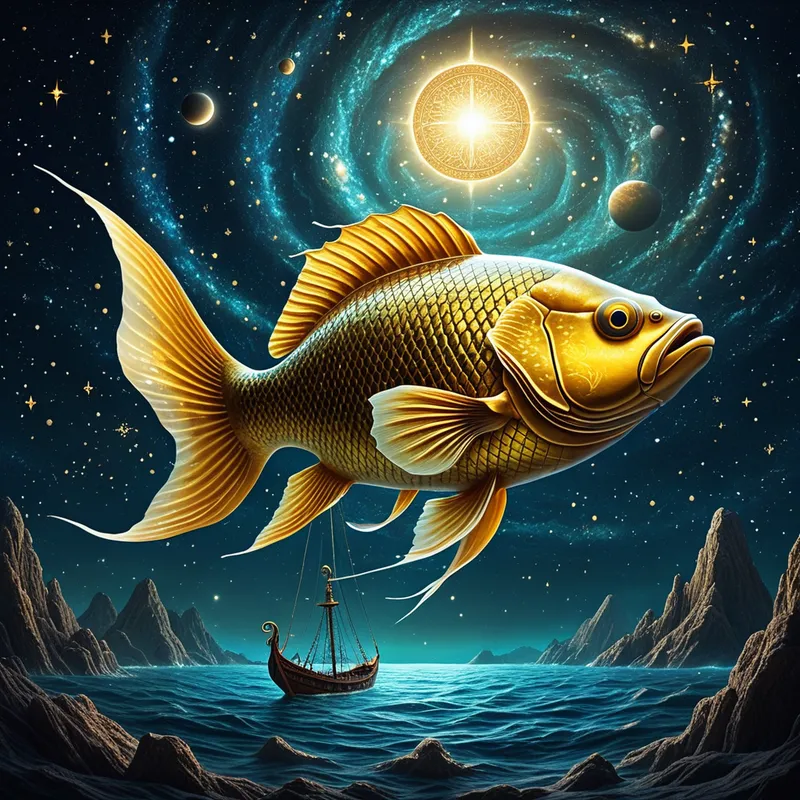
Finally, standing on the shore of the boundless ocean, Manu released the being. It filled the horizon, a leviathan of golden scales, with a single, radiant horn upon its head. The sky itself seemed to bow before its majesty. It was then the great fish revealed itself as Vishnu, the sustainer of all worlds.
"Listen, Manu," boomed the voice, which was the sound of all rivers converging. "A great deluge approaches. The fabric of time is fraying, and the oceans will rise to swallow the lands, to cleanse the cosmos for its next breath. Build a massive ship. Gather upon it the seeds of every plant, the pairs of every animal, and the Saptarishis. Bring the sacred Vedas. When the waters rise, I will be here."
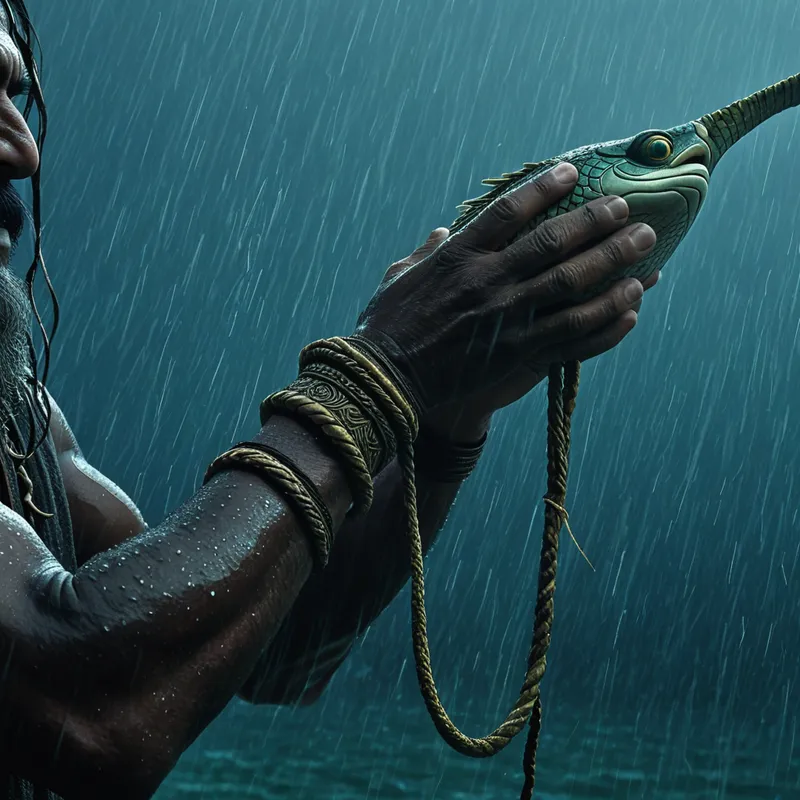
Terror and purpose gripped Manu’s heart. He labored as commanded. Soon, the skies cracked open. Rain fell not as drops, but as solid sheets of water, a roaring, vertical sea. The world drowned. Manu’s ship, a fragile shell of wood, was tossed upon the apocalyptic waves. Just as despair threatened to swallow the last hope, a presence surged from the depths. The horn of Matsya pierced the tumult. Manu fastened the great ship to that horn using Vasuki, the cosmic serpent. For the duration of the deluge, Matsya towed the vessel through the chaos, a beacon through the storm, guarding its precious cargo against the abyss. As the waters receded, revealing a newborn world, glistening and pure, Matsya delivered the ship to the peak of a mighty mountain. The seed of all life, and the flame of all wisdom, was preserved.
Cultural Origins & Context
The myth of Matsya is one of the earliest and most foundational narratives within the Vedic and subsequent Puranic traditions. It is first mentioned in the Shatapatha Brahmana, a detailed ritual text, and is later elaborated with great poetic flourish in the Vishnu Purana and the Mahabharata. This was not merely a story for entertainment, but a cosmological map and a social covenant. Recited by priests and sages, it functioned as a sacred anchor, explaining the cyclical nature of time (Yugas and Pralaya) and establishing the divine mandate for kingship and preservation. Manu, the first man saved, is also the progenitor of humanity and the giver of sacred law (Manusmriti). The myth thus served to connect cosmic order (Dharma), royal duty, and the survival of civilization itself, teaching that wisdom and life must be consciously protected at the brink of each dissolution.
Symbolic Architecture
Matsya is not a random savior, but a precise symbolic engine. The fish is the creature of the primordial, unconscious deep—the Karana Samudra. That Vishnu first appears here signifies that preservation begins not in the bright light of day, but in the dark, watery womb of potential. The growth from tiny minnow to cosmic leviathan illustrates the swelling of divine consciousness within the mundane, the recognition of the infinite within the finite.
The savior does not descend from above, but emerges from below, from the very medium of the impending catastrophe.
The horn is a spire of consciousness, a point of connection for the beleaguered ego (the ship) to latch onto. The serpent-rope, Vasuki, is the binding energy of the universe, the latent power (Kundalini) that can be harnessed to tether ourselves to the divine during psychic floods. The ship is the contained vessel of the Self, carrying the "seeds"—the essential archetypal patterns and core truths that must survive any personal or collective dark age. The deluge is not punishment, but a necessary dissolution, the psyche’s own return to a fluid state so it can be reconstituted anew.
The Dreamer's Resonance
When this myth stirs in the modern unconscious, it often surfaces in dreams of overwhelming floods, of finding strange, wise creatures in domestic water sources (a talking fish in a bathtub, a growing entity in a sink), or of desperately safeguarding a box of precious, ancient items. Somatically, this can correlate with feelings of being emotionally "in over one’s head," a sense of foundational structures dissolving, or conversely, a strange calm in the center of a life crisis.
Psychologically, this marks the onset of a numinous regression—a voluntary or involuntary return to a more fluid, primitive state of being where old identities are washed away. The dream-ego is Manu, tasked with discerning what is essential to save. The tiny, speaking fish is the first, often ignored, intuition from the deep Self, a whisper of guidance that seems insignificant but contains the blueprint for survival. The dream is the psyche’s assurance that a guiding principle (Matsya) will appear from within the chaos itself, but only if we heed the initial, small call and commit to the labor of building the vessel.

Alchemical Translation
The alchemical journey modeled by Matsya is the opus contra naturam—the work against the current of mere dissolution. The flood is the nigredo, the blackening, where all solid forms are dissolved in the aqua permanens, the eternal water. In this psychic sea, the conscious mind (Manu) faces total annihilation.
Individuation is not about avoiding the flood, but about learning what to tie to the horn of meaning as the world drowns.
The first step is the capture of the minnow: paying attention to the small, persistent voice of the Self that emerges during times of quiet desperation or routine. The next is the vessel-building: the conscious work of therapy, journaling, or ritual that creates a container for the soul’s fragments. The gathering of "seeds" is the process of identifying core values, traumas, and talents that are non-negotiable to one’s essence.
The final, transcendent stage is the tethering to the horn. This is the act of surrender and connection, where the ego relinquishes control and hooks its entire structure of meaning to something transpersonal—be it a creative pursuit, a spiritual practice, or a profound commitment. One is pulled through the storm not by one’s own power, but by being anchored to the divine instinct for preservation that swims within the chaos. One emerges, like Manu on the mountaintop, not as the same person who entered the flood, but as the progenitor of a new world of the psyche, carrying forward the preserved, distilled wisdom of all that was, ready to begin the cycle anew.
Associated Symbols
Explore related symbols from the CaleaDream lexicon: