Mary's Gold Myth Meaning & Symbolism
A myth where the Virgin Mary's tears, shed at the Crucifixion, transform into gold coins to aid a grieving, impoverished family.
The Tale of Mary's Gold
Listen, and hear a tale not carved in stone or sung in high cathedrals, but whispered in the hearth-smoke of the poor, a story that blooms in the shadow of the world’s greatest sorrow.
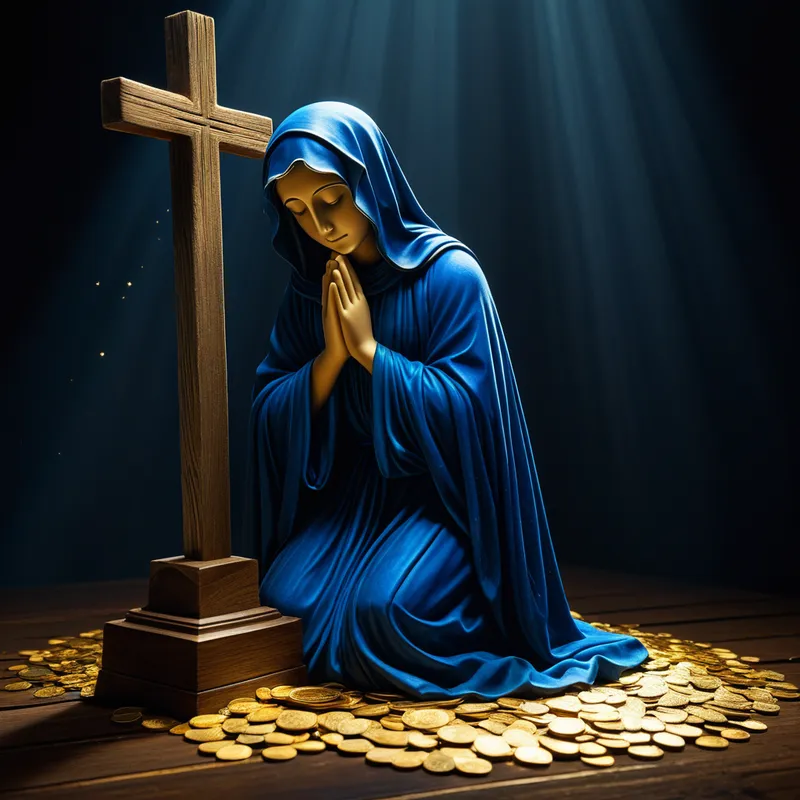
The sky was a wound of bruised purple and iron grey. The earth itself held its breath. On a stark hill, the world’s heart was nailed to a cross of rough timber. And there, at its foot, knelt the Virgin Mary. Her grief was a silent ocean, too vast for sobs. It was a pain that hollowed the cosmos, a mother’s anguish mirrored in the trembling ground and the sun’s retreat. As the final breath left her son’s body, a tremor passed through her, and the tears she had bravely held back began to fall.
They were not ordinary tears. They were the distilled essence of a love that witnessed creation, and a sorrow that tasted its unraveling. They fell slowly, heavily, like molten pearls. And as each one struck the blood-dampened soil of Golgotha, it did not sink into the mud. It shimmered, solidified, and transformed. Where salt water met sacred ground, a miracle of metallic compassion was born: perfect, warm coins of purest gold.
The wind, carrying the scent of rain and myrrh, gathered these coins and swept them down from the place of skulls, through the gloomy streets of Jerusalem, and out into the forgotten lanes of the countryside. It carried them to a place where another, quieter grief resided.
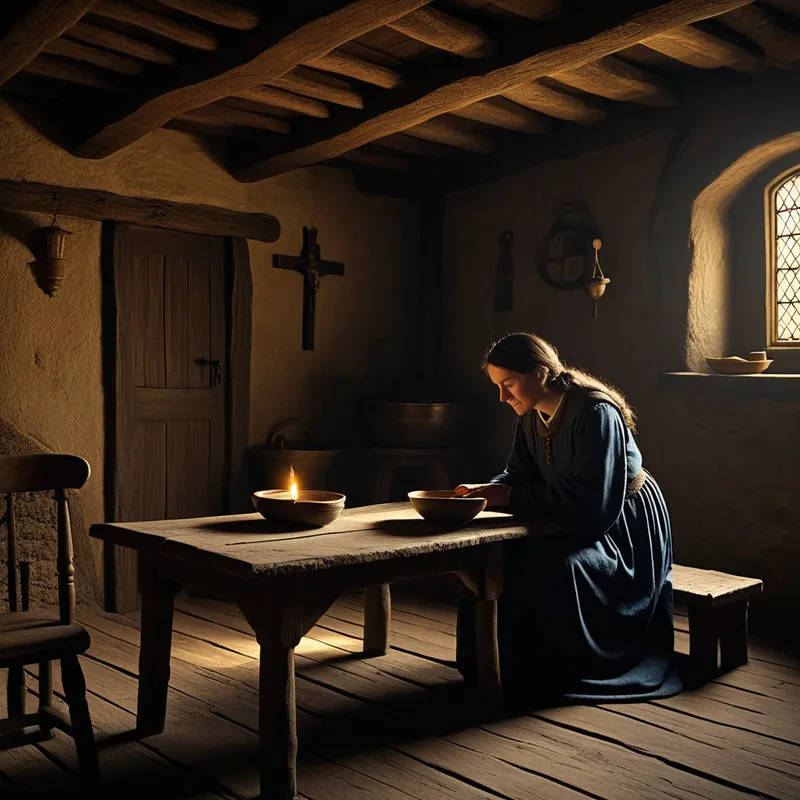
In a hovel of crumbling clay and thatch, a widow sat. Her fire was dead ash, her cupboard held only dust. Before her, her two children slept the thin, restless sleep of hunger. Her own tears fell—silent, desperate, and utterly human. They fell onto the packed earth floor, a prayer without words. And there, amidst her poverty, a gentle clink sounded.
A single coin of impossible gold lay by her foot, as if it had always been there. Then another, near the cold hearth. And another, by her children’s pallet. They were warm to the touch, bearing not the face of Caesar, but the invisible stamp of a shared, sanctifying sorrow. They were not payment, but communion. Not charity, but alchemy. The widow’s human despair met the divine mother’s holy grief, and in that meeting, in the silent language of tears turned to gold, her family was sustained. The cosmic tragedy had yielded a fragment of grace, sent on the wind to a specific, aching heart.
Cultural Origins & Context
The story of Mary’s Gold belongs not to the scriptural canon, but to the rich, living stratum of folklore and devotional legend that flourished in Medieval Europe. It is a tale of the people, for the people. Emerging in the late Middle Ages, it was passed down by grandmothers, shared by traveling friars, and depicted in the modest icons of village churches.
Its primary function was pastoral and psychological. For a peasantry intimately acquainted with hardship, infant mortality, and the relentless threat of famine, the official theological narrative of the Passion could feel cosmically immense yet personally distant. This myth bridged that gap. It localized the divine. It said that Mary, in the very apex of her own suffering, did not become remote or exclusively divine. Instead, her grief became generative. It overflowed and actively sought out parallel suffering in the world.
The myth served as a theodicy for the poor—an answer to the question of why a loving God permits suffering. The answer it implied was not philosophical, but tangible: God, through the heart of the Mother, participates in your pain and transforms its very substance. Your tears are seen, and they are connected to a sacred wellspring that can, mysteriously, nurture life. It validated everyday maternal grief and poverty, weaving them directly into the most sacred narrative of the culture.
Symbolic Architecture
At its core, the myth is a profound map of transformative compassion. The gold is not mined; it is wept. The value is not assigned by a kingdom, but generated by a heartbreak. This reverses our worldly understanding of wealth and power.
The alchemy of the soul does not begin with what we possess, but with what we are willing to fully feel and surrender.
Mary here represents the archetype of the Mater Dolorosa—the Sorrowful Mother. She is the ultimate container for unbearable pain. Her tears are the symbolic overflow of a container that has reached its limit. Yet, in this myth, that overflow is not a failure; it is the necessary release that initiates transmutation. The salt of human suffering, when touched by the ground of ultimate sacrifice (Golgotha), becomes the gold of grace.
The gold coins themselves are potent symbols. They are concretized empathy. They are feeling made substance, sorrow made actionable. They move from the center of sacred tragedy to the periphery of mundane tragedy, guided by an invisible, intelligent force (the wind). This represents the mysterious, often unexpected ways in which our deepest wounds, once fully processed, can later become the very resources that help others—or parts of ourselves—survive.
The Dreamer's Resonance
When this myth stirs in the modern unconscious, it rarely appears as a biblical tableau. Instead, a dreamer might find themselves in a stark, empty landscape, feeling a profound, inarticulate grief. They may witness themselves crying, and see their tears fall as heavy, metallic droplets that sink into the ground—only to have a strange, warm light emerge from that spot later.
Alternatively, one might dream of receiving an unexpected gift—a sum of money, a precious object, a crucial opportunity—from a source associated with a past loss or a maternal figure. The gift feels charged with emotional significance, not just practical value. It feels like a recognition.
These dreams signal a somatic and psychological process of psychic transmutation in progress. The conscious ego is often in a state of poverty—of spirit, hope, or meaning—akin to the widow’s literal need. The tears represent the unconscious, finally allowing a long-held or unprocessed sorrow to surface. The transformation into “gold” in the dream is the psyche’s own assurance that this painful process is not destructive, but generative. It is the dream’s way of validating the necessity of the grief and promising that it will yield an internal resource—resilience, wisdom, deepened compassion—that the dreamer’s “impoverished” conscious self desperately needs.

Alchemical Translation
For the individual on the path of individuation, the myth of Mary’s Gold models the critical stage where suffering is redeemed not by being avoided or explained away, but by being fully integrated and transformed.
The first operation is Calcinatio—the burning. This is the Crucifixion itself, the searing, inescapable experience of loss, failure, or heartbreak that reduces the ego’s certainties to ash. Mary at the cross is the image of the conscious self that must stand witness to this inner devastation without turning away.
The second is Solutio—the dissolving. This is the flow of tears. It is the surrender to the grief, the allowing of the hardened, pained self to dissolve in the waters of feeling. This is not wallowing; it is the necessary liquefaction of a frozen trauma.
The gold is forged not in the fire of the event, but in the water of the response.
The final, miraculous stage is Coagulatio—the solidifying into new form. The tears, having dissolved the old state, now interact with the “ground” of one’s deepest, perhaps sacrificial, truth (one’s personal Golgotha). From this union, a new substance coagulates: the gold of inner value. This is the “coin” of self-knowledge, hard-won empathy, or creative insight that now becomes part of the soul’s permanent currency.
For the modern individual, the “widow” is often an orphaned or impoverished part of the self—a neglected talent, a starved creativity, a lonely inner child. The process of individuation involves allowing our deepest sorrows to be felt, not as ends in themselves, but as the raw material for a compassion that is first turned inward. The “gold” we generate from our own wept tears becomes the resource that finally feeds and sustains those impoverished inner figures, leading to a more whole, self-nourished, and authentically compassionate existence. The myth, therefore, is an ancient promise: your profoundest pain, if met with courageous witness and surrender, holds the secret seed of your most enduring strength.
Associated Symbols
Explore related symbols from the CaleaDream lexicon: