Mary Myth Meaning & Symbolism
The story of a mortal woman chosen to bear the divine, embodying the archetype of the sacred vessel and the transformative power of radical acceptance.
The Tale of Mary
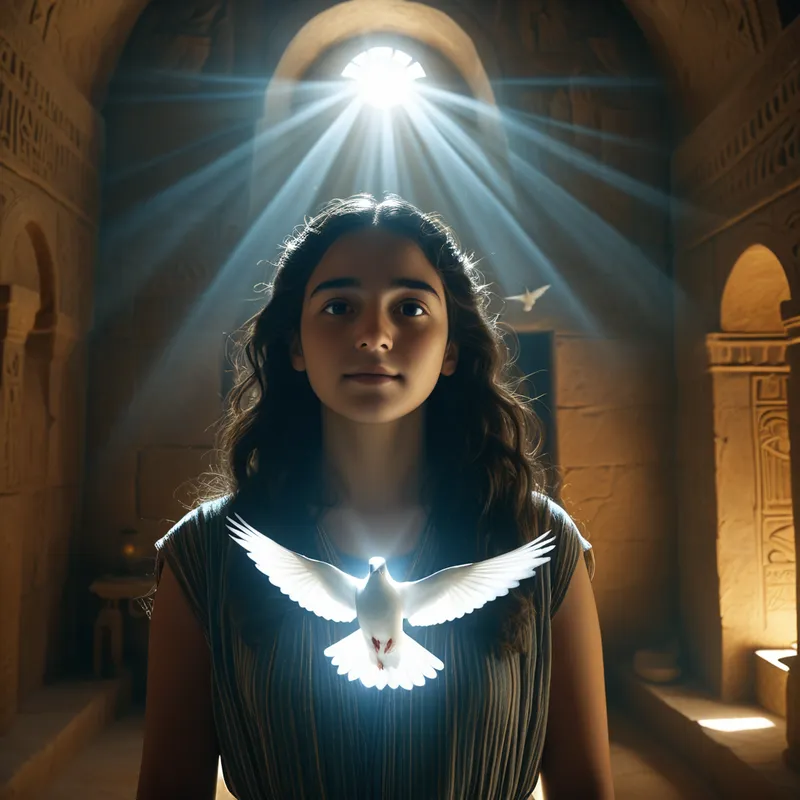
In the quiet heart of a world thick with expectation, under a sky heavy with unspoken promises, there lived a girl. Her name was Mary, of Nazareth, and the air around her hummed with the ordinary: the scent of olive wood, the coarse texture of wool, the rhythm of daily prayers. She was betrothed to a man of steady hands, Joseph, and her life was a scroll yet to be unfurled, its story written in the familiar ink of family and faith.
Then, the veil tore.
It was not with thunder, but with a presence that filled the room like a silent chord. A being of light, an angel named Gabriel, stood before her. The air grew thin and electric. “Greetings, favored one,” the voice was not a sound, but a resonance in the marrow of her bones. “The Lord is with you.” Terror, pure and instinctual, gripped her. But the presence held no malice, only an unbearable intensity of purpose.
“Do not be afraid, Mary,” the resonance continued. “You have found favor with God. And behold, you will conceive in your womb and bear a son, and you shall call his name Jesus.”
The words hung in the air, impossible, world-shattering. “How can this be,” she whispered, the question not of doubt, but of a soul grappling with the mechanics of the miraculous, “since I am a virgin?”
The answer came, a mystery wrapped in a promise. “The Holy Spirit will come upon you, and the power of the Most High will overshadow you; therefore the child to be born will be called holy—the Son of God.” And then, the final, impossible proof: her aged kinswoman Elizabeth was also with child. “For nothing will be impossible with God.”
In that suspended moment, the axis of the world tilted. All futures converged on her yes or her no. To say yes was to embrace scandal, potential abandonment, a path of unimaginable sorrow and glory. It was to offer her very body, her life, as the vessel for a story not her own. She felt the weight of all creation in her breath. And then, from the depths of her being, rose the words that would echo through eternity:
“Behold, I am the servant of the Lord; let it be to me according to your word.”
And the angel departed. The light faded, but the world did not return to what it was. The divine seed was sown. She traveled to Elizabeth, and at her greeting, the child in Elizabeth’s womb leaped for joy. Mary’s spirit erupted in a song of revolution, the Magnificat, praising a God who scatters the proud and lifts the lowly.
Then came the journey to Bethlehem, the rejection, the stable. Amidst the animal breath and hay, in the raw, vulnerable act of birth, she brought forth the light of the world. Shepherds came, wild-eyed with angelic news. Wise men from the East followed a star, laying treasures at the feet of her infant son. She “treasured up all these things, pondering them in her heart.”
But a sword would pierce her own soul, as prophesied. She fled to Egypt to save her child from a king’s jealousy. She watched her son grow, and felt the strange distance as he began his Father’s work. And finally, she stood on Golgotha, the place of the skull. She witnessed the nails, the thorns, the agonizing ascent of the cross. Her heart, the vessel that once cradled divinity, was broken open upon the rock of the world’s cruelty. She received his lifeless body back into her arms, a terrible completion of the circle.
And then, three days later, the impossible joy of the empty tomb. She was there, with the disciples, when the Spirit descended like fire at Pentecost. Her story ends not with her death, but with her assumption—tradition says she was taken body and soul into heaven, the vessel made wholly one with the divine.

Cultural Origins & Context
The myth of Mary emerges from the fertile ground of Second Temple Judaism, a culture yearning for a Messiah. Her story is primarily woven from the threads of the Gospels of Matthew and Luke, written decades after the events they describe. These were not journalistic accounts, but theological narratives designed to proclaim Jesus’s identity. Luke’s version, with its intimate annunciation and visitation, is particularly foundational.
For centuries, the story was passed down orally within early Christian communities, sung in hymns, and depicted in clandestine art in the catacombs. It served a critical societal function: it humanized the incarnation, grounding the cosmic event of God becoming man in the relatable, vulnerable experience of a young woman. As Christianity spread, Mary became a bridge figure. Her qualities as mother, intercessor, and Theotokos resonated with pre-Christian goddess archetypes across the Mediterranean and Europe, facilitating cultural integration and providing a feminine face to the divine within a patriarchal theological structure.
Symbolic Architecture
Mary is the archetype of the Sacred Vessel. She is not the source of the divine, but the perfectly receptive, consenting container that makes its manifestation in the material world possible.
She represents the human ego that must make space for, and willingly bear, the transformative eruption of the Self—the greater, totality of the psyche.
Her virginity is not merely a physical state, but a profound symbolic condition. It represents a psyche that is complete in itself, not defined by external possession or worldly expectation (“I know not man”). It is an inner integrity and preparedness that makes her capable of receiving the wholly Other without being assimilated or destroyed by it. The Annunciation is the critical moment of call and response, where the unconscious (the divine) proposes a impossible task to consciousness (Mary). Her Fiat—“let it be”—is the ultimate act of psychological surrender, the ego aligning itself with the deeper will of the Self.
Her perpetual pondering of events “in her heart” symbolizes the essential feminine principle of relatedness and interiority. While the masculine logos of doctrine explains, the Marian principle holds, nurtures, and connects the mysteries, allowing them to transform the soul from within. Her Seven Sorrows map the inevitable suffering that accompanies the process of bringing any new consciousness to birth in a world resistant to change.

The Dreamer's Resonance
When the Mary pattern stirs in the modern dreamscape, it signals a profound invitation from the depths of the psyche. To dream of a mysterious, sacred pregnancy—regardless of the dreamer’s gender—points to the gestation of a new potential, a new level of consciousness, or a creative life that is asking to be born. This is often accompanied by somatic sensations of fullness, pressure, or a quiet, internal quickening.
Dreams of annunciation—a visitation by a luminous figure, a disembodied voice, or an overwhelming sense of being chosen for a daunting task—reflect the soul’s encounter with its own calling. The anxiety in such dreams mirrors Mary’s fright; it is the ego’s terror at being usurped by a greater power. Conversely, dreams of holding a divine or radiant child suggest the nascent consciousness has successfully emerged and requires protection and nurturance.
Dreams situated in the Pietà motif, where the dreamer holds the lifeless form of something precious they have birthed (a project, a relationship, an old identity), indicate the necessary phase of mourning and letting go. It is the recognition that what the soul brings forth does not belong to it, and must be sacrificed to a larger order.
Alchemical Translation
The myth of Mary is a precise blueprint for the alchemical process of individuation. It models the opus of psychic transmutation.
The first stage is nigredo, the blackening, found in the annunciation’s shock and fear. The ego’s known world is dissolved by the intrusion of the Self. Mary’s “How can this be?” is the soul’s confusion before the mystery. Her Fiat is the critical leap into the albedo, the whitening—the conscious, willing submission to the process. “Let it be” is the password that unlocks transformation.
The incarnation within Mary is the alchemical coniunctio, the sacred marriage of spirit and matter, conscious and unconscious, within the vessel of the individual psyche.
The pregnancy is the citrinitas, the yellowing or incubation, where the new substance is nurtured in secret. This is the long, patient work of “pondering in the heart,” where insights are related to one another without premature conclusion. The suffering at the cross represents a second, deeper nigredo—the death of the personal attachment to the divine child. The mother must witness the crucifixion of her own creation, the ego’s hope for how the new consciousness should manifest.
The final assumption into heaven symbolizes the rubedo, the reddening or completion. The vessel itself is glorified. In psychological terms, the ego, having fully served its purpose as the carrier of the Self, is not destroyed but eternally united with it. The individual is no longer merely a container for the divine spark but has become, through the ordeal of consent and surrender, a fully integrated expression of it. The myth teaches that wholeness is achieved not through heroic conquest, but through the courageous, humble, and ultimately joyful act of saying yes to the unimaginable wanting to be born through us.
Associated Symbols
Explore related symbols from the CaleaDream lexicon: