Martha of Bethany Myth Meaning & Symbolism
A woman of profound hospitality wrestles with the sacred tension between necessary work and radical presence, finding divinity in the dust of her own home.
The Tale of Martha of Bethany
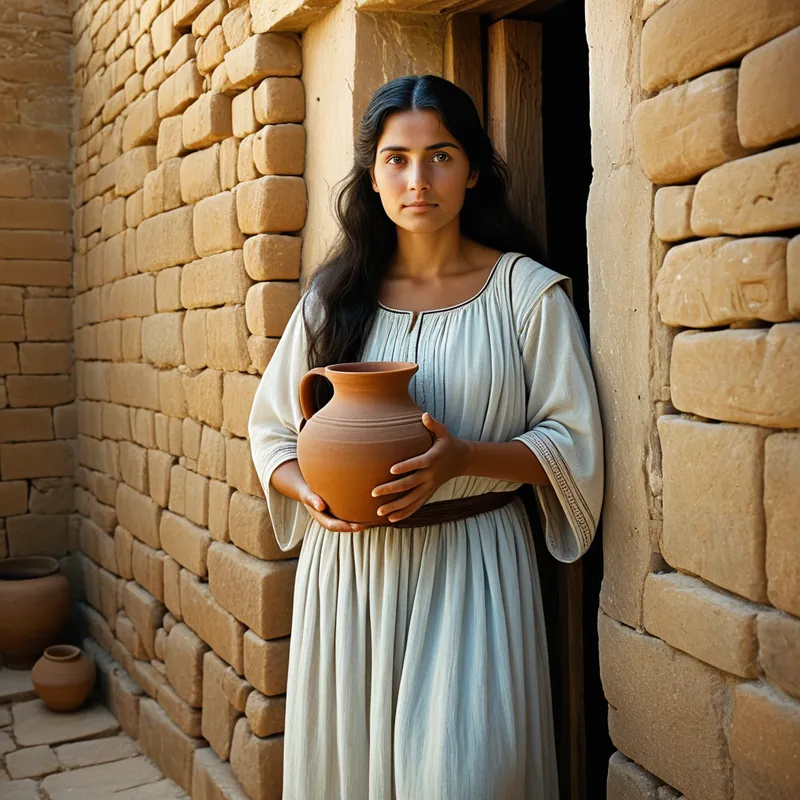
The road to Bethany was dust and thirst. It was a place of refuge, a simple house of two sisters and a brother, clinging to the hillside like a swallow’s nest. And within its walls lived Martha, the pillar of that home. Her world was measured in bushels of grain, in the weight of water jars, in the scent of bread baking on the hearth and herbs crushed for the stew. Her hands were maps of practical love, her mind a ledger of necessities.
When the Teacher came, the house trembled—not with fear, but with a sudden, pressing fullness. He brought with him the road’s dust, the murmur of crowds, and a silence that was louder than any noise. Martha’s domain, the courtyard and the kitchen, erupted into a sacred crisis of hospitality. There was water to draw, bread to bake, cushions to arrange, the thousand tiny acts that wove a net of safety for a weary traveler.
She moved, a figure of beautiful, frantic grace, her attention splintered into a dozen tasks. The fire needed tending, the lentils threatened to boil over. And through the archway, she saw her sister, Mary, who had cast aside the spindle and the basket. Mary sat on the packed earth at the Teacher’s feet, her body still, her face upturned like a flower to the sun, lost in the river of his words.
A knot tightened in Martha’s soul—a fierce, hot knot of righteousness and resentment. The work was hers alone. The burden of the tangible world pressed upon her shoulders while her sister bathed in the intangible. The heat of the oven became the heat of her complaint. She strode from her realm of action into the circle of contemplation, her hands still dusty with flour.
“Lord,” she said, and her voice was not gentle. It was the voice of the foundation stone feeling the strain. “Do you not care that my sister has left me to serve alone? Tell her then to help me.”
The room held its breath. The Teacher turned his gaze upon her. It was not a look of rebuke, but of a profound and heartbreaking recognition. He saw not a nagging woman, but a world-bearer on the verge of collapse under the weight of her own necessary love.
“Martha, Martha,” he said, and the repetition of her name was a balm and a key. “You are anxious and troubled about many things.” He named her inner storm. “But one thing is necessary.” His words hung in the sunlit air, a single, unwavering note. “Mary has chosen the good portion, which will not be taken away from her.”
The words did not dismiss her service, but they transfigured it. They were not a command to stop, but an invitation to see. The conflict did not end with Mary rising to help; it resolved in the silent, seismic shift within Martha herself. The pillar of the house was asked not to crumble, but to become a vessel. The keeper of the hearth was shown that the fire she tended could also illuminate from within.
Cultural Origins & Context
This brief, potent narrative is found only in the Gospel of Luke (10:38-42). It is a story passed down not in grand temples, but in the intimate space of the home, the oikos. In the 1st-century Mediterranean world, the home was the primary locus of religious and social life for women. Martha’s role as materfamilias was one of immense honor and responsibility; hospitality (xenia) was a cornerstone virtue.
The story functioned as a provocative teaching within early Christian communities, which often met in homes. It presented a radical tension within the domestic sphere itself. It challenged the assumed hierarchy of action over contemplation, of visible service over receptive learning. For listeners, it raised a haunting question: in the daily labor that sustains life, where does one encounter the sacred? The tale validates the essential work of caregiving while simultaneously breaking open its container, suggesting that the work itself can become a distraction from the presence it is meant to honor.
Symbolic Architecture
Martha and Mary are not merely historical figures but two poles of a fundamental human tension. They represent the essential dichotomy of the vita activa and the vita contemplativa. Martha is the archetype of the ego in its necessary mode: managing, providing, securing. She is the psyche’s administrator, ensuring survival and order.
The sacred is not only in the temple; it is in the tension between the pot on the fire and the silence that fills the room when you stop to listen.
Her complaint is the cry of the ego burdened by its own identification with duty. She is “anxious and troubled about many things”—a perfect description of the fragmented, multi-tasking modern mind. Mary symbolizes the Self, or the soul’s innate orientation toward wholeness and connection. Her “sitting at the feet” of the teacher is an image of radical receptivity, of prioritizing being over doing.
The Teacher’s response is the critical intervention of a transcendent function. He does not choose Mary over Martha, but highlights Mary’s choice for Martha’s benefit. The “one thing necessary” is not contemplation instead of action, but the conscious, centered presence that can inform action. The myth suggests that service devoid of presence becomes a prison of resentment, while presence that refuses to act is spiritual bypass. The “good portion” is the integrated state where hands work from a heart at rest.

The Dreamer's Resonance
When this myth stirs in the modern dreamer, it often manifests as somatic anxiety within scenarios of overwhelming responsibility. You may dream of preparing a colossal, never-ending meal for unseen guests, of a house that is perpetually dirty or crumbling despite your frantic efforts, or of being stuck in a service role while others celebrate in the next room.
These dreams signal a psyche where the Martha complex is over-identified with and exhausted. The body feels the “trouble about many things”—tight shoulders, a knotted stomach, restless sleep. The psychological process is one of confrontation with the inner slave-driver. The dream is not condemning your labor, but asking the Martha within: For whom are you doing this? From what well are you drawing your water? It is an invitation to step through the archway, to momentarily lay down the ladle and listen to the silent, guiding voice that your own busyness has drowned out.

Alchemical Translation
The individuation process modeled here is the alchemy of duty into devotion, of service into sacrament. Martha’s initial state is one of prima materia: the raw, burdensome weight of worldly care. Her confrontation with Mary and the Teacher is the nigredo, the dark night of the soul where her former mode of operation collapses in frustration.
The Teacher’s words are the albedo, the clarifying insight. “One thing is necessary” acts as the philosopher’s stone, transmuting the lead of anxious labor into the gold of conscious presence. The integration is not Martha becoming Mary, but Martha discovering the Mary within her own Martha-hood.
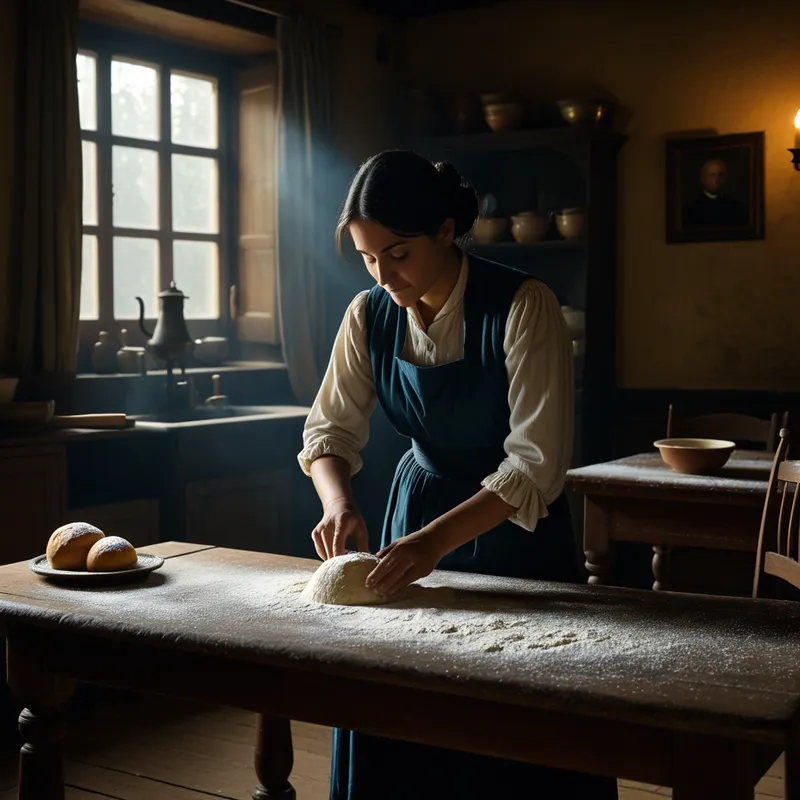
The ultimate alchemy is not to escape the kitchen, but to find that the kitchen hearth is also the altar, and the daily bread you knead is the substance of the soul.
For the modern individual, this means recognizing that the path to wholeness does not always lead away from our responsibilities, but directly into their heart. It is to perform the necessary tasks of life—the emails, the chores, the care of others—not with a fragmented, resentful mind, but from a center of chosen presence. The “good portion” is the portion of awareness we bring to our actions. It is the realization that in the very act of sweeping the floor with full attention, we are not just cleaning a house; we are performing a timeless, sacred rite of making space for the holy to enter. Martha’s journey is the myth of enlightenment found not in the hermit’s cave, but in the well-ordered, love-filled, and now consciously inhabited home.
Associated Symbols
Explore related symbols from the CaleaDream lexicon: