Marn Grook Myth Meaning & Symbolism
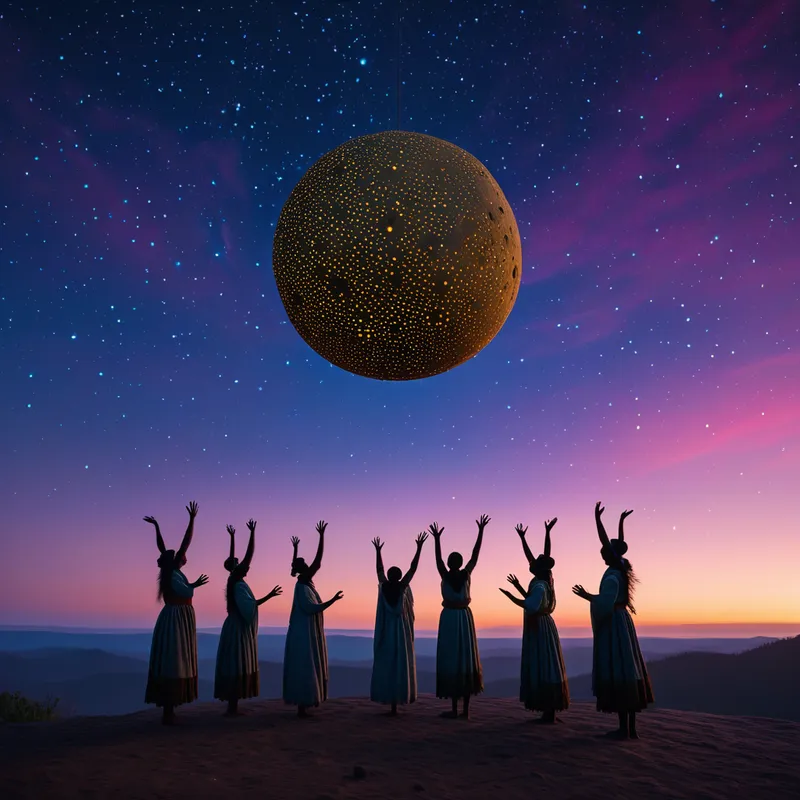
A mythic tale of a celestial game played by ancestral spirits, weaving the land with joy and establishing the sacred bond between people and place.
The Tale of Marn Grook
Listen. Before the first sunrise hardened the red earth, when the world was soft and singing, the ancestors walked. This was the time of the Dreaming. The sky was a deep, living purple, and the air hummed with the stories being dreamed into stone, river, and tree.
Among them moved the spirits of the Kulin and the Gunaikurnai. They were giants of shadow and starlight, their feet tracing the first paths, their voices giving names to the unnamed. But the work of creation is vast, and even ancestral spirits can feel the weight of a world yet to be fully woven.
One evening, as the evening star (Barnumbirr) began her slow journey across the twilight, a restlessness stirred. A spirit, feeling the immense silence between the songlines, picked up a piece of earth. It was not just dirt; it was the skin of the dreaming land. He shaped it, rolled it in the ashes of a sacred fire, and wrapped it tightly with the sinew of a great, dreaming kangaroo. He stitched it with threads of spider-silk, until he held a firm, round ball.
He tossed it into the gloaming. It did not fall. It hung, a small, dark moon against the violet sky. Another spirit saw it, and with a laugh that sounded like water over rocks, leaped. He did not just jump; he flew upwards, defying the pull of the earth, and struck the ball with the flat of his hand. Thwump. The sound echoed across the plains.
And so the game began. Not a battle, but a dance of impossible grace. Spirits gathered, forming no sides, recognizing no opponents. There was only the ball, the sky, and the joyous imperative to keep it aloft. They leaped like fire, their bodies arcing against the emerging stars. They struck the ball with hands, feet, heads, sending it in parabolic gifts across the gathering dark. With each strike, a spark of creative energy fell to the earth below. Where a spark landed, a gum tree would later grow tall. Where a player landed from a mighty leap, a waterhole would spring forth.
The game, Marn Grook, wove the land itself. The high marks, the running catches, the shared laughter—these were not mere sport. They were the stitches in the fabric of country, binding spirit to place through pure, exuberant play. They played until the first hint of dawn paled the east, and as they faded back into the dreaming, the last spirit to touch the ball placed it gently in the cradle of a mountain range, where it turned to stone, a heart of joy forever embedded in the land.
Cultural Origins & Context
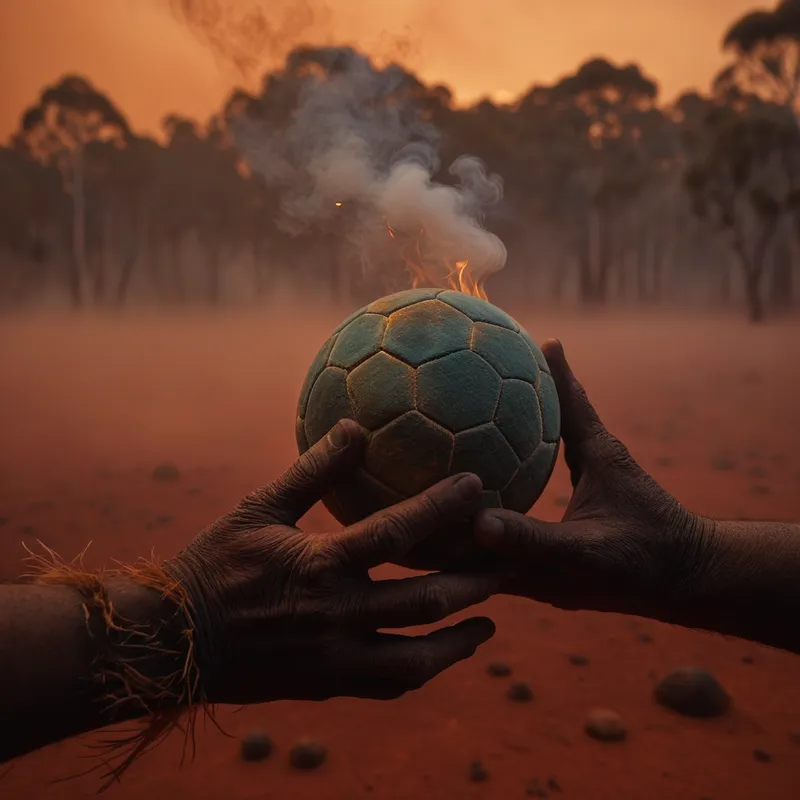
The stories of Marn Grook belong primarily to the Aboriginal nations of what is now southeastern Australia, notably the Djab Wurrung and Jardwadjali peoples. It was not merely a legend of the distant past but a living practice observed by early European settlers in the 19th century. They witnessed children and men playing with a ball made of possum skin, engaging in a game characterized by spectacular high leaps, called "marks," and fluid, non-possessive teamwork with the explicit goal of keeping the ball in continuous motion.
The myth and the practice were inseparable. The game was a ritual re-enactment of the ancestral drama, a way to physically inhabit the stories of the Dreaming. It was passed down not through a single bardic figure, but through community participation—by doing. Elders would encourage the young to play, to leap high, to emulate the ancestral spirits. Its societal function was multifaceted: it taught coordination, strength, and agility vital for survival; it reinforced community bonds through a shared, non-competitive activity; and most profoundly, it was an act of connection to country. By playing Marn Grook on a specific tract of land, the players were quite literally re-animating it with the original creative joy of the ancestors, maintaining the spiritual health of place and people.
Symbolic Architecture
At its core, Marn Grook is a myth about connection forged through joyful, purposeless purpose. The ball is the central symbol—not a trophy to be won, but a shared focal point of energy, a cosmic token passed in celebration.
The sacred object is not possessed; it is hosted, and in its movement, it creates the community.
The game has no goals, no score, and no permanent teams. This absence of oppositional structure is radical. It symbolizes a worldview where relationship precedes rivalry, where the primary cosmic act is not conquest but sustaining a shared rhythm. The spectacular high leap, the "mark," is the individual moment of transcendent effort, but its value is only realized in the service of the ball's continued flight—the gift is passed on. Psychologically, this represents the ego's highest achievement not as personal glory, but as a contribution to a flow greater than itself.
The sparks that become trees and the footprints that become waterholes reveal the myth's alchemical premise: that pure, embodied joy is itself a creative, world-shaping force. The spirits are not working to create the landscape; they are playing, and the landscape emerges as a byproduct of their celebration.
The Dreamer's Resonance
When the pattern of Marn Grook surfaces in modern dreams, it often manifests not as a literal game, but as a somatic sensation or a specific scenario. The dreamer may find themselves in a vast, open space, compelled to leap with an effortless, gravity-defying grace. They may be trying to keep a fragile, glowing object—a light, a bubble, a crystal—aloft, often with others whose faces are unclear.
This dream signals a psychological process of re-connecting severed parts. The somatic feeling of leaping high points to a potential for rising above a mundane or burdensome perspective. The effort to keep something aloft reflects the psyche's attempt to sustain a vital energy—joy, inspiration, hope, a relationship—that is in danger of falling into inertia or despair. The presence of others, even as shadows, indicates this is not a solitary task but one that involves the social or collective unconscious. The dream is an invitation from the deep self to engage with life not as a struggle for possession, but as a participatory dance where the goal is simply to keep the spirit of the thing in motion.

Alchemical Translation
For the modern individual navigating the path of individuation—the process of becoming a whole, integrated self—Marn Grook offers a profound model of psychic transmutation. Our cultural conditioning often frames growth as a heroic, solitary battle: slay the dragon, seize the treasure, conquer the unconscious. Marn Grook proposes a different alchemy.
The first operation is to identify one's "ball." This is the animating spirit of one's life, the core joy, the central creative spark. It is not a material goal (wealth, status) but an energetic quality (curiosity, compassion, playfulness). The alchemical work is to "keep it aloft." This means making choices that sustain that inner spirit, that prevent it from being grounded by cynicism, obligation, or fear.
Individuation is not about winning the game of self, but about learning the art of the continuous pass.
The "high mark"—those moments of insight, triumph, or peak experience—are crucial, but they are not endpoints. Their value is in the momentum they provide, energy that must be gracefully passed back into the flow of daily life and relationships. The myth teaches that the Self is not a fortress to be built in isolation, but a pattern of energy sustained in the dynamic interplay between the individual leap and the communal field. The transmutation occurs in the very act of participation, where the weight of the personal psyche is lightened through connection, and the leaden burden of isolation is turned into the golden, weightless flight of shared spirit.
Associated Symbols
Explore related symbols from the CaleaDream lexicon: