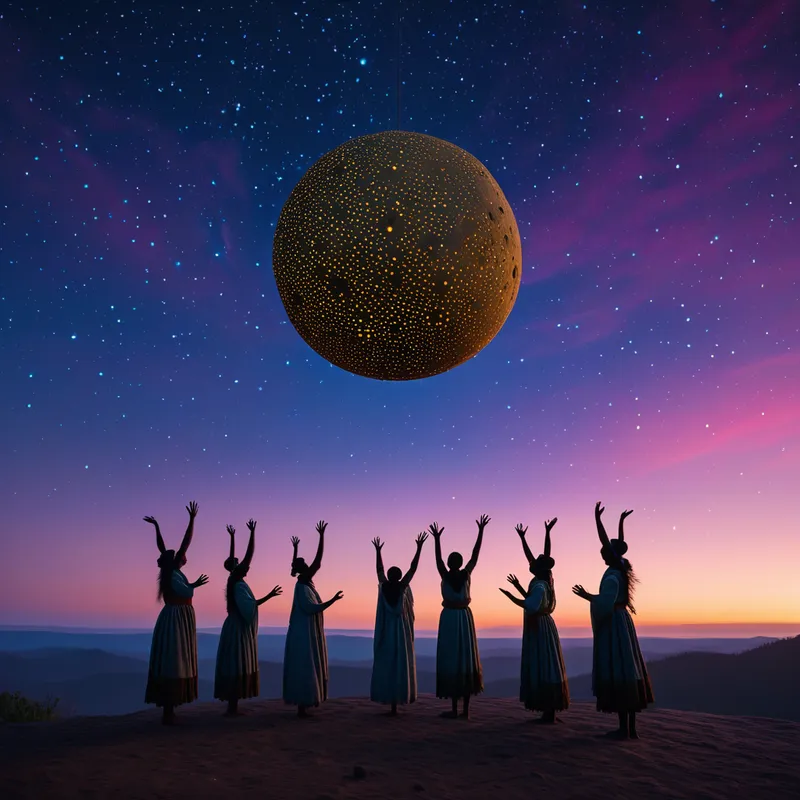
The Dream of Play: An Alchemy of Spontaneous Joy
The Somatic Echo
Before the image of a game or the memory of laughter forms, the dream of play announces itself in the body as a subtle, electric hum. It is a lightness behind the breastbone, a loosening in the joints of the jaw and shoulders—a sensation of potential energy coiled and ready to spring without a target. It feels like the moment before a child’s giggle erupts, a somatic sigh of release from the constant, low-grade tension of performance and persona. This is not the adrenaline of competition, but the vibrational shift of a system unclenching, a forgotten internal fluidity returning. The breath comes easier, as if the air itself has become more malleable, ready to be shaped by whimsy rather than will.
The Dreamer's Log (Case Vignette)
I am in a cavernous, abandoned server room, all cold blue light and the hum of dormant machines. In the center, I find a single, dusty arcade cabinet. I press start. The screen flickers to life with a simple, timeless game of Pong. As I play, the rhythmic blip of the digital ball begins to synchronize with the server lights, then with my own heartbeat. The entire chamber starts to pulse with this gentle, playful rhythm, the rigid racks of servers seeming to sway.
Alchemical Interpretation: The rigid, logical architecture of the waking self is being gently reprogrammed by the most basic pulse of interaction and joy, transforming a temple of data into a sanctuary of rhythm.

The False Lead
The dream of play is not a command to be more frivolous or to shirk responsibility. It is not an invitation to childishness, but to childlikeness—a critical distinction. This theme is often misinterpreted as the psyche’s demand for distraction or escape, a mere pressure valve. That is the shadow of play, its hollow echo. True play, as dreamt, is the opposite of escape; it is a profound engagement with the foundational rules of your own being. It is not about winning a game, but about rediscovering the pleasure of the game itself, the sacred dialogue between self and world that operates outside the economies of achievement and validation.
Psychological Architecture
To dream of play is to encounter a subversive and necessary form of Shadow work. The Shadow here is not a monster, but the exiled part of you that knows how to operate without a script, the part that creates for the sheer somatic joy of creation and relates for the electric thrill of connection. Our internal family systems are often governed by a council of Managers—the Achiever, the Caretaker, the Rational Mind—who maintain order through predictable routines. Play is the Rebel Orphan, the exiled inner child who knows a different law: the law of curiosity. Integrating this exile is not about letting it run the boardroom, but about allowing its perspective to dissolve the brittle rigidity of the internal boardroom table altogether. It is an individuation process that moves beyond crafting a perfected self, toward discovering a fluid self, capable of spontaneous reconfiguration in response to life’s music.
Mythic Resonance
We see this alchemy in the Norse myth of the god Loki. Beyond his role as a mere trickster, Loki is the principle of play injected into the solemn order of Asgard. He cuts Sif’s hair not just for malice, but to disrupt a stagnant image; he engineers the birth of Sleipnir, the eight-legged horse, from a moment of chaotic, shape-shifting mischief. His actions, while disruptive, force the gods to adapt, to think in new ways, to engage with realities outside their rigid protocols. He is the living embodiment of the dream-play that destabilizes to make room for unforeseen possibilities. Similarly, in the Greek tradition, the child-god Eros is not initially the god of romantic love, but of creative, generative desire—the playful, magnetic force that brings disparate elements together to form new wholes, the original spark before the story solidifies into myth.
Symbolic Nodes
- Abandoned Playgrounds/Schoolyards at Twilight: The memory of play, calling for reanimation.
- Simple, Repetitive Games (Pong, Catch, Tag): The core, rhythmic pulse of interaction stripped of complex goals.
- Improvised Instruments or Making Music with Objects: The creation of order and beauty from spontaneous, rule-free engagement.
- Dancing Alone in an Empty Space: Sovereignty of movement, the body celebrating its own intelligence.
- Building Unstable or Nonsensical Structures (Card Towers, Sandcastles): Investment in the process of creation, not the permanence of the product.
- A Ball That Defies Physics: The suspension of known laws, inviting wonder over understanding.
Archetypal Resonance
The energy of the play dream resonates most powerfully with The Jester Archetype. The Jester is not merely the fool, but the sacred truth-teller who uses levity to topple pretension, who reveals the flexibility of reality through paradox and game. Its somatic echo is that precise, liberating click when a perceived truth is revealed as just one possible rule in a game you can choose to play differently. The Jester’s core energy is freedom through disruption—freedom from the tyranny of the single, serious story we tell about ourselves. Its alchemical potential lies in its ability to dissolve the leaden weight of literalism and performance anxiety, transmuting it into the gold of creative adaptability and authentic, unguarded engagement with the present moment.
The Alchemical Process
The alchemy of play requires the heat of conscious permission and the pressure of sustained attention on joy. The prima materia, the base lead, is the ingrained identity of the Serious Person—the one who believes worth is mined only through struggle and tangible output. The fire is applied when you deliberately interrupt a productive impulse to do something purposeless: to doodle in a margin, to step away to swing on a swing set, to follow a curiosity without a goal. This feels like a transgression, generating psychic heat. The pressure is the sustained focus on the somatic pleasure of the act itself—the feel of the chalk, the rush of air, the neural spark of the new connection—without allowing the mind to justify it as a “brain break” or a means to an end. In this crucible, the rigid identity softens, dissolves, and reforms around a new central axiom: that joy is not the reward for work, but a foundational, generative state from which all authentic work naturally flows.

The Integration Protocol
Question 1: Where in your waking life have you confused rules for reality? What one rule, in one area of your life, can you experimentally treat as optional, just for a day?
Question 2: When was the last time you did something purely for the tactile, auditory, or kinesthetic pleasure of it, with no narrative, social media post, or improved skill attached?
Question 3: Which of your internal "Managers" (the Achiever, the Critic, the Responsible One) is most threatened by the idea of unstructured play, and what is it afraid will happen if that Manager takes a five-minute break?
Action 1 (Micro-Suspension): For the next 48 hours, commit to one two-minute period of deliberate, non-productive play per day. This is not meditation. This is throwing a pen in the air and catching it, making a silly sound, tracing patterns in the condensation on a window. Set a timer. Feel the resistance, then do it anyway.
Action 2 (Creative Cartography): Take a large sheet of paper. In the center, write "PLAY." Without thinking, draw lines, shapes, and words that radiate from it—not what you should do for fun, but what fragments of memory, sensation, or absurdity arise. Use colors. Let it be messy. This is a map of your exiled Jester's language.
Action 3 (Ritual of Re-enchantment): Choose a common, daily object (a coffee mug, a door handle, a tree on your commute). For one week, your task is to interact with it in a subtly new, playful way each day—tapping a rhythm on it, noticing a new texture, imagining its secret history. You are not changing the object; you are changing your relationship to perception itself.
Final Validation
It is profoundly difficult to heed this call. We are armored against it, convinced that our worth is housed in our solemnity and our output. To feel the pull of the abandoned playground and to actually walk toward it requires a courage that rivals any heroic quest—the courage to be deemed frivolous, most of all by yourself. But this is the soul’s rebellion against a life rendered in grayscale. To integrate the dream of play is to reclaim your native right to co-create reality with a spirit of curiosity and delight. It is to stop building a monument and start cultivating a garden, where the most beautiful growth is always unexpected, and the only rule is the dance of life itself.