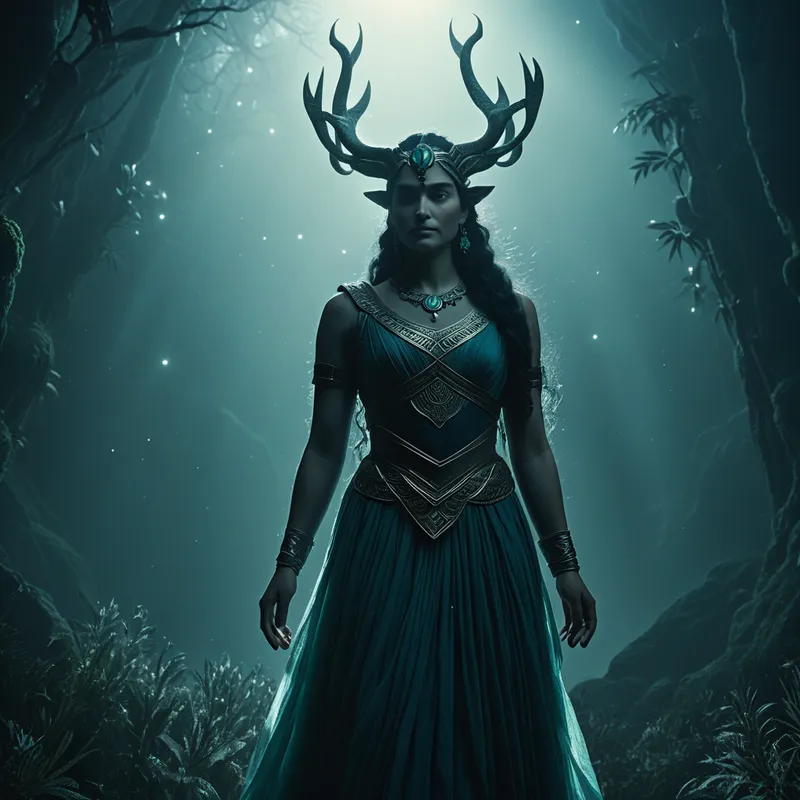
Marduk Slays Tiamat
The Babylonian creation epic where the storm god Marduk defeats the primordial chaos dragon Tiamat, establishing order from chaos and creating the world from her body.
The Tale of Marduk Slays Tiamat
In the beginning, before the naming of things, there was only the mingled, salt-sweet water of Apsu and the churning, bitter water of Tiamat. From their union, the first generations of gods were born. But their clamor and light disturbed the deep, primordial sleep of Apsu, who resolved to destroy his own children to return to silence. The wisest of the gods, Ea, learned of this plot. With cunning and profound magic, he slew Apsu, and upon his still waters established his own dwelling. There, in that first sacred space, Marduk was born to Ea—a god of storm and sunlight, of terrifying power and radiant order, with four eyes, four ears, and fire blazing from his lips.
Yet a greater disturbance was seeded. Tiamat, the great mother of all, who had been indifferent to Apsu’s fate, was stirred to a furious wrath by the goading of the younger gods, who had captured and imprisoned her second consort, Kingu. Her grief and rage became a cosmic tempest. She gave birth to a legion of monsters: sharp-toothed serpents, raging lions, scorpion-men, and the Mushussu dragon. She made Kingu the commander of this host and placed the Tablets of Destiny upon his breast, granting him supreme authority over the fates of all.
The pantheon of younger gods trembled. One by one, their champions went forth to face Tiamat’s chaos and returned in paralyzing fear. In their council of desperation, they turned at last to Marduk. He agreed to be their champion, but on one absolute condition: if he succeeded, he must be granted undisputed kingship over all the gods. In a great assembly, they tested his power. They placed a constellation in the sky and commanded him to make it vanish with a word. He spoke, and it was gone. He spoke again, and it reappeared. Convinced of his sovereign might, they cried, “Marduk is king!”
Thus armed with their divine mandate, Marduk prepared for battle. He fashioned a bow, tipped arrows with lightning, filled his body with flame, and crafted a great net held by the four winds to ensnare Tiamat. He mounted his storm-chariot drawn by four devastating tempests and rode out to meet the primordial abyss.
The confrontation was not mere combat; it was the moment of cosmic choice. Tiamat opened her maw, the void of unformed creation, to swallow him whole. But Marduk, invoking the hurricane, forced the winds into her belly, distending her vast form. As she gaped, helpless, he shot an arrow down her throat. It pierced her heart, and her life-breath was extinguished. Her monstrous host fled in disarray, and Marduk captured Kingu, seizing from him the Tablets of Destiny.
Then came the act of creation. The victor stood upon the vast, lifeless body of the defeated. With a cleaving blow, he split Tiamat’s carcass like a clamshell. From one half, he raised the vault of the heavens, stationing guards to hold back her waters above. From the other, he founded the solid earth below. From her weeping eyes, he sourced the Tigris and Euphrates rivers. He organized her breasts into mountains and from her spittle formed the clouds. From the blood of the traitor Kingu, mixed with earth, he fashioned humanity—beings bound to serve the gods and maintain the new order. Finally, in the center of this new world, he built the great city of Babylon, with its temple Esagila at its heart, establishing his throne and the fixed axis of the cosmos.
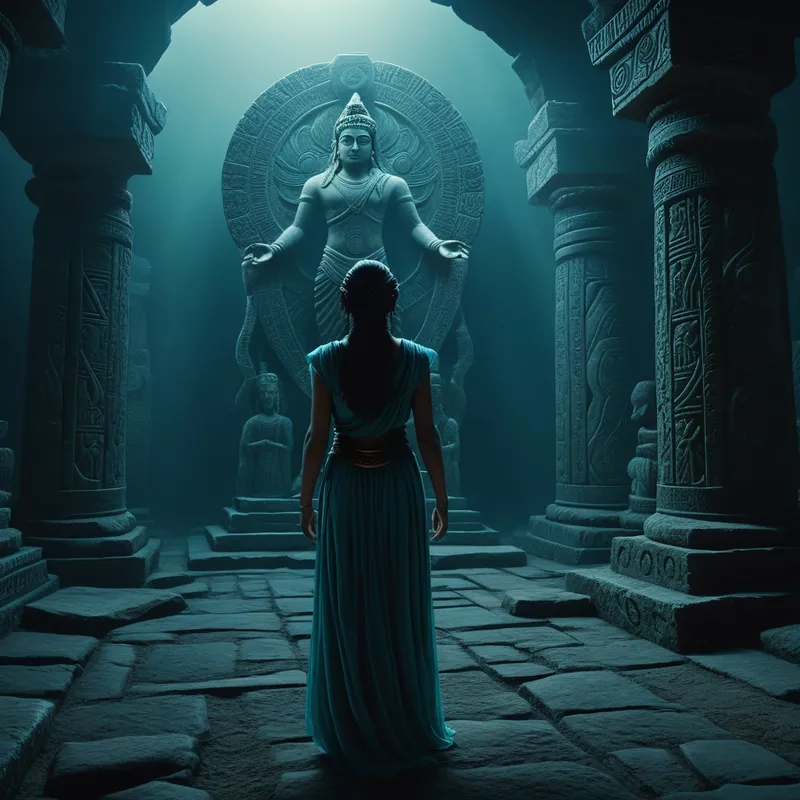
Cultural Origins & Context
This myth, known as the Enuma Elish (“When on High”), is not merely a story of beginnings. It is a political and theological document of profound significance, composed likely during the Second Babylonian Dynasty (c. 1894–1595 BCE) and elevated to a central national epic during the reign of Hammurabi (c. 1792–1750 BCE). Its primary function was to legitimize the rise of the city-god Marduk, and by extension, the city of Babylon itself, to supremacy over the older Mesopotamian pantheon.
In the narrative, Marduk’s ascent mirrors Babylon’s own historical ascent from a minor city to the capital of an empire. The transfer of kingship and the Tablets of Destiny from the defeated older generation (represented by Tiamat and Kingu) to Marduk is a divine ratification of Babylonian political hegemony. The myth was recited annually during the Akitu (New Year) festival, a ritual that re-enacted the battle, reaffirmed the king’s mandate (as Marduk’s earthly regent), and cosmically regenerated the ordered world against the ever-present threat of chaos. It served as the foundational “charter myth” for Babylonian society, justifying its hierarchical structure, from the king and priesthood down to the laboring humans created to sustain the divine order.
Symbolic Architecture
The battle is the archetypal drama of differentiation. Tiamat represents the undifferentiated, potential-filled, but also terrifying Ungrund—the state of being where all opposites are merged, a nurturing yet devouring womb-tomb. Marduk represents the erupting principle of consciousness, the Logos that must name, separate, and structure to bring a knowable world into being.
The violence of creation is not gratuitous; it is the necessary trauma of emergence. Order is not found, it is carved.
Tiamat’s monsters symbolize the psychic terrors that arise when the unconscious is violently agitated—formless anxieties, archaic impulses, and paralyzing fears that must be faced and organized by the emerging ego-consciousness (Marduk). The Tablets of Fate represent the laws of causality and destiny that only a sovereign consciousness can administer. Marduk’s act of world-building from Tiamat’s body is the ultimate act of psychic integration: the raw material of the unconscious (the body of the Mother) is not discarded but is transformed into the very architecture of the conscious world. The cosmos is not built against chaos, but from it.
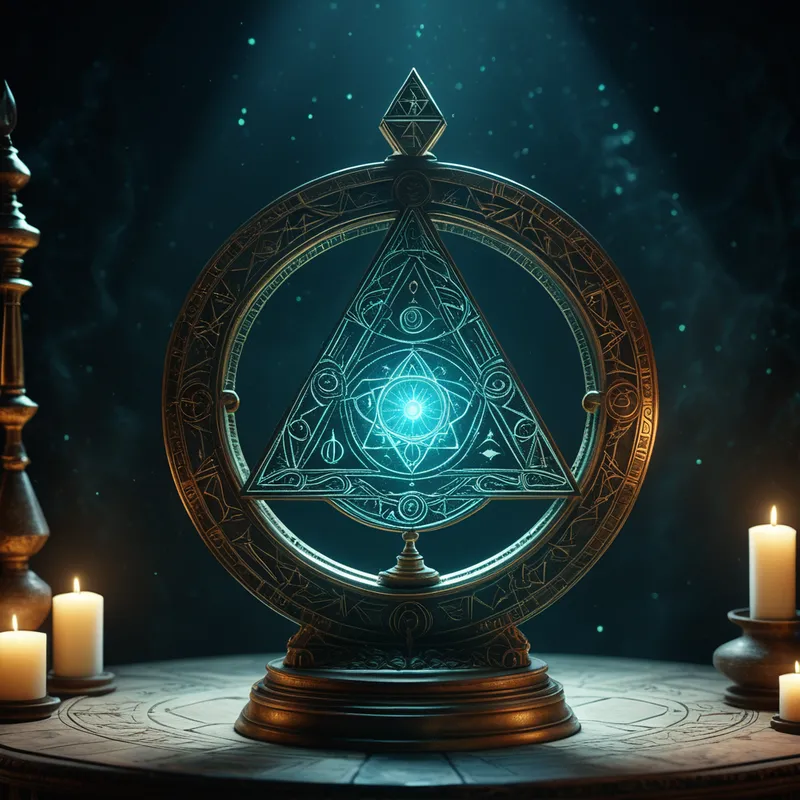
The Dreamer's Resonance
For the individual psyche, the myth of Marduk and Tiamat resonates in the lifelong struggle to forge a coherent self from the inner chaos of instinct, emotion, and archetypal force. The “younger gods” are like nascent aspects of the personality that disturb the primal, unconscious stillness. The ensuing inner conflict can feel like a civil war, with monstrous self-doubts and chaotic passions (Tiamat’s brood) threatening to overwhelm.
The dreamer encountering this myth may be at a critical threshold where an old, undifferentiated state of being (a relationship, a career, a self-image) must be consciously “slain” and restructured to allow for a new, more complex order to emerge. It speaks to the necessity of a central, organizing principle—a “Marduk consciousness”—that can face the terrifying, creative-destructive power of the deep psyche (Tiamat) and harness it for building a life of meaning and structure. The guilt of this “parricide” against the primal mother/chaos is assuaged by the sacredness of the resulting creation: one’s own world is built from the substance of what was overcome.
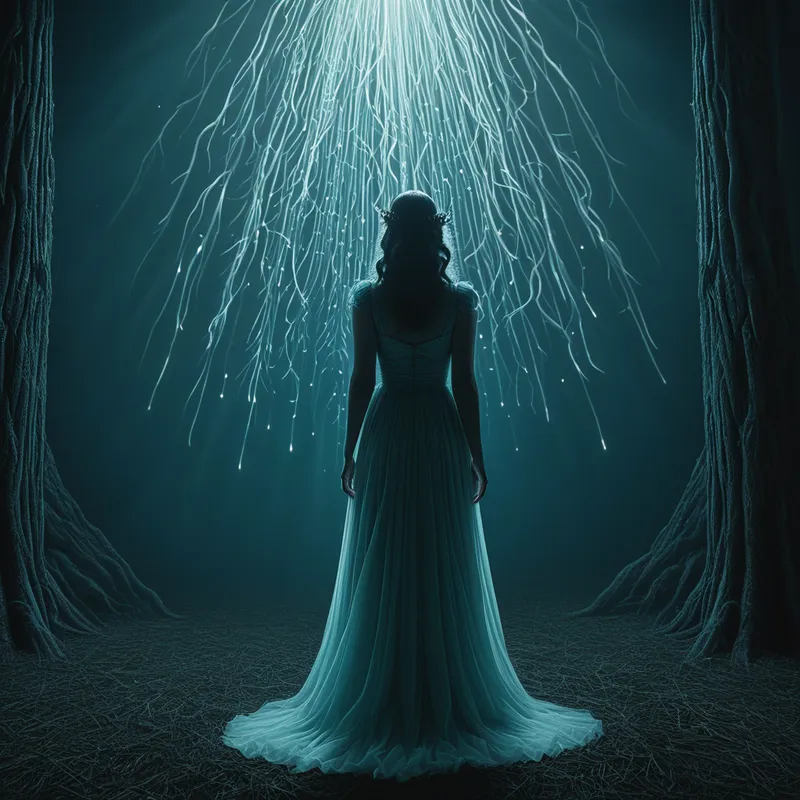
Alchemical Translation
In alchemical terms, the Enuma Elish narrates the entire Opus Magnum. The prima materia is the Mare Tenebrosum, the Dark Sea—Tiamat herself, the chaotic, salty waters. The stirring of the gods is the initial agitation, the nigredo that blackens and leads to the putrefaction of the old, undifferentiated state.
The battle is the separatio and mortificatio: the violent dissolution of the unified chaos into distinct principles (heaven/earth, above/below). Marduk’s weapons—wind, net, arrow—are the alchemical agents of separation.
Marduk’s reign and world-building are the stages of albedo (whitening) and rubedo (reddening), resulting in the lapis philosophorum, the Philosopher’s Stone. This Stone is the ordered, enduring cosmos itself—and by extension, the integrated, perfected self. Babylon, the “Gate of the God,” is the vas or sealed vessel where the transformation is completed and stabilized. Humanity, created from the blood of a rebel god (Kingu) and earth, represents the homunculus, the conscious entity born from the union of spirit (divine blood/fate) and matter (clay/body), tasked with tending the sacred garden of the achieved work.
Associated Symbols
Explore related symbols from the CaleaDream lexicon:
- Dragon — The primordial, chaotic force of unformed potential and instinctual terror, often guarding a treasure or representing the ultimate adversary to be integrated.
- Chaos — The formless, boundless state preceding creation, containing all possibilities but also the terror of the unknown and the undifferentiated.
- Order — The principle of structure, law, and differentiation imposed upon chaos to create a habitable, knowable world of distinct forms and hierarchies.
- Hero — The conscious agency that ventures into the unknown or confronts a monstrous status quo to secure a boon, establish new order, or redeem a community.
- Water — The primordial element of the unconscious, life-giving yet formless, symbolizing the source of all things and the medium of potential before differentiation.
- Mountain — The stable, axial center of the world established after the defeat of chaos; a symbol of enduring order, revelation, and the meeting place of heaven and earth.
- Thunder — The terrifying, disruptive voice of the storm god, representing the shattering power of divine will that breaks apart stagnant forms and announces a new regime.
- Temple — The built sanctuary at the center of the ordered world, a microcosm of the cosmos and the dwelling place of the sovereign principle that maintains cosmic law.
- Sacrifice — The necessary killing of the old, undifferentiated state (the primal being) as the foundational act from which the new world is constructed and sustained.
- Creation — The act of bringing forth distinct, enduring forms from a state of formlessness, often involving a violent separation and the organization of primordial substance.
- Border — The critical threshold between chaos and order, the line drawn by the hero’s act that defines the inside of the known world from the outside wilderness of the unformed.