Mara's Temptation Myth Meaning & Symbolism
The story of the Buddha's final trial, facing the demon Mara's army of desire and fear to achieve ultimate awakening under the Bodhi tree.
The Tale of Mara's Temptation
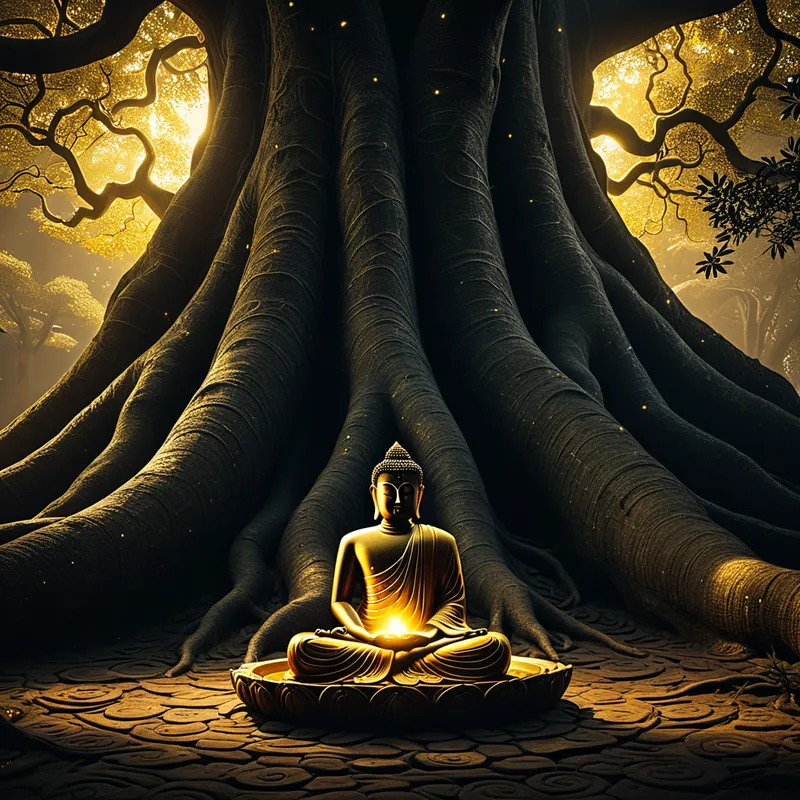
Beneath the spreading branches of the Bodhi tree, a man sat. His name was Siddhartha Gautama, and his bones knew the weight of six years of hunger, his mind the sharp edge of relentless inquiry. The air in Bodh Gaya was still, heavy with the promise of a final truth. He had vowed not to rise until he saw the ultimate nature of reality, the end of suffering.
But in the realms of power and illusion, a tremor was felt. Mara</ab title="The personification of death, desire, and obstruction in Buddhist cosmology">Mara, the Lord of the Realm of Desire, the great tempter and obstructer, felt the foundations of his kingdom shake. A mortal was poised to escape his domain entirely, to become a Buddha. This could not be allowed.
First, Mara sent his army. Not of soldiers clad in iron, but a legion of nightmares given form. They swarmed from the shadows—monstrous beings with fangs and claws, hurling mountains of fire and torrents of boiling blood. They shrieked with the voices of a thousand fears. Yet, as the projectiles neared the seated figure, they transformed into flower petals, falling harmlessly at his feet. Siddhartha’s heart was a still lake; the stones of hatred could not ripple its surface.
Enraged, Mara advanced himself, mounted on his great war elephant, Girimekhala. He loomed, vast and terrible, his voice a rolling thunder. “Arise from that seat! It belongs to me! Who will bear witness to your right to sit here?”
Siddhartha, unmoving, reached down with his right hand to touch the earth. “This solid earth,” he said, his voice quiet yet piercing the din, “is my witness. It has supported me through countless lifetimes of generosity and virtue.”
At his touch, the earth itself roared in affirmation. The goddess Sthavara emerged, wringing from her hair a torrent of water—the flood of Siddhartha’s accumulated merit—that swept Mara’s phantom army away.
Defeated in force, Mara shifted to subtlety. He sent his three daughters—Tanha (Craving), Arati (Discontent), and Raga (Lust). They transformed into visions of unparalleled beauty, dancing with grace that could stir the dead. They whispered promises of sensual bliss, of power, of a glorious worldly reign. They appealed to the last vestiges of the prince he had been. Siddhartha gazed upon them, and with the eye of perfect insight, saw not beauty but the process of decay, the impermanence of form, the prison of attachment. Their allure withered to dust before his understanding.
As dawn approached, Mara retreated, vanquished. The cosmos held its breath. And in that profound silence, free from all obstruction, Siddhartha Gautama pierced the veil of ignorance. He saw the endless cycle of samsara, the cause of suffering, and the path to its cessation. He awoke. He was the Buddha.
Cultural Origins & Context
The story of Mara’s temptation is not a peripheral fable but the central, defining drama of the Buddha’s awakening, recorded in the earliest strata of Buddhist literature, such as the Sutta Pitaka. It functioned as the mythological cornerstone for the historical event of enlightenment. Passed down orally by monastic communities for centuries before being committed to text, it was a tale told to inspire and instruct.
Its societal function was multifaceted. For monks and nuns, it was a map of the final, most intense stage of meditation, a warning and a guide about the nature of internal obstacles. For lay followers, it dramatized the superhuman accomplishment of the Buddha, validating his authority as a teacher who had truly conquered the world’s deepest pulls. The myth served to externalize and personify the internal battle every practitioner faces, making the path to Nirvana a heroic, archetypal journey with a clear antagonist and a triumphant, compassionate victor.
Symbolic Architecture
Mara is not a devil in a Western sense, but a profound psychological symbol. He is the totality of the conditioned mind, the psychic inertia that clings to existence as we know it. His name means “death,” but also “killing” that which leads to liberation. He is the embodiment of distraction, doubt, and desire—the three primary poisons that bind beings to suffering.
Mara is the personified resistance of the psyche to its own annihilation and rebirth. He is the guardian of the threshold who must be faced to leave the known world.
His army represents the chaotic, fearful, and aggressive energies of the untamed mind. The daughters are the seductive, seemingly positive attachments—to pleasure, to identity, to comfort—that are far harder to renounce than obvious fear. The Bhumisparsha Mudra, the earth-touching gesture, is the ultimate symbol of grounding in reality and truth. It signifies the move from abstraction to embodied witness, from seeking external validation to relying on the unshakable ground of one’s own authentic experience and accumulated integrity.

The Dreamer's Resonance
When this myth pattern arises in modern dreams, the dreamer is often at a critical juncture of personal awakening or integration. The “Mara” figure may not be a demon king, but a looming deadline that paralyzes, a seductive but hollow relationship, a wave of crushing anxiety, or the haunting voice of self-doubt that says, “You are not worthy of this change.”
Somatically, this can feel like a tightening in the chest, a weight of exhaustion, or a frantic, scattered energy—the “army” attacking the nervous system. Psychologically, it is the process of the ego’s last stand. The conscious self has committed to a deeper truth (the “Bodhi tree” vow), and the unconscious shadow, the repository of all our repressed fears and unintegrated desires, mobilizes to defend the status quo. Dreaming of being besieged yet remaining calm, or of touching something solid and real amidst chaos, directly mirrors the Buddha’s ordeal. It signals the psyche’s attempt to navigate a profound internal resistance to its own evolution.

Alchemical Translation
The alchemy modeled here is the transmutation of identification into witnessing. The practitioner does not fight Mara in the sense of destroying him; to fight is to still be engaged in his drama. Instead, the Buddha recognizes him. He sees the army as empty phenomena, the daughters as transient forms. This is the alchemical separatio—dis-identifying from the content of the mind.
Enlightenment is not the destruction of temptation, but the dissolution of the one who could be tempted.
The earth-touch is the coniunctio, the sacred marriage with reality as it is. By grounding in witness-consciousness, the scattered psychic elements (the army) lose their power and are re-integrated not as rulers, but as seen, acknowledged phenomena. The “I” that was tempted, afraid, or desirous is deconstructed. What remains is not a victorious ego-hero, but a field of awareness—empty, luminous, and compassionate. For the modern individual, this translates to the moment we stop battling a thought or feeling and simply, fully acknowledge its presence without becoming its agent. In that pause, in that touch of the “earth” of our present-moment experience, the siege ends, and a deeper, more authentic self is born—not from victory, but from profound and unshakable intimacy with what is.
Associated Symbols
Explore related symbols from the CaleaDream lexicon: