Mara's Illusions Myth Meaning & Symbolism
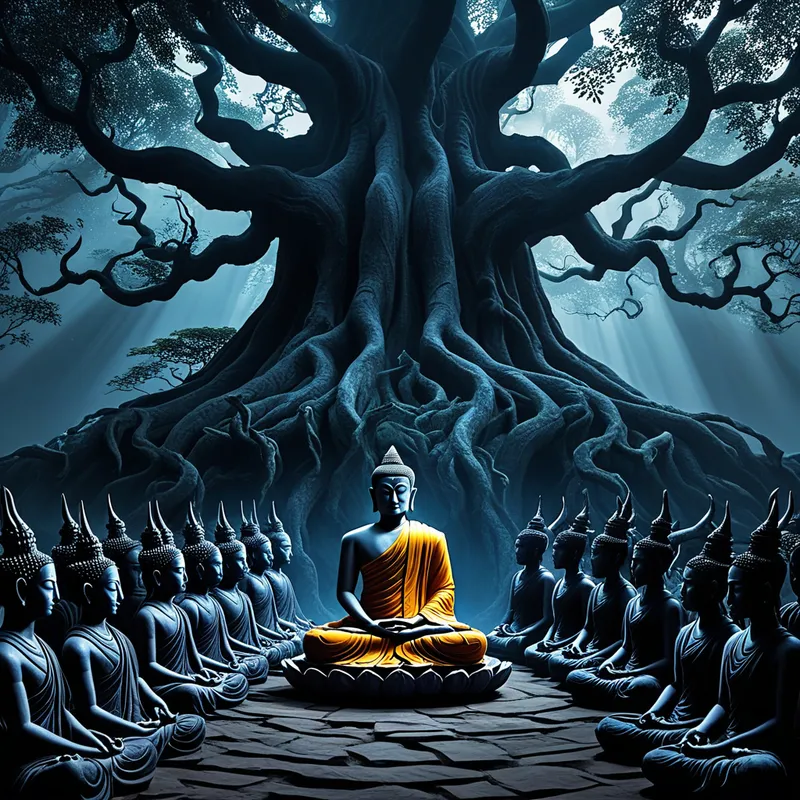
The story of Siddhartha Gautama's final trial beneath the Bodhi tree, where he faced the demon Mara's army of desire, fear, and doubt to achieve awakening.
The Tale of Mara's Illusions
The air beneath the Bodhi tree was thick, not with humidity, but with potential. Siddhartha Gautama sat upon the adamantine seat of grass, his breath a slow tide against the shore of his ribs. He had journeyed to the very edge of human understanding, past the forests of asceticism and the deserts of philosophy. Now, at the cusp of a truth that would shatter the world’s sorrow, the cosmos held its breath.
And the Tempter felt it. Mara, the Lord of the Realm of Desire, the architect of illusion, stirred from his throne. A crack had appeared in the great wheel of suffering, of birth and death over which he presided. A mortal was about to slip the knot. This could not be.
First, he sent his daughters—Tanha, Arati, and Raga. They emerged from the twilight not as monsters, but as visions of perfected beauty, their forms shifting to embody every secret longing, every whispered “if only.” They danced with the grace of celestial nymphs, their voices a symphony of promise. “Great sage,” they cooed, “why this harsh solitude? The world holds pleasures you have never imagined. Rule with us. Love with us. Live with us.” Siddhartha did not open his eyes. He saw the skeleton beneath the silken skin, the chain within the offered garland. His mind, like a deep mountain lake, remained unrippled. The daughters faded, wailing in frustration.
Then came the army. The ground trembled as Mara’s legions assembled—a horrific panorama of the mind’s own making. There were warriors with faces of rage and weapons of sharpened doubt. Beasts with the maws of gnawing anxiety and the claws of paralyzing fear. A cacophony of voices shrieked accusations: “You are selfish! You have abandoned your family! Your quest is vanity!” Arrows of terror, spears of despair, and boulders of crushing inadequacy were hurled toward the motionless figure.
Siddhartha remained. He touched the earth.
It was not a gesture of defeat, but of witness. He called the very ground to testify to his countless lifetimes of virtue, his right to be there. And the earth answered. The goddess Thorani emerged, her hair a torrent of dark water. She wrung her long tresses, and a great flood issued forth—not of water, but of the accumulated purity of Siddhartha’s compassion. It surged across the plain, not drowning the demons, but dissolving them. The terrifying armies melted like salt sculptures in a tide, their roars turning to whimpers, then to silence.
Defeated, Mara himself confronted the sage. “Who bears witness to your right to claim this seat of enlightenment?” he demanded, his voice the sound of a world clinging to its pain.
Siddhartha’s voice was quiet, yet it filled the universe. “This earth, impartial and enduring, is my witness.”
With those words, the last illusion shattered. As dawn’s first light touched the tips of the Bodhi tree leaves, Siddhartha Gautama vanished, and the Buddha was born. Mara, the great deceiver, bowed his head and disappeared. The victory was not over an external devil, but over the final, most intimate attachment: the belief in a separate, besieged self.

Cultural Origins & Context
The story of Mara’s assault is not a later embellishment but is woven into the earliest strata of Buddhist textual tradition, found in the Pali Canon in sources like the Padhana Sutta. It functioned as the foundational drama of the Buddha’s biography, the necessary final ordeal that transformed the seeker Siddhartha into the teacher Buddha. Passed down orally by monks for centuries before being committed to text, it was a teaching story par excellence.
Its societal function was multifaceted. For monastic communities, it served as a powerful map of the meditative path, naming and personifying the very internal hindrances—sense desire, ill-will, sloth, restlessness, and doubt—that practitioners would inevitably confront. For lay followers, it provided a compelling, narrative encapsulation of the Buddha’s supreme achievement, making the abstract concept of “enlightenment” tangible as a heroic victory. The tale established a critical Buddhist paradigm: the real battle is never against the world, but against the mind’s own projections and clingings, personified by the master projector, Mara.
Symbolic Architecture
Mara is not a literal demon waiting in a dark realm. He is the psychological principle of fragmentation, the architect of the ego’s fortress.
Mara is the voice that whispers, “You are only this body, these memories, these fears.” The Buddha’s awakening is the thunderous silence that replies, “I am that which knows the body, witnesses the memories, and can release the fears.”
His army represents the totality of conditioned existence. The seductive daughters are the allure of tanha—the craving for pleasure, for existence, and for non-existence. The monstrous troops are the inevitable flip side: the aversion, fear, and self-loathing that arise when craving is thwarted. Mara’s final question—“Who is your witness?”—is the ultimate gambit of the separate self, demanding credential and authority from within the very system of illusion.
The Bodhi tree symbolizes the axis of awakening, the still point where the turning world of samsara can be seen and transcended. The earth-witness gesture is profoundly alchemical. By touching the ground, the Buddha does not call upon an external power, but roots himself in ultimate reality, in suchness (tathata). He aligns with the impartial, non-judgmental ground of being, which is untouched by the dramas played out upon its surface. Thorani’s flood is the sudden, irrefutable upwelling of integrated wholeness, which dissolves the fractured projections of the psyche not by fighting them, but by revealing their insubstantiality.
The Dreamer's Resonance
When this myth stirs in the modern unconscious, it rarely appears as a literal Buddha under a tree. It manifests as the dream of final confrontation. You may dream of being in your own home as it is besieged by shadowy intruders—a somatic metaphor for the psyche feeling invaded by anxiety or unresolved trauma. You may dream of being offered a glorious but hollow crown, or of a loved one’s face morphing to deliver a devastating critique. These are the dream-forms of Mara’s daughters and army.
The somatic experience is often one of paralysis within the dream—a direct echo of the seated, unmoving Buddha. This is not helplessness, but the profound, often terrifying, process of sitting with rather than running from the contents of the shadow. The dream-ego is learning the posture of the witness. The moment of “touching the earth” in a dream might be a sudden, grounding memory of a real place of safety, or an inexplicable feeling of deep, solid calm rising amidst the chaos. This signals the dreamer’s nascent connection to an inner authority deeper than the ego’s reactions, the beginning of the end of the illusion of being solely the content of one’s mind.

Alchemical Translation
The journey from Siddhartha to Buddha is the ultimate model of individuation—not as the inflation of the ego, but as its graceful dissolution into the Self. For the modern individual, Mara’s illusions are the sum total of our identifications: I am my job, my trauma, my desires, my anxieties.
The alchemical fire is not willpower against temptation, but unwavering attention. In that heat, the lead of identification transmutes into the gold of awareness.
The first step is to recognize the projection. When we are seized by craving (a daughter’s whisper) or flooded by fear (a demon’s roar), the practice is to name it: “This is Mara.” This personification creates a critical space between the experiencer and the experience. We are not the fear; we are the one aware of the fear.
The second is the earth-witness gesture. This translates to rooting consciousness in the body and the present moment, beyond narrative. When the mind screams its stories of lack or threat, we feel the breath, the weight on the seat, the solidity of the ground. We call upon the “earth” of direct, sensory experience as our witness against the airy accusations of the thought-made demon.
The final transmutation is dissolution through compassion. Thorani’s flood is the power of a heart that has understood its own suffering and thus can no longer be an enemy to itself. As we meet our own inner demons not with hatred but with a curious, compassionate awareness, their solidity melts. The energy once bound in maintaining the illusion of a separate, besieged self is released, becoming the very light of awakening. We discover that Mara, the great obstructor, was, in the end, the final and most necessary teacher, for he showed us everything we had to let go of to be free.
Associated Symbols
Explore related symbols from the CaleaDream lexicon: