
Maple Sugar Moon Myth Meaning & Symbolism
A sacred time when the trees bled pure syrup, until a hero's intervention taught the people the value of work and the gift of transformation.
The Tale of Maple Sugar Moon
Listen, and let the cold, clear air of the North fill your lungs. Let the scent of thawing earth and sleeping pine carry you back to the First Days, when the world was new and the agreements were still being written between the People and all their Relations.
In that time, the great Nanabozho walked among the Anishinaabe. He saw his people shivering as the long winter’s grip began to loosen, their stores of food growing thin. He heard the hungry cries of the children. And then, he saw a miracle.
It was the time of the Iskigamizige-giizis, the Boiling Moon. But in those days, it was known by another, sweeter name. For the Manitou of the Maple Trees, a generous and gentle spirit, loved the People so deeply that she gave without measure. When Nanabozho came to a grove of ancient sugar maples, he found the people simply lying beneath the great branches with their mouths open. Thick, pure, wondrously sweet syrup flowed directly from the trees into their waiting vessels. No work was needed. The gift was as effortless as breathing.
The people were glutted on sweetness. They grew lazy and fat. They forgot to give thanks, to hunt, to tend their fires, or to tell the stories. The sacred reciprocity was broken; they only took. Nanabozho watched this, and a great sorrow filled his heart. He saw not abundance, but a slow spiritual death. The gift, given too freely, was becoming a curse.
He went to the river and gathered clean, cold water in a great birchbark basket. Under the watchful eye of the night sky, he returned to the maple grove. With a heavy spirit but a resolved hand, he poured the water into the roots of the greatest maple. He did this not in anger, but in love—a terrible, necessary love. He poured and poured, diluting the very essence of the tree’s gift.
The next morning, the people ran to the trees, expecting the rich flow. What dripped from the taps was thin, watery, barely sweet. They cried out in dismay and confusion. Nanabozho stood before them, not as a punisher, but as a teacher.
“The Spirit’s love is still here,” he said, his voice echoing through the silent grove. “But you have forgotten your part in the circle. Nothing truly sacred comes without attention, without effort, without the transforming fire of your own spirit.”
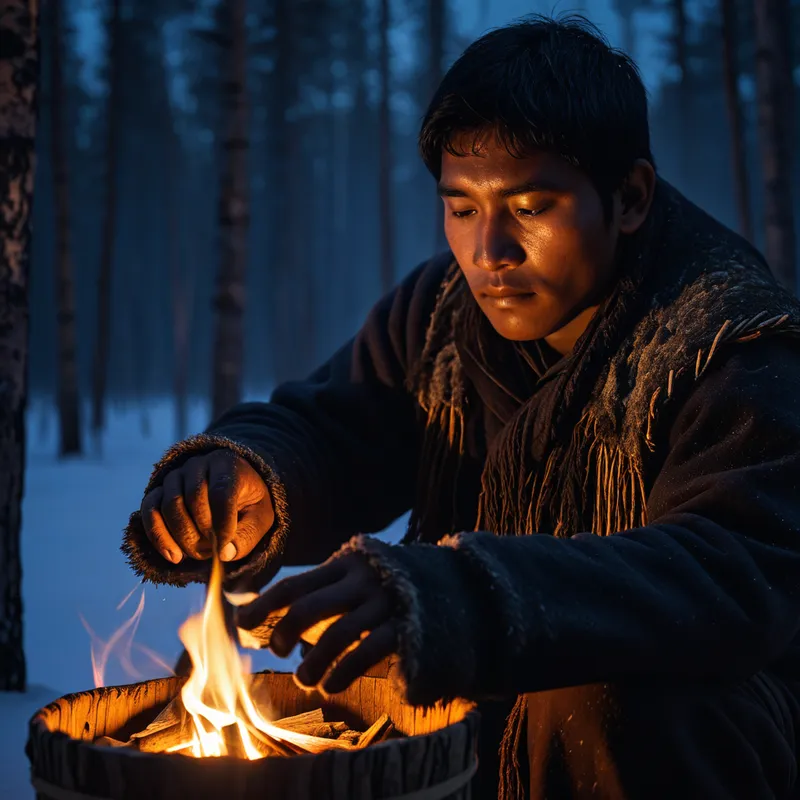
He then showed them. He taught them to tap the trees with respect, to collect the watery sap in birchbark containers. He showed them how to build a fire, how to suspend the containers over the flames, and how to tend the long, slow boil. For days and nights they worked, feeding the fire, watching the steam rise like prayers, stirring the liquid as it slowly, magically, thickened into glorious, amber syrup. The grove was filled with the smell of wood smoke and caramelizing sugar, with the sound of singing and shared labor.
When the first batch was ready, cooled and dark and sweet, the people tasted it. This sweetness was different. It carried the memory of the winter’s ice, the patience of the tree, the heat of their fire, and the diligence of their hands. It was a sweetness earned, and therefore infinitely more precious. The Maple Spirit had not abandoned them; she had, through Nanabozho’s intervention, offered a deeper gift: the gift of participation in creation itself.
Cultural Origins & Context
The story of the Maple Sugar Moon is a foundational aadizookaan of the Anishinaabe peoples (Ojibwe, Odawa, Potawatomi, and others). It is intrinsically tied to the seasonal round and subsistence cycle, specifically to the late winter/early spring period of Aninaatig ozawa. This was not merely an economic activity but a profound ceremonial time, often the first major communal gathering after the deep isolation of winter.
Elders and knowledge keepers would recount this myth during the sugaring season, transforming the laborious work of boiling sap into a ritual re-enactment of the sacred story. The telling served multiple societal functions: it encoded vital ecological knowledge (the timing of the sap run, the boiling process), reinforced core cultural values of gratitude, hard work, and reciprocity, and spiritually sanctioned the harvest, ensuring the continued goodwill of the Maple Spirit. The myth established a sacred contract, turning a technological process into a holy communion with the non-human world.
Symbolic Architecture
At its heart, this is not a myth about scarcity, but about the meaning of abundance. The Maple Spirit’s initial gift represents undifferentiated, unconscious bounty—a primal, maternal nourishment that requires no ego development. It is the sweetness of the womb, of effortless grace.
The first gift is nature’s grace; the second gift is the soul’s work. The alchemy happens in the space between them.
Nanabozho’s act of dilution is the critical intervention of consciousness. He is the archetypal Caregiver, but one who understands that true care sometimes means withholding immediate gratification to foster greater strength. He introduces the necessary obstacle. The watery sap symbolizes potential—a latent sweetness that requires human engagement to be realized. The fire, the long vigil, the collective labor: these are the archetypal elements of transformation. The syrup that results is no longer a raw product of nature; it is a co-creation of nature and culture, spirit and human effort. It symbolizes the individuated self—a unique essence distilled through the trials of life, patience, and applied consciousness.

The Dreamer's Resonance
When this myth pattern arises in modern dreams, it often signals a psyche at a crossroads of dependency and self-actualization. Dreaming of endless, effortless bounty (money flowing from a tap, food appearing without work) may indicate an unconscious longing for a return to passive, infantile nourishment—a resistance to the difficult work of psychological maturation.
Conversely, dreaming of laboring over a slow, steaming boil, of patiently tending a transforming substance, points to an active engagement with the individuation process. The somatic feeling is often one of weary dedication mixed with anticipation. The dreamer is in the middle of the myth, doing the hard work of condensing a diffuse life experience or a raw talent into a concentrated, valuable, and durable form of “sweetness”—be it wisdom, art, or a mature personality. The dream is an affirmation from the deep unconscious: You are in the process of earning your soul’s syrup.

Alchemical Translation
The alchemical journey mirrored in this myth is the solve et coagula—dissolve and coagulate. The Maple Spirit’s pure syrup represents a prima materia that is too fixed, too perfect in its raw state. Nanabozho, as the alchemist, first solves it—he dissolves its concentrated form back into a watery, chaotic potential (the sap).
This is the necessary deconstruction phase of psychic life, where old, rigid structures of entitlement or passive receiving must be broken down. Then begins the long, slow coagula: the boiling. This is the ego’s patient work over the fire of attention. Impurities (laziness, ingratitude, entitlement) are skimmed off as scum and burned away. What remains is subjected to consistent, gentle heat—the pressures of life, the demands of responsibility, the heat of focused intention.
The fire does not create the sweetness; it reveals it. The work does not create the soul; it distills it.
The final product, the maple sugar or syrup, is the lapis philosophorum of this particular operation. It is the psychological gold: a character that has integrated the gift of nature (one’s innate talents, the “sweetness” of life) with the discipline of culture (effort, patience, gratitude). The modern individual undergoing this alchemy moves from a state of expecting life to provide concentrated meaning, to accepting the watery, often tedious work of boiling down experiences—through reflection, therapy, creative effort, or spiritual practice—to discover the profound and earned sweetness of a life truly lived. The myth teaches that the most sacred things are not found, but made, in partnership with the world.
Associated Symbols
Explore related symbols from the CaleaDream lexicon: