Maple in Ogham Myth Meaning & Symbolism
A tale of a bard's sacrifice, his transformation into the first maple, and the birth of Ogham script from blood, memory, and the whispers of the land.
The Tale of Maple in Ogham
Listen, and let the fire’s crackle become [the wind](/myths/the-wind “Myth from Various culture.”/) in the leaves. In the time when [the world](/myths/the-world “Myth from Tarot culture.”/) was younger and [the veil](/myths/the-veil “Myth from Various culture.”/) between the seen and unseen was a mere breath, there lived a bard named Fionntán. His memory was the memory of the land itself; in his songs slept the names of every river, the lineage of every king, and the secret paths of the stars. Yet, a great forgetting began to creep over the people. They traded stories for possessions, and the old tongues grew thick with disuse. The [Sídhe](/myths/sdhe “Myth from Celtic / Irish culture.”/) watched from [the hollow hills](/myths/the-hollow-hills “Myth from Celtic culture.”/), their music growing faint to mortal ears.
Driven by a sorrow deeper than any personal grief, Fionntán sought the counsel of the Morrígan at a sacred well where three roads met. She appeared not as a phantom of battle, but as a woman of [the earth](/myths/the-earth “Myth from Hindu culture.”/), her cloak the colour of dried blood and fresh moss. “The memory of the world is slipping into the mud,” Fionntán lamented. “How can I hold it when my own breath is but a mist on the glass?”
[The Morrígan](/myths/the-morrgan “Myth from Celtic culture.”/)’s voice was the sound of stones grinding beneath a river. “To keep a [thing](/myths/thing “Myth from Norse culture.”/), you must become it. To give a voice to the silent, you must join your breath to theirs. The answer grows on the hill where the north wind sleeps.” She gave him a knife of black stone, cold as a winter stream.
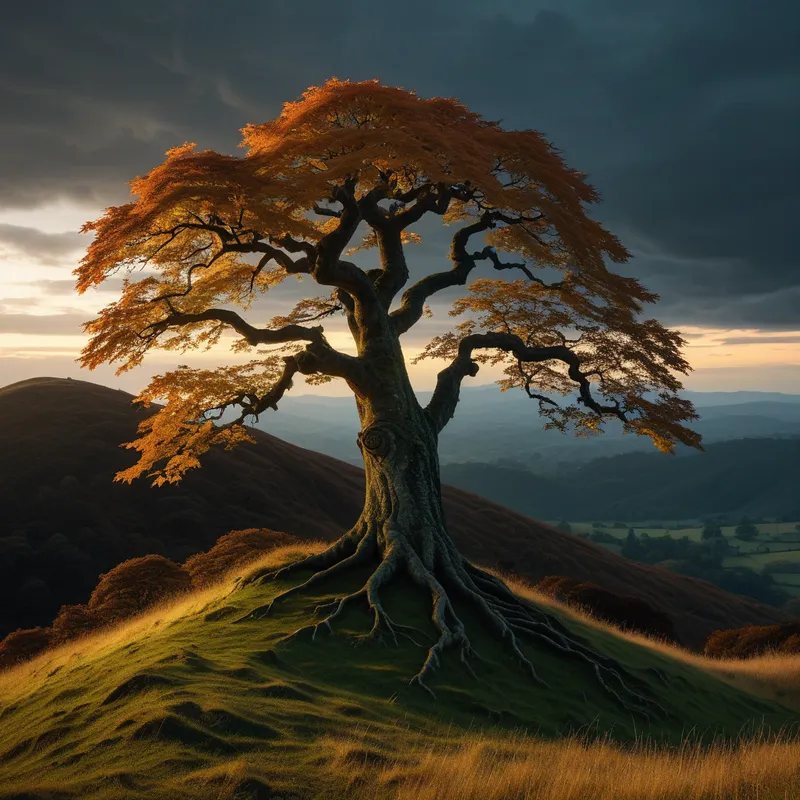
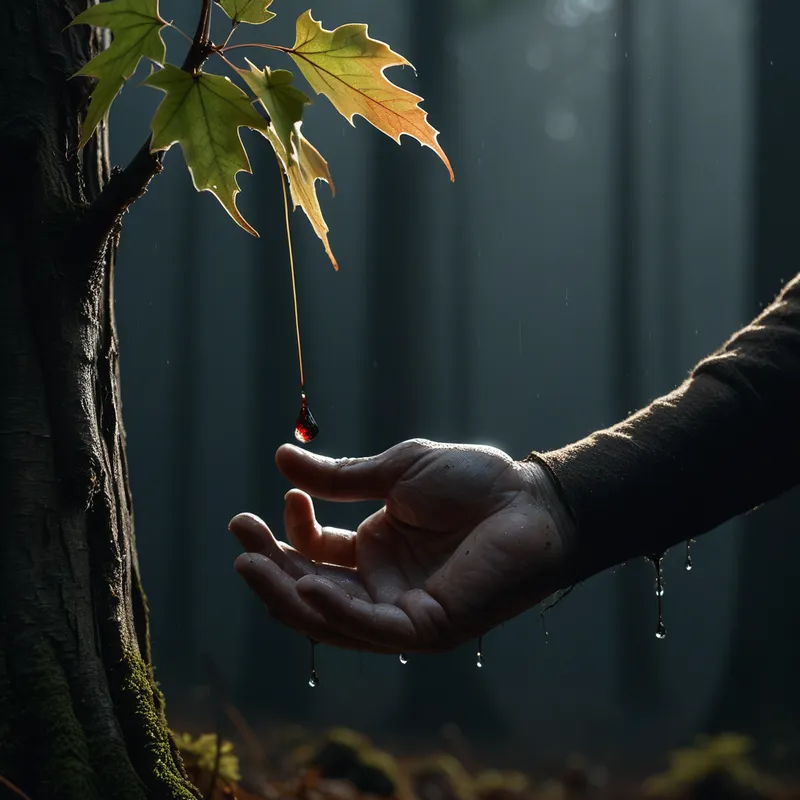
Fionntán climbed the lonely hill. At its crown stood a young maple, its leaves a vibrant, singing green. He understood. Placing his palm against the smooth bark, he felt the hum of the land’s deep memory—the first sunrise, the first rain, the first footfall. With the stone knife, he made a cut upon his own palm, and then a matching cut upon the tree’s pale flesh. He pressed their wounds together.
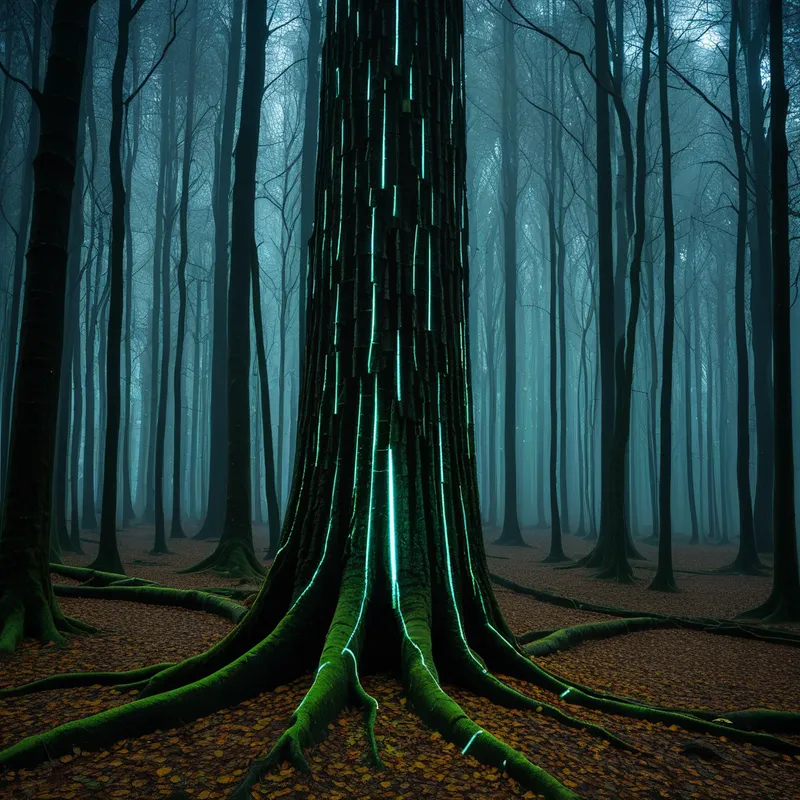
The world dissolved into sensation. His feet tore through his boots, driving deep as roots, drinking from dark, mineral-rich streams. His skin hardened and stretched into bark, feeling the scrape of lichen and the tickle of insects. His blood did not drip to the ground; it flowed into the tree, up through the sapwood, a river of memory and song. His final human breath sighed out through a thousand leaves, and in that exhalation, the bark where their wounds met began to change. Lines appeared, not carved, but grown: straight scores and angled notches, the first [Ogham script](/myths/ogham-script “Myth from Celtic culture.”/). Each letter was a story, a law, a name, solidified from his sacrificed life and the tree’s enduring spirit. The wind through his new branches no longer just whispered; it spoke in the old tongue, and the script upon his bark glowed with a soft, enduring light.
Cultural Origins & Context
The story of Maple in [Ogham](/myths/ogham “Myth from Celtic culture.”/) is a myth of origin for [the Ogham alphabet](/myths/the-ogham-alphabet “Myth from Celtic culture.”/) itself, emerging from the later Druidic tradition of Ireland and parts of Britain. It is a Dindshenchas tale—a lore of place—explaining not just a hill or a tree, but the very system of written knowledge. Unlike the classical myths preserved in texts like the Lebor Gabála Érenn, this narrative feels closer to the bardic schools, where knowledge was considered a living, somatic force.
It was likely told not as a simple fable, but as a rosc, a cryptic, rhythmic poem used for teaching and initiation. Its societal function was profound: it sacralized the act of writing and memory-keeping. It taught that true knowledge requires exchange and sacrifice, that the scholar’s duty is one of self-offering to the continuity of culture. [The bard](/myths/the-bard “Myth from Celtic culture.”/) does not merely observe or record; he merges with the object of his study, becoming a bridge between the human community and the animate, intelligent world.
Symbolic Architecture
At its core, the myth is an [alchemy](/symbols/alchemy “Symbol: A transformative process of purification and creation, often symbolizing personal or spiritual evolution through difficult stages.”/) of [consciousness](/symbols/consciousness “Symbol: Consciousness represents the state of awareness and perception, encompassing thoughts, feelings, and experiences.”/). The [maple tree](/symbols/maple-tree “Symbol: The Maple Tree symbolizes nourishment, endurance, and the beauty of transformation, representing the cyclical nature of life and the importance of roots.”/) is not a passive [symbol](/symbols/symbol “Symbol: A symbol can represent an idea, concept, or belief, serving as a powerful tool for communication and understanding.”/) of [nature](/symbols/nature “Symbol: Nature symbolizes growth, connectivity, and the primal forces of existence.”/); it is the cosmic pillar in [microcosm](/symbols/microcosm “Symbol: A small, self-contained system that mirrors or represents a larger, more complex whole, often reflecting the universe within an individual.”/), its roots in the [underworld](/symbols/underworld “Symbol: A symbolic journey into the unconscious, representing exploration of hidden aspects of self, transformation, or confronting repressed material.”/) of ancestral [memory](/symbols/memory “Symbol: Memory symbolizes the past, lessons learned, and the narratives we construct about our identities.”/), its [trunk](/symbols/trunk “Symbol: The trunk in dreams typically denotes the core structure or foundation of one’s identity, values, or beliefs.”/) in the mortal [realm](/symbols/realm “Symbol: The symbol of ‘Realm’ often signifies the boundaries of one’s consciousness, experiences, or emotional states, suggesting aspects of reality that are either explored or ignored.”/), and its leaves touching the heavens of inspiration. Fionntán’s sacrifice is the ultimate act of the [Creator](/symbols/creator “Symbol: A figure representing ultimate origin, divine power, or profound authorship. Often embodies the source of existence, innovation, or personal destiny.”/) [archetype](/symbols/archetype “Symbol: A universal, primordial pattern or prototype in the collective unconscious that shapes human experience, behavior, and creative expression.”/)—giving one’s own substance to forge a [vessel](/symbols/vessel “Symbol: A container or structure that holds, transports, or protects something essential, representing the self, emotions, or life journey.”/) for eternal meaning.
The script is not inscribed upon the tree, but born from the marriage of blood and sap. It is memory made manifest, a nervous system for the soul of a people.
Psychologically, Fionntán represents the conscious ego that realizes its own limitations. His [crisis](/symbols/crisis “Symbol: A crisis symbolizes turmoil, urgent challenges, and the need for immediate resolution or change.”/) is the fear of cultural and personal [dissolution](/symbols/dissolution “Symbol: The process of breaking down, dispersing, or losing form, often representing transformation, release, or the end of a state of being.”/)—the “great forgetting.” The Morrígan here acts not as a war [goddess](/symbols/goddess “Symbol: The goddess symbolizes feminine power, divinity, and the nurturing aspects of life, embodying creation and wisdom.”/), but as the personification of the transformative, often ruthless, imperative of [the Self](/myths/the-self “Myth from Jungian culture.”/)—the total psychic entity that demands wholeness. Her gift of the [stone](/symbols/stone “Symbol: In dreams, a stone often symbolizes strength, stability, and permanence, but it may also represent emotional burdens or obstacles that need to be acknowledged and processed.”/) knife is the gift of necessary wounding, the cut that makes [connection](/symbols/connection “Symbol: Connection symbolizes relationships, communication, and bonds among individuals.”/) possible. The resulting Ogham is the symbolic [life](/symbols/life “Symbol: The symbol of ‘Life’ represents a journey of growth, interconnectedness, and existential meaning, encompassing both the joys and challenges that define human experience.”/), the structured, communicable form that emerges when personal [identity](/symbols/identity “Symbol: Identity represents the sense of self, encompassing personal beliefs, cultural background, and social roles.”/) (the [bard](/symbols/bard “Symbol: Bards represent the power of storytelling, music, and the transmission of culture and history.”/)’s [life](/symbols/life “Symbol: The symbol of ‘Life’ represents a journey of growth, interconnectedness, and existential meaning, encompassing both the joys and challenges that define human experience.”/)) is willingly offered up to a transpersonal, enduring [pattern](/symbols/pattern “Symbol: A ‘Pattern’ in dreams often signifies the underlying structure of experiences and thoughts, representing both order and the repetitiveness of life’s situations.”/) (the [tree](/symbols/tree “Symbol: In dreams, the tree often symbolizes growth, stability, and the interconnectedness of life.”/), the [language](/symbols/language “Symbol: Language symbolizes communication, understanding, and the complexities of expressing thoughts and emotions.”/)).
The Dreamer’s Resonance
When this myth stirs in the modern unconscious, it often manifests in dreams of profound integration or terrifying dissolution. To dream of becoming a tree, especially feeling roots grow from one’s body, speaks to a somatic process of grounding—a desperate, instinctual need to connect with something foundational and real amidst life’s abstractions. The sensation of bark forming over skin can mirror feelings of emotional callousing for protection, or the healthy development of a more resilient [persona](/myths/persona “Myth from Greek culture.”/).
Dreams featuring unintelligible writing on natural surfaces—words on leaves, symbols in wood grain—point directly to this mythic pattern. They signal that the dreamer’s deep, perhaps wordless, psychological or somatic experiences are seeking formulation. The [psyche](/myths/psyche “Myth from Greek culture.”/) is attempting to create its own “Ogham,” to encode personal truth into a communicable, structured form. There may be an accompanying feeling of sacrifice—the dreamer might be “bleeding” time, energy, or an old identity to feed this nascent growth. The conflict is between the fear of losing oneself (the bard’s death) and the profound urge to contribute to something that outlives [the ego](/myths/the-ego “Myth from Jungian culture.”/) (the eternal [tree of knowledge](/myths/tree-of-knowledge “Myth from Abrahamic culture.”/)).
Alchemical Translation
The journey of Fionntán is a precise map of the individuation process. The starting point is a conscious realization of a collective malady: the “great forgetting.” In modern terms, this is the feeling of meaninglessness, disconnection from tradition, nature, or inner truth. The seeker (the ego) then encounters the Morrígan—the daunting, often fearsome voice of the Self that presents the impossible, sacrificial solution.
The alchemical nigredo is not in the bard’s death, but in the willing wounding, the conscious choice to be opened. The albedo is the flowing of blood into sap, the mixing of human consciousness with the objective, instinctual pattern of life. The rubedo is the glowing script itself—the new, enduring creation born from the union.
For the individual, this translates to the moment when a personal passion, insight, or trauma is so deeply felt that one must offer their old self to it. The artist must “become” their art, the therapist must authentically engage with the client’s pain, the seeker must let their rational mind be rewired by a spiritual experience. The “Ogham” that results is the unique, structured expression of that union—a philosophy, a body of work, a healed and wiser personality, a new way of being in the world. The myth teaches that our deepest contributions are not merely made, but grown from the fertile ground of our own surrendered identities, and that true legacy is written in the language of the soul, etched not on stone, but in the very grain of our transformed being.
Associated Symbols
Explore related symbols from the CaleaDream lexicon: