Mansur al-Hallaj Myth Meaning & Symbolism
A mystic's ecstatic declaration of divine union leads to his execution, becoming a timeless myth of love, annihilation, and the soul's ultimate truth.
The Tale of Mansur al-Hallaj
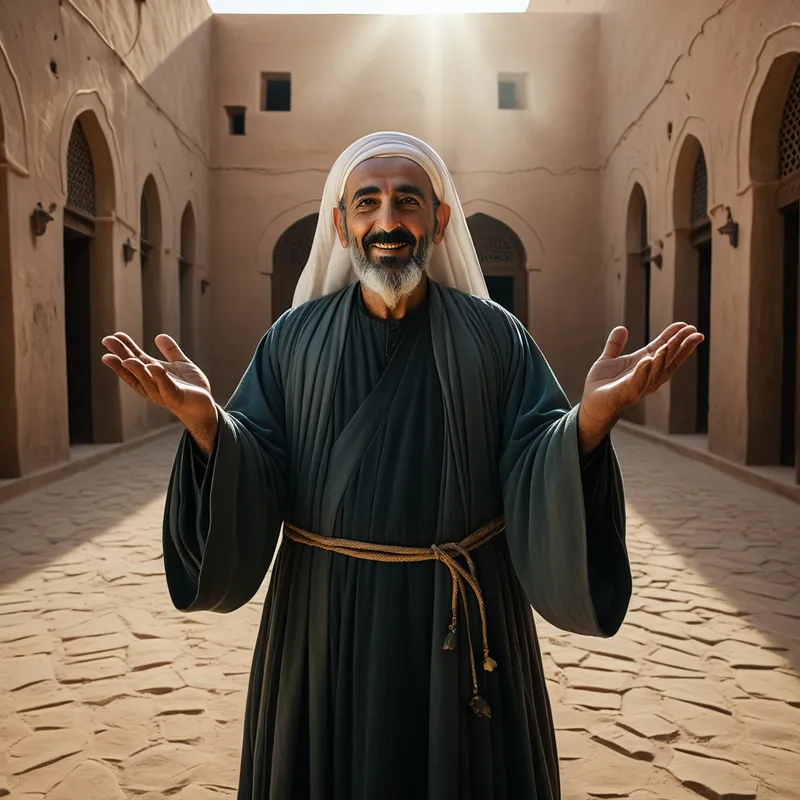
Listen. In the heart of Baghdad, when the Tigris ran thick with the silt of empires and the air hummed with the prayers of a thousand minarets, there walked a man who was a secret. His name was Mansur al-Hallaj. He was not a king, nor a warrior, but a lover—a lover drunk on a wine no vineyard could produce.
He wandered the markets and the mosques, his eyes holding a fire that both warmed and terrified. He spoke not of law, but of a union so intimate it dissolved the very boundary between the lover and the Beloved. He whispered of a Tariqa that led not around the mountain, but directly into its blazing core. The people gathered, some drawn by the scent of this strange honey, others repelled by its dangerous sweetness.
The conflict was not of swords, but of meanings. The guardians of order, the scholars and the powerful, heard a heresy in his ecstatic poetry. They saw a threat to the careful walls built to contain the divine. But Hallaj saw only the Beloved’s face in every face, heard only the Beloved’s name in every sound. The rising action was a slow, tightening cord. Whispers became accusations. His teachings, once shared in intimate circles, were now proclaimed in public squares, a scandal of the heart.
Then came the moment that shattered the world of separation. In a state of Fana, consumed utterly, he uttered the words that would echo through eternity: “Ana al-Haqq!” — “I am the Truth.” To the ears of power, it was the ultimate blasphemy, a man claiming the name of God. To the ears of love, it was the ultimate confession, a drop realizing it is the ocean.
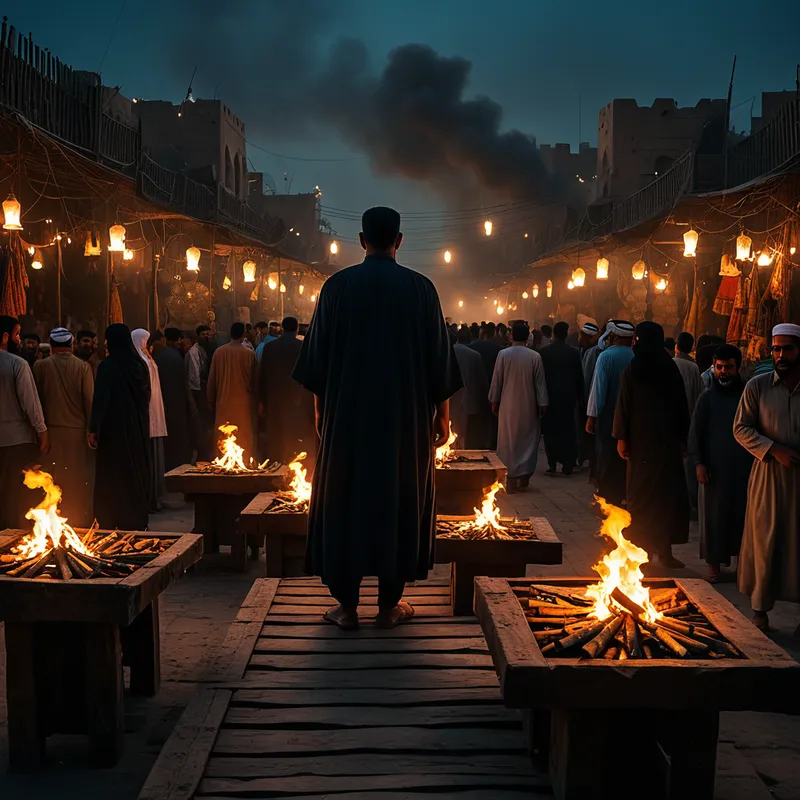
The resolution was written in fire and blood. He was arrested, imprisoned for years in a dark pit, subjected to the scrutiny of tribunals. Yet, in his cell, he was freer than his jailers. Finally, they led him to the place of execution. They scourged him, cut off his hands and feet. They raised him upon a gibbet. And as the crowd roared, he did not cry out in pain, but in gratitude. It is said his final words were for his executioners: “And now, it is for You alone to look upon my face.” They lit the pyre. His ashes were cast into the Tigris. And legend says the river carried them to the sea, and the waves wrote “Ana al-Haqq” upon every shore.
Cultural Origins & Context
The story of al-Hallaj is rooted in the rich soil of 9th and 10th century Sufism, within the Abbasid Caliphate. Historically, Husayn ibn Mansur al-Hallaj was a real Persian mystic, theologian, and poet. His myth, however, transcends the historical record, cultivated in the oral traditions of Sufi orders, in whispered hikayat, and most powerfully, in the poetry of those who came after him, like Rumi and Attar, who immortalized him in The Conference of the Birds.
The myth was passed down not as a dry chronicle, but as a living, breathing teaching story—a cautionary tale and an inspirational one. It functioned as a societal and spiritual boundary marker. For the orthodox establishment, it reinforced the necessity of doctrinal boundaries and social order. For the mystical heart of Islam, it became the ultimate example of the perils and pinnacles of the path of love (Ishq), a stark reminder that the experience of divine union (Tawhid) could be so overwhelming that it shatters the container of the social self. It asked every seeker: How much truth can you bear? How much of yourself are you willing to lose?
Symbolic Architecture
At its core, the myth of al-Hallaj is a map of the soul’s most radical transformation. The declaration “Ana al-Haqq” is not a statement of egoic pride, but the final, ecstatic gasp of an ego that has been utterly annihilated in the divine reality. Hallaj represents the human consciousness that has completed the journey from servitude to union.
The moth does not become the flame; it discovers, in its annihilation, that it was always made of the flame’s substance.
His trial and execution symbolize the inevitable conflict between the realized, boundless Self and the structures of the conventional, bounded world—be they religious, social, or psychological. The prison is the material world and the limited identity; the gibbet is the final altar of sacrifice. The scattering of his ashes represents the diffusion of this radical truth into the collective unconscious, ensuring it can never be contained or destroyed.
Psychologically, Hallaj embodies the archetypal moment when the personal psyche touches the transpersonal. His cry is the voice of the Self breaking through the persona. His punishment is the brutal, often self-inflicted, backlash of the ego and the internalized critical voices (the inner tribunal) that strive to maintain separation and control.
The Dreamer's Resonance
When this myth stirs in modern dreams, it often signals a profound psychological crisis of identity and authenticity. To dream of being accused of a great "crime" for speaking a soul-truth, or of being on trial for one’s deepest beliefs, mirrors Hallaj’s tribunal. It indicates a somatic and psychic process where an emerging, more authentic Self is confronting the internalized laws and fears of the old persona.
Dreams of fiery annihilation or dismemberment, followed not by terror but by a strange peace or expansion, resonate with the al-Hallajian transformation. The dreamer may experience a powerful, non-rational knowing—a “truth” that feels absolute yet threatens their current life structure. This is the psyche’s enactment of Fana, the necessary dissolution of outdated self-concepts. The somatic feeling is often one of simultaneous terror and ecstasy, a heart so full it feels it will burst—a direct echo of the mystic’s unbearable divine intoxication.

Alchemical Translation
For the modern individual, the myth of al-Hallaj models the most daring stage of individuation: the sacrifice of the known self to the unknown Self. The alchemical process here is solve et coagula—dissolve and coagulate. Hallaj’s journey is the ultimate solve.
The gold cannot be found until the base metal of the separate ego is dissolved in the acid of divine love and the fire of ordeal.
First, one must hear the “call” of a deeper truth, often experienced as a disruptive passion or a spiritual longing that conventional life cannot satisfy (Hallaj’s early ecstasies). Then comes the “declaration,” the often-awkward, premature, or shocking attempt to live from that truth in the world, which inevitably provokes a crisis (the backlash of family, society, or one’s own inner critic). The imprisonment is the period of introversion, doubt, and inner work, where the truth is tested and refined in solitude.
The execution is the symbolic death—the letting go of status, relationships, self-image, or core beliefs that are incompatible with the new level of being. This is not a physical death, but the death of an identity. The final, grateful glance toward the divine represents the realization that this death is not an end, but a consummation. The new Self that “coagulates” is no longer the isolated individual, but a consciousness that experiences itself as a unique expression of a universal reality. One moves from being a seeker of God to being a manifestation of the divine principle in human form. The path is one of terrifying love, and its destination is a truth for which one must be willing to pay everything.
Associated Symbols
Explore related symbols from the CaleaDream lexicon:
- Fire — The central symbol of divine love, ecstasy, purification, and the consuming ordeal of transformation that leads to annihilation and illumination.
- Sacrifice — The voluntary offering of the limited ego-identity on the altar of a greater truth, which is the core transformative act of the myth.
- Heart — The seat of mystical knowledge and divine union in Sufism; Hallaj's heart is the vessel that contains and proclaims the unbearable truth.
- Mask — The social persona or ego that Hallaj utterly shatters with his declaration, revealing the true face of the Self beneath.
- God — The ultimate Beloved and Reality, with whom Hallaj experiences a union so complete that the boundary between lover and Beloved dissolves.
- Death — Not an end, but the necessary passage for spiritual rebirth; the execution is the symbolic death of the separate self.
- Truth — The divine reality (al-Haqq), which is both the object of the seeker's quest and the shocking identity realized by the annihilated mystic.
- Tower — The gibbet of execution, representing both the pinnacle of spiritual realization and the structure of worldly power that seeks to destroy it.
- Ocean — The divine reality into which the drop of the individual soul merges, losing its separate identity while finding its true nature.
- Love — The driving force of Ishq (divine passionate love) that compels the mystic on the path, leading to both ecstasy and ultimate sacrifice.
- Shadow — The rejected, terrifying aspect of the psyche—the divine claim—that must be integrated, often at great cost, for full individuation.
- Rebirth — The mystical state of Baqa (subsistence in God) that follows Fana (annihilation); the new life born from the ashes of the old self.