Manikya Myth Meaning & Symbolism
A myth of a divine gem born of sacrifice, embodying the paradox of ultimate fulfillment and the cosmic price of possessing celestial light.
The Tale of Manikya
Listen. Before the world knew its own name, when the gods walked the earth and the sages could hear the turning of the stars, there existed a silence so profound it was a kind of music. In that age, there lived the great sage Bhrigu. His tapas was a furnace that burned not with fire, but with a cold, focused light that could pierce the veils of reality. He sat upon a peak in the Himalayas, his breath so still that snow leopards mistook him for stone.
But in his heart, a paradox bloomed. He had mastered the outer cosmos, yet felt an inner cosmos—a universe of human feeling—remain locked and barren. He understood the dance of dharma, but not the ache of love. He could converse with Vishnu, but could not comprehend the simple, devastating beauty of a tear. This lack became his final, greatest penance.
For a thousand years, he meditated not on the formless Brahman, but on the essence of fulfillment itself. He poured all his accumulated power, all his wisdom, into a single, impossible question: What is the form of perfect contentment? The heavens trembled. The earth grew warm beneath him. The gods themselves gathered in the sky, clouds of silent witness.
And then, the miracle. Not from the heavens, but from the very core of his being. From the place where his unmet human longing met his divine austerity, a single drop of condensed essence—part sorrow, part joy, part pure, unadulterated want—welled up in his inner eye and fell. It did not hit the stone. It hung in the air before him, a shimmering tear of the soul. And as the combined gaze of the sage and the gods fell upon it, it crystallized.
It became Manikya.
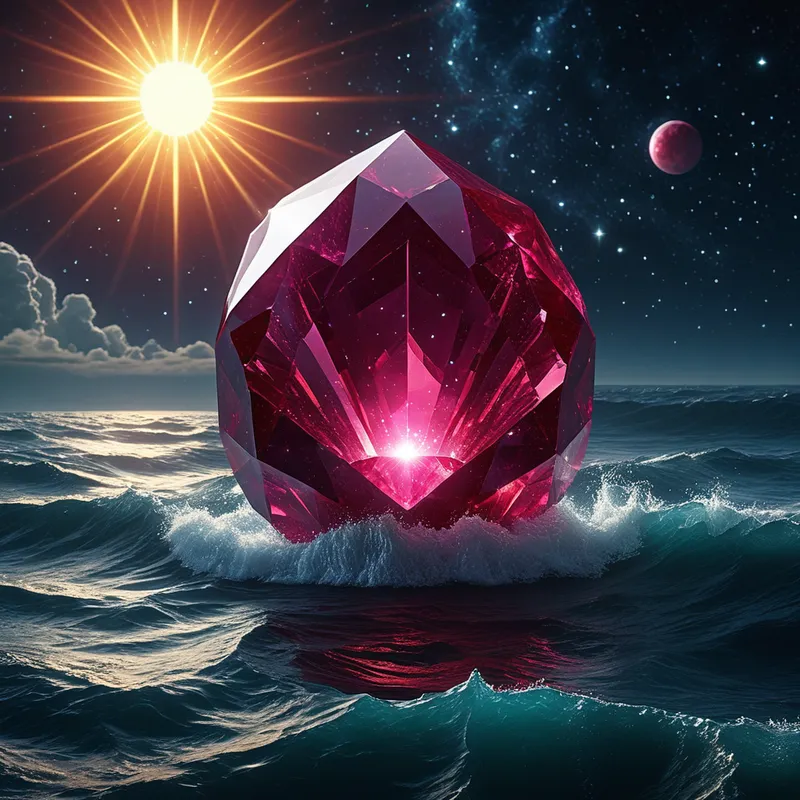
It was not merely a gem. It was a captured sunset, a solidified heartbeat, a prison for a star. It glowed with a light that promised to fill every hollow, answer every silent plea. It was the objective correlative of desire itself—beautiful, perfect, and complete.
Word of the Manikya spread like wildfire across the three worlds. Kings and asuras alike were consumed by a fever to possess it. Great wars, the Mahabharata of the jewels, were fought over it. It passed from hand to hand, each owner believing it would bring everlasting sovereignty and bliss. And for a time, it did. But the light of the Manikya was a mirror; it showed the holder not just glory, but the shadow of their own hunger amplified a thousandfold. Empires rose in its gleam and crumbled under the weight of the paranoia it inspired. Finally, weary of the blood spilled in its name, the gem, guided by its own latent consciousness born of sacrifice, found its way into the deep, forgiving darkness of the ocean, where it rests still, a buried sun, waiting.

Cultural Origins & Context
The story of the Manikya is not the centerpiece of a single, canonical epic like the Ramayana or Mahabharata. Instead, it is a pervasive motif, a glittering thread woven through the vast tapestry of Vedic and Puranic literature, as well as regional folklore. It appears in tales of the Samudra Manthan (the churning of the ocean) as one of the ratnas that emerged, and is intricately linked to the lore of the nine sacred gems (Navaratna).
Its primary function was didactic and symbolic. Told by traveling storytellers and village elders, the myth served as a narrative vessel for exploring profound philosophical tensions: between renunciation and possession, spiritual power and worldly desire, creation and its consequences. The sage Bhrigu, as a progenitor figure, ties the gem to the very origin of human aspiration. The myth warned of the dangers of unbridled craving while simultaneously acknowledging the sublime beauty and creative power of focused desire. It was a cultural dream about the price of perfection.
Symbolic Architecture
At its core, the Manikya is not an external treasure but an internal one externalized. It is the concretized kama of a sage—his life-force and longing turned to stone. This is the first great paradox: the ultimate symbol of worldly desire is born from the ultimate act of worldly renunciation.
The most sought-after object in the cosmos is born not from having, but from the conscious, agonizing fullness of not-having.
Psychologically, the Manikya represents the Integrated Self, the jewel of the psyche that forms when conscious discipline (tapas) consciously engages with the raw, unmet material of the unconscious (longing, emotion, "the human"). Bhrigu does not suppress his feeling of lack; he focuses his entire being upon it until it transforms. The gem is that transformation—a third thing, neither pure spirit nor base desire, but a transcendent object containing both.
Its journey through the world, causing war and strife, mirrors the fate of any half-integrated treasure of the Self. When we project this inner jewel outward—onto a person, a status, a possession—we ignite endless conflict, for we are asking the outer world to hold a light it cannot contain. The gem’s final resting place in the ocean is profoundly significant: the ocean symbolizes the collective unconscious, the vast, primordial source. The integrated Self, once fully realized, must return to and become part of the source, not be hoarded by the individual ego.
The Dreamer's Resonance
When the pattern of the Manikya myth stirs in the modern dreamer, it signals a critical phase of psychic crystallization. You may dream of finding a radiant gem, only to have it turn to coal in your hand, or to be pursued for possessing it. You may dream of a glowing red light in your own chest, or of laboring to pull a heavy, beautiful stone from deep mud.
Somatically, this can feel like a tightness in the chest or solar plexus—a pressure of something forming. Psychologically, it is the process of individuation pressing toward tangible form. The dreamer is in the grip of a Bhrigu-like ascetic phase, having perhaps endured a period of discipline, therapy, or introspection. Now, the accumulated energy seeks an outlet, a "form." The gem in the dream is that potential form—a new career, a creative work, a committed relationship, a hard-won insight. The conflict in the dream (losing it, being attacked for it) reveals the dreamer's fears about the consequences of embodying this new, radiant part of themselves.

Alchemical Translation
The myth of Manikya is a precise map for the alchemical process of psychic transmutation, what Jung called individuation.
Stage 1: The Calcination of Bhrigu. This is the initial, often painful, phase of introspection and burning away of illusions. The dreamer confronts their inner "lack" or emptiness directly, sitting with it in meditation-like focus, allowing the heat of attention to purify the desire.
Stage 2: The Coagulation of the Tear. Here, the purusha (conscious discipline) and prakriti (primal longing) unite. The diffuse energy of longing is given a boundary, a form. This is the moment of inspiration, the "Eureka!" when a nebulous feeling becomes a clear idea, a poem, a decision, a business plan. It is the birth of the Philosopher's Stone for that individual.
The goal is not to own the jewel, but to become the sage who can create it—and then release it to the world.
Stage 3: The Projection and Recovery. The newly formed "gem" is inevitably projected. The dreamer may become obsessed with the outer form of their creation (fame, money, validation), leading to the "wars" of anxiety, competition, and ego-inflation. The alchemical task is to recognize this projection, to withdraw the gem from the marketplace of the world and internalize its value. This is the gem sinking into the personal and collective ocean—the realization that the true value was in the act of creation itself, not in its possession.
The final teaching is that the true Manikya is not an object to be held, but a state of being to be inhabited. It is the luminous, durable center of a Self that has willingly contained the fire of its own desire and the frost of its own discipline, and from that marriage, brought forth something whole, something that shines with its own inner light, before finally offering that light back to the depths from which all life comes.
Associated Symbols
Explore related symbols from the CaleaDream lexicon: