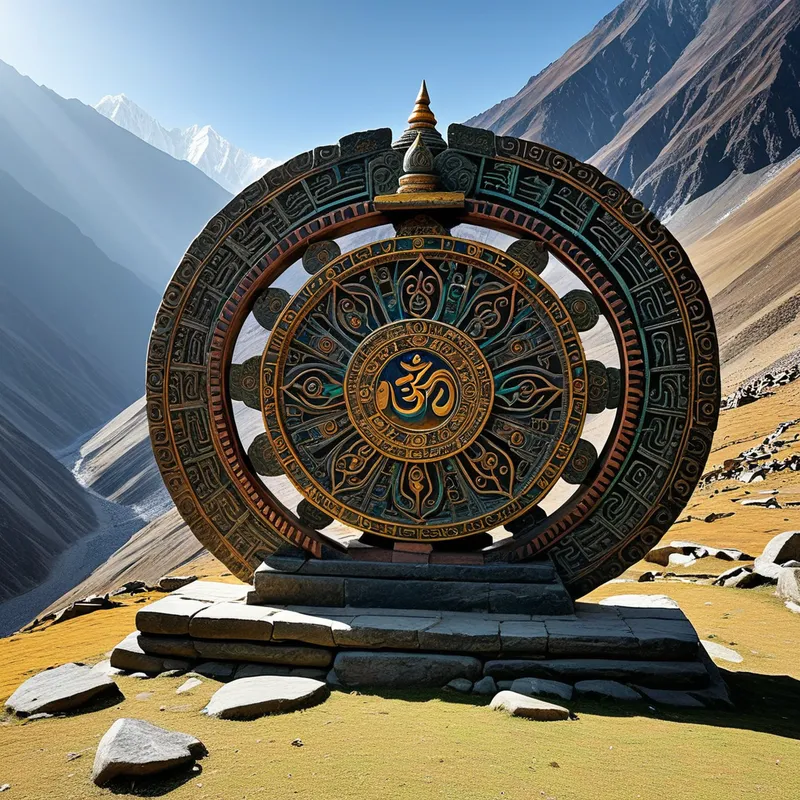
Mani Wheel Myth Meaning & Symbolism
A mythic tale of a sacred wheel, born from divine compassion, that turns the suffering of the world into the liberating sound of a mantra.
The Tale of Mani Wheel
In the time when the world was a raw wound of suffering, when the wind that scoured the high plateaus carried not just cold, but the echoes of ignorance, fear, and clinging, the compassionate gaze of Chenrezig rested upon the earth. His thousand eyes wept for every being trapped in the endless cycle of Samsara. From these tears of boundless compassion, a resolve was forged—not to wash the world away, but to give it a tool for its own liberation.
He saw that the minds of beings were like mountains: heavy, immovable, caught in the rigid patterns of their own making. Their prayers were often silent, trapped within the heart. Their suffering was a locked chamber with no key. And so, Chenrezig descended from his celestial abode, not in a flash of lightning, but as a whisper in the mind of a humble yogi meditating in a cave of ice. He placed a vision within the yogi’s inner sight: a wheel. Not a wheel of a chariot for war, nor a wheel of fortune for chance, but a wheel of profound method.
This wheel was to be a vessel for the essence of his own being, the six-syllable mantra Om Mani Padme Hum. The yogi, his hands guided by divine inspiration, took copper and wood, ink and devotion. He crafted the first Mani Wheel. As he formed its cylindrical body, he inscribed upon countless scrolls the sacred formula, filling the wheel’s core with the written breath of compassion. He set it upon a spindle, so it could turn.
The moment the wheel completed its first full rotation, a soundless thunder echoed through the unseen realms. It was not a sound heard by the ear, but a vibration felt by the soul. With each turn, the inscribed mantras were not merely read by the eyes of gods; they were released. They flew out like golden bees, carrying the blessing of Chenrezig into the world. They touched the harsh winds and softened them into whispers of solace. They seeped into the stony ground, promising potential for growth. The wheel became a nexus where human effort—the simple act of turning—met divine grace, generating a field of purification and protection.
The people of the highlands learned. They built great wheels by monastery gates, turned by water and wind. They carried small wheels in their hands, their walking pilgrimages measured in countless rotations. The conflict was the world’s suffering; the rising action was the dedicated turning, the physical prayer; the resolution was not a dramatic battle, but a gradual, pervasive saturation of the environment with the frequency of compassion, slowly transforming the very fabric of reality from within.
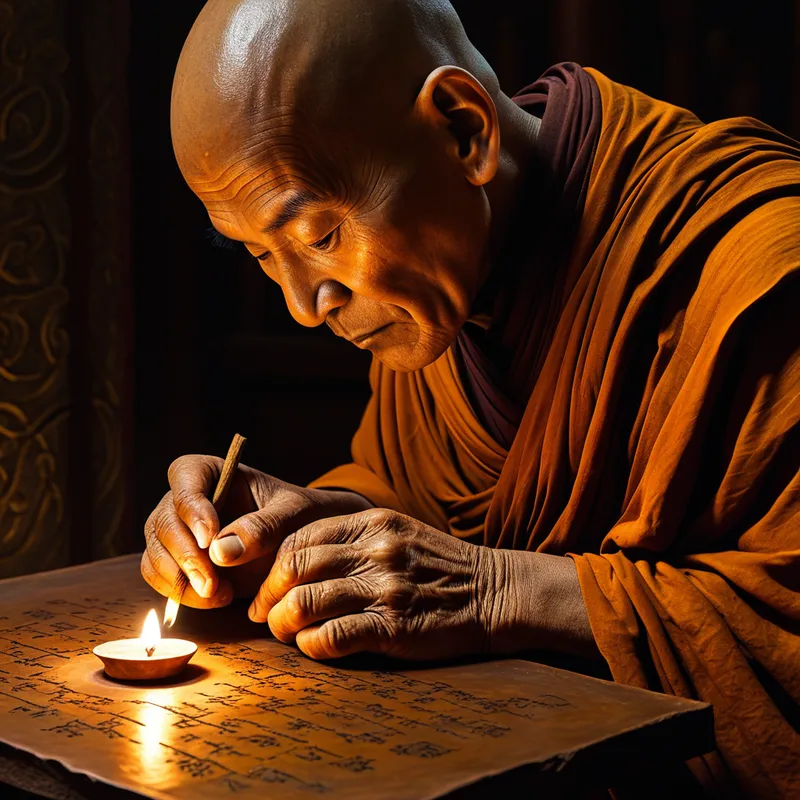
Cultural Origins & Context
The myth of the Mani Wheel is not a singular story with a fixed origin, but a living narrative embedded in the practical spirituality of Tibetan Buddhism. It emerged from the Mahayana view that skillful means (Upaya) are essential for liberating all beings. The wheel is a quintessential example of upaya—making the profound accessible through the physical.
Passed down orally by lamas and teachers, and detailed in ritual texts, its "story" is taught each time a novice is shown how to fill, seal, and spin a wheel. Its societal function is multifaceted: it is a tool for the illiterate to accumulate merit and wisdom, a community focal point for collective prayer, and a constant, kinetic reminder of the Dharma in the mundane world. The myth legitimizes the practice, framing it not as a superstition, but as a direct collaboration with the compassionate activity of Chenrezig. It turns ritual into a participatory myth, where every individual who spins the wheel becomes an actor in the ongoing story of the world’s liberation.
Symbolic Architecture
At its core, the Mani Wheel is a perfect symbol of the interdependent nature of reality and the alchemy of consciousness.
The wheel turns, and in its motion, the static written word becomes dynamic, spoken blessing. This is the transformation of latent potential into active reality.
The cylinder represents the universe, containing all phenomena. The mantra scrolls inside are the essential, ordered truth (Dharma) at the heart of chaos. The spindle upon which it turns is the axis mundi, the central pillar of reality, synonymous with unwavering mindfulness and ethical discipline. The act of spinning is the application of effort—the turning of the wheel of karma from suffering towards liberation.
Psychologically, the wheel represents the mind itself. Our thoughts, habits, and karmic impressions are the countless inscribed prayers within the cylinder of our psyche. Often, they sit dormant, repeating silently. The conscious, disciplined "turning"—through meditation, ethical action, and compassionate intention—activates them. It sets our inner mantras in motion, transforming neurotic patterns (Kleshas) into wisdom. The myth teaches that liberation is not about destroying the contents of the mind, but about setting them into a new, liberating rotation.
The Dreamer's Resonance
To dream of a Mani Wheel is to encounter a symbol of profound psychic process. If the wheel is turning smoothly, it suggests the dreamer is in a phase of effective integration. Their efforts at self-understanding or healing are "in motion," actively transforming inner content. The somatic sensation might be one of rhythmic calm or flowing energy.
A stuck, broken, or heavy wheel that refuses to turn speaks to a felt sense of psychological or creative blockage. The dreamer may feel their prayers—their deepest hopes or efforts for change—are trapped, unheard, or ineffective. The weight is the burden of unlived life or unmourned grief. A wheel spinning wildly out of control could mirror anxiety, obsessive thought patterns, or a feeling that one's spiritual or psychological practice has become mechanical and devoid of meaning. The dream presents the wheel as a diagnostic tool for the state of the dreamer's inner alchemical process.
Alchemical Translation
The myth models the individuation process—the journey toward psychic wholeness—with elegant precision. The modern individual often feels like a container filled with the scrolls of their past: traumas, family narratives, cultural conditioning, and personal failures, all inscribed within. This is the personal "karmic data." The ego often tries to either rigidly control this cylinder or ignore it entirely.
Individuation is not about crafting a new self from nothing, but about learning the sacred art of turning what you already contain.
The alchemical work begins with the recognition of the spindle—the central, authentic Self that exists beneath the shifting contents. The first step is to establish this axis through self-honesty and grounding. Then comes the courageous act of "turning." This is the engagement with therapy, active imagination, creative expression, or shadow work. Each conscious engagement with an inner complex (a "scroll") is a rotation. You are not erasing the memory or the pain; you are changing its relationship to the whole system, setting it in motion within the field of compassionate awareness (the blessing of Chenrezig, which here symbolizes the transcendent function of the psyche).
With consistent turning, the heavy, leaden suffering begins to emit a different frequency. Grief becomes wisdom. Anger becomes protective energy. Fear becomes alert presence. The mantra Om Mani Padme Hum—"the jewel in the lotus"—is the promise of this process: the irreducible, radiant value (the jewel) of the true Self, revealed through the murky waters of the unconscious (the lotus). The wheel teaches that our liberation is generated by the faithful, compassionate rotation of our own attention upon all that we are. We build the wheel, fill it, and by turning it, we are turned.
Associated Symbols
Explore related symbols from the CaleaDream lexicon: