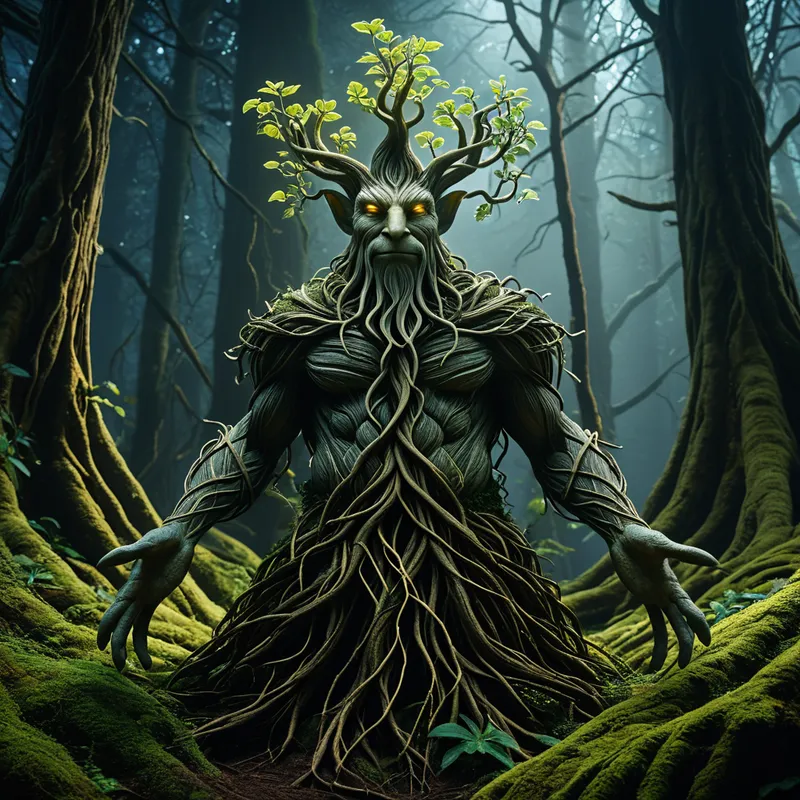
Mandrake Myth Meaning & Symbolism
A myth of a being born from the earth's memory, whose sacrifice weaves the threads of fate and grants the gift of foresight to the gods.
The Tale of Mandrake
Listen, and hear the whisper from under the roots. Before the first wolf’s howl split the silence of Ginnungagap, before the great tree Yggdrasil stretched its limbs to hold the worlds, the earth remembered. And from that memory, from the deep, dreaming soil where the echoes of what-could-be and what-once-was mingled, it grew.
They called it Mandrake. It was not a god, not a giant, not a beast. It was a presence—a stillness of gnarled bark and patient roots, a form that seemed carved by time itself from the living heartwood of the world. It stood in a grove so ancient it had no name, where the mist clung like a shroud and the only light was the cold gleam of stars on frost. It did not speak, but the wind through its branches sighed with the weight of secrets.
The Æsir, in their shining hall of Asgard, were mighty but blind. They could shape mountains and summon storms, but the threads of ørlög were a tangled skein they could not unravel. They saw the present in brilliant clarity but stumbled toward a future shrouded in mist. Odin, the restless seeker, his single eye burning with a hunger for knowledge, heard of the earth-rememberer. He journeyed down the great roots of Yggdrasil, past the well of Mímisbrunnr, and into the silent grove.
He found Mandrake, a pillar of silent knowing. No plea from a god could move it; no threat could stir its roots. Odin understood. The wisdom of the earth was not given, but exchanged. It required a meeting of essences, a sacrifice that would open a conduit between the divine will and the world’s memory.
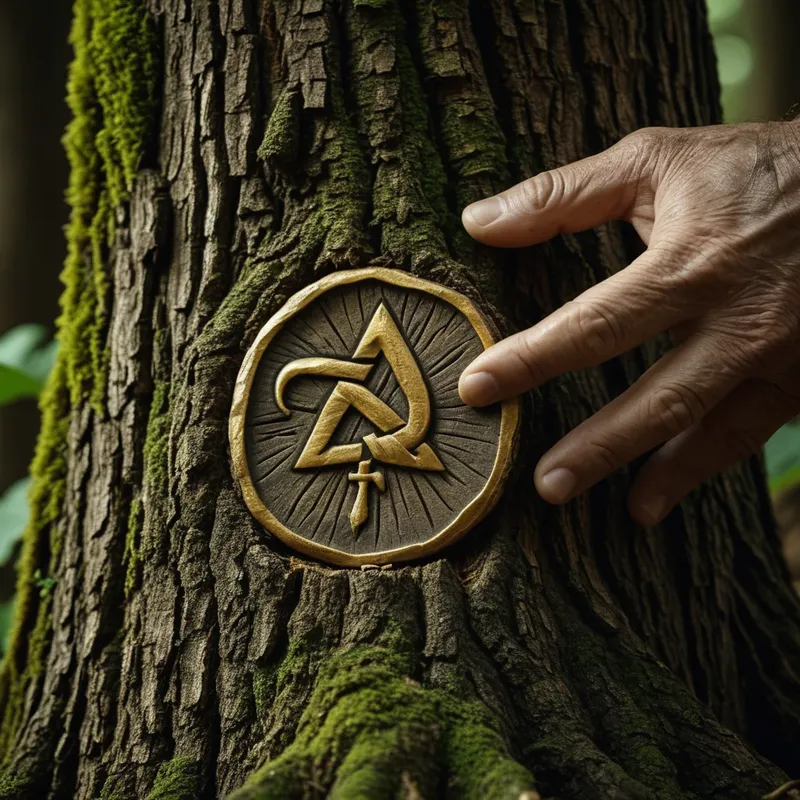
Odin took from his own being a rune of power, a symbol of binding and perception, carved not on wood but from his own intent. He approached the ancient form. With a reverence reserved for the most sacred of acts, he pressed the rune into a deep fissure in Mandrake’s bark. The moment it touched the inner heartwood, the grove shuddered. A sound emerged—not a cry, but a deep, resonant groan, as of continents shifting. From the wound, a sap neither gold nor amber but the color of twilight began to flow, thick and slow.
This was the exchange. The rune, a fragment of divine consciousness, opened Mandrake to a pain it had never known—the sharp, specific agony of foresight. In turn, Mandrake’s essence, the slow, dreaming knowledge of the earth, seeped into the rune and through it, into Odin. Visions flooded the Allfather: not clear prophecies, but patterns—the interweaving of causes and effects, the delicate balance of choice and consequence. He saw the threads, and in that seeing, gained the dread and burden of the seer.
Mandrake did not die. It transformed. Its form grew stiller, more stone-like, its roots digging ever deeper, becoming one with the foundational bones of the world. It became the silent anchor, the remembered price, the living library of cost. And from that day, the whisper of fate carried a new note—the sigh of the earth-rememberer, who gave its timeless dream so that gods, and perhaps men, might glimpse the pattern of their doom.
Cultural Origins & Context
The tale of Mandrake, as a distinct narrative, does not appear in the primary surviving texts of the Eddas. It exists in the liminal space of folklore that clung to the edges of the official canon—a story whispered by skalds in moments of introspection, perhaps used to explain the profound, non-transactional nature of certain ancient wisdoms. Its function was not to glorify the gods, but to contextualize the source of their most terrible knowledge. It served as an etiological myth for the cost of foresight, a quality so central to Odin’s character.
In a culture steeped in the inevitability of Ragnarök, understanding the mechanism of fate was paramount. This story positions ultimate wisdom not as a conquest, but as a sacred violation and a symbiotic sacrifice. It would have been told not in the grand mead-hall, but in quieter settings, emphasizing that some truths are rooted in silence and suffering, not in battle and boast. It reflects a deep Norse understanding that knowledge, especially of fate, is never free; it is always purchased with a piece of one’s own innocence or peace.
Symbolic Architecture
Mandrake itself is the central symbol: the psychic substrate, the unconscious mind in its primordial, pre-personal state. It is pure potential and memory, containing all patterns but conscious of none. It represents the slow, organic intelligence of the body and the earth, the wisdom of growth and decay that operates on a timescale incomprehensible to the ego.
The unconscious does not speak our language; it speaks in the slow grammar of roots and the silent syntax of stone. To hear it, we must offer a piece of our conscious self as a translator.
Odin’s rune is the focused power of consciousness—the ego, the will, the intellect—attempting to interface with this deep wisdom. The act of insertion is the heroic, yet violent, attempt of the conscious mind to know the unconscious. The resulting flow of sap is the symbolic substance of insight, but it is mingled with the pain of becoming conscious. The transformation of Mandrake into a foundational stone signifies the integration of this deep, unconscious material into the very structure of the psyche; once touched by consciousness, the unconscious is forever altered, becoming a stabilizing, but memorialized, part of the self.
The Dreamer's Resonance
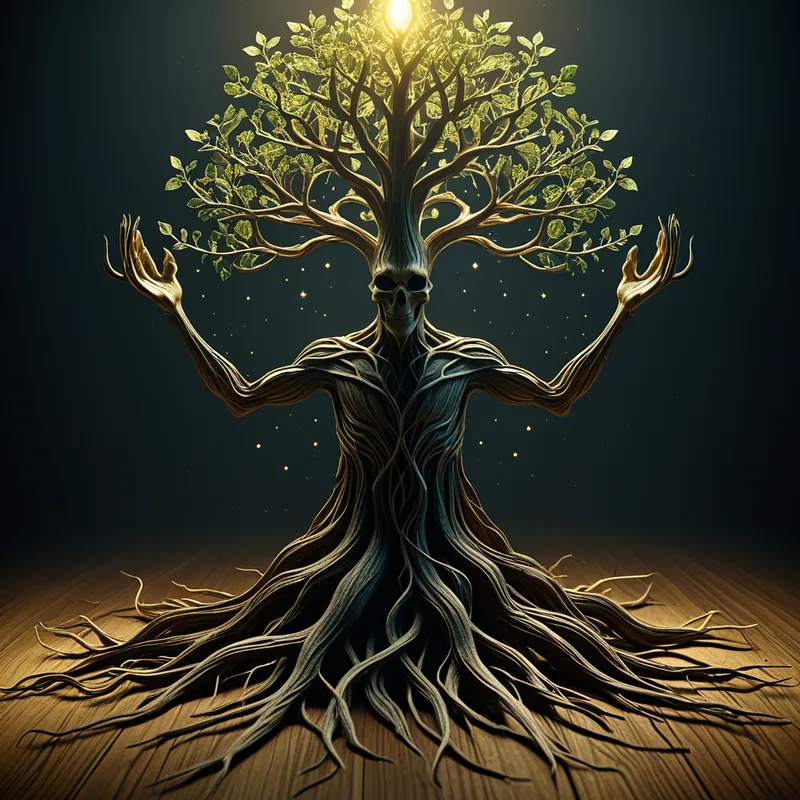
When this myth stirs in the modern dreamer, it often manifests not as a literal narrative, but as a somatic and atmospheric experience. One might dream of ancient, immobile trees that seem to hold a profound secret; of putting a hand against a cold stone wall and feeling it pulse with a slow, knowing heartbeat; or of discovering a deep, root-filled chamber within one’s own house.
Psychologically, this indicates a process of connecting to foundational, often neglected, aspects of the self. The “pain” of Mandrake is felt as a deep, resonant anxiety or a poignant sadness upon waking—the grief of the unconscious being made to articulate itself. The dreamer is in a state where deep, instinctual knowledge is rising to the threshold of awareness. This is not a sudden enlightenment, but the beginning of a long, slow integration. The body may feel heavy, grounded, or oddly sensitive, as if the dreamer’s very roots are being exposed to the air for the first time.
Alchemical Translation
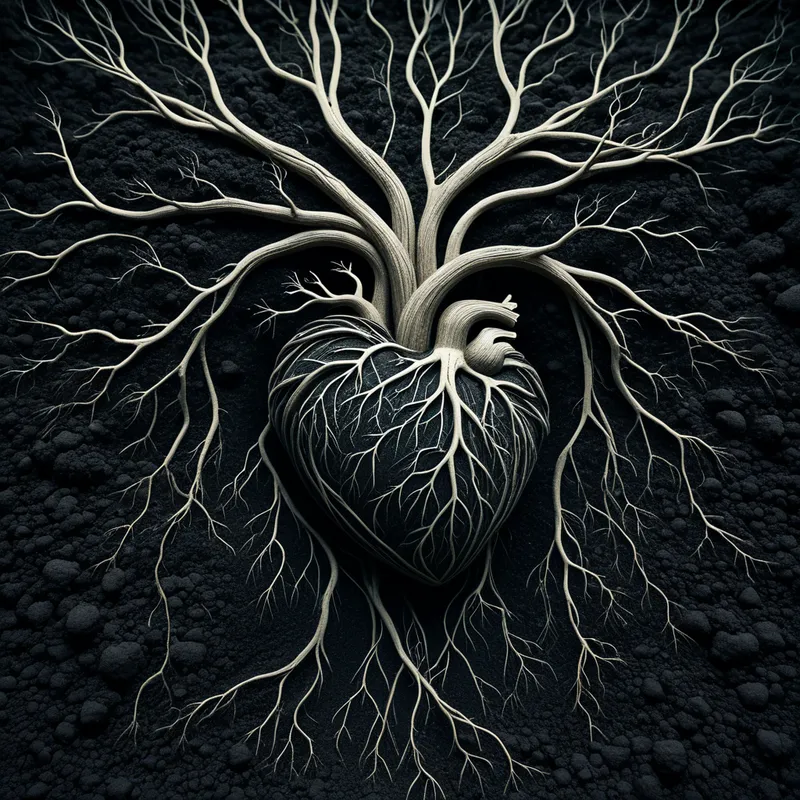
The myth of Mandrake is a perfect map for the alchemical stage of nigredo, the blackening, and the beginning of albedo. The conscious ego (Odin) descends into the dark, fertile soil of the unconscious (the grove). The goal is not to plunder, but to initiate a sacred exchange that will transmute both parties.
The process of individuation requires this same sacrifice. We must offer up a well-crafted piece of our conscious identity—a cherished belief, a defended self-image—and allow it to be implanted into the unknown, messy core of our being. This is always experienced as a wounding, a sacrifice. The conscious mind feels it as a loss of control; the unconscious feels it as a violent intrusion.
The gold of the Self is forged in the wound where consciousness and the unconscious meet. The sap and the rune must mingle.
The “sap” that flows back is the transformed content: raw instinct or memory now partially illuminated by consciousness, becoming usable insight, creativity, or a new feeling-toned understanding. The final state—Mandrake as the foundational stone—symbolizes the achieved integration. The once-alien unconscious content becomes the bedrock of a more complete personality. The ego no longer raids the unconscious for quick answers, but is permanently connected to it, drawing sustained wisdom from a source that now forms part of its own eternal structure. The seeker gains foresight, but carries forever the sobering knowledge of its cost, written in the silent language of the roots now woven through their soul.
Associated Symbols
Explore related symbols from the CaleaDream lexicon: