Manabozho Myth Meaning & Symbolism
The myth of Manabozho, the Great Hare, is a foundational epic of the Anishinaabe people, detailing his journey from foolishness to wisdom and the re-ordering of the world.
The Tale of Manabozho
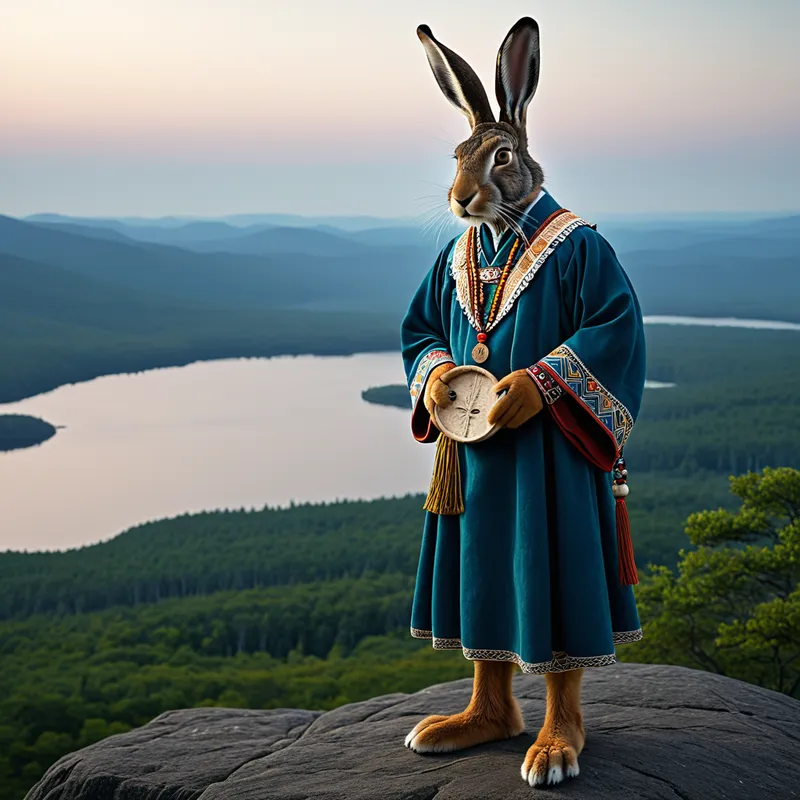
Listen. In the time before time, when the world was soft and new, when the waters spoke and the stones dreamed, he was born of a breath of the West Wind and a mortal woman. They called him Manabozho. From the first, he was a creature of paradox—grandson of the Moon, brother to the Wolf, a being of immense power wrapped in the cloak of foolishness.
He entered the world hungry, not just for food, but for knowing. His grandmother, Nokomis, raised him under the great dome of the sky, teaching him the names of things. But Manabozho was restless. His power was a wild river inside him, and he did not know its banks. He played tricks on the animals, shaping the world through mischief and accident. He tried to imitate the birds and fell from the sky. He tried to wrestle the giant Biboon, the Winter Maker, and was frozen solid, saved only by the cunning of his brother, the Wolf.
Yet within this foolishness was a seed of sacred purpose. The world was out of balance. Monstrous beings, the Mizhibizhu, lurked in the deep lakes, bringing death and chaos. The most terrible of them had taken his beloved brother, the Wolf. When Manabozho found the bones of his brother picked clean, a howl of grief tore from his throat that shook the pines and silenced the loons. This grief was the fire that forged his foolishness into resolve.
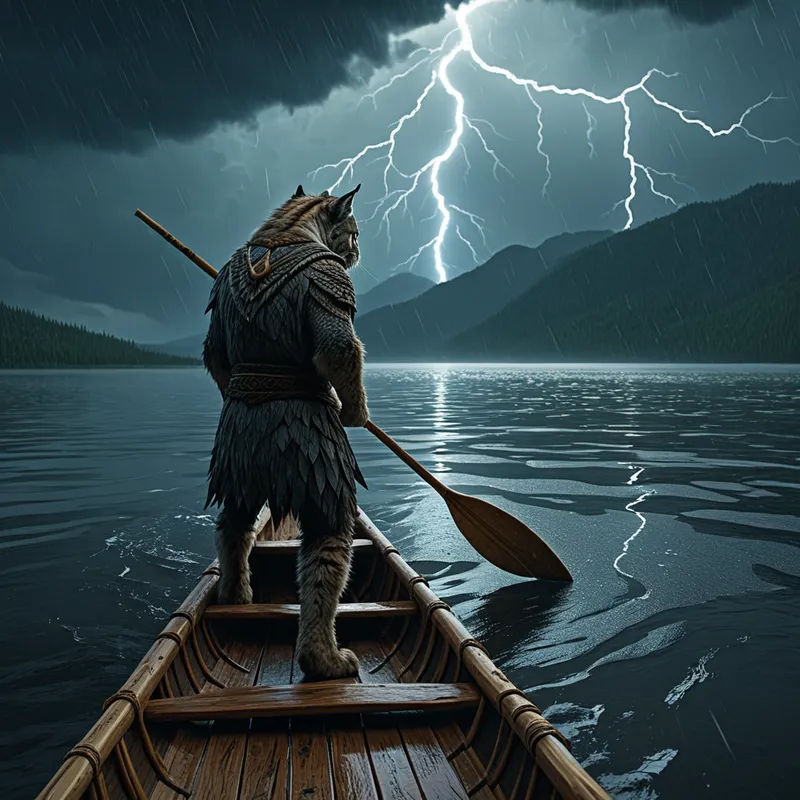
He prepared for a war of the spirit. He fasted. He prayed. He called upon his grandfathers of the Four Directions. He built a canoe of strong birchbark and armed himself not with mere arrows, but with the sacred Midewiwin knowledge whispered to him by the trees. Then he pushed out onto the vast, treacherous water, seeking the lair of the Great Lynx.
The battle was not of claw and tooth alone, but of will and magic. The Mizhibizhu stirred the waters into a frothing maelstrom, its scaled back like an island of knives. Manabozho stood in his fragile canoe, singing his power songs. He called the lightning from the sky and the thunder from the mountains. He transformed, he dodged, he endured. In the end, it was not brute force but cunning and the invoked power of the natural world that prevailed. He struck the monster’s heart, and from its fall, the very shape of the land was changed—islands were born, channels carved.
Victorious but weary to his soul, Manabozho did not rest. He walked the earth, teaching the people the sacred ways he had learned through loss and struggle. He gave them the rituals of the Midewiwin, the medicine to heal both body and spirit. He taught them how to live in balance, to honor the gifts of the forest and lake. Having brought order from chaos and wisdom from pain, his work complete, he withdrew to the edges of the world, where he watches still, a presence in the whisper of the reeds and the path of the sun.
Cultural Origins & Context
The myth of Manabozho is the foundational epic of the Anishinaabe peoples, which include the Ojibwe, Odawa, and Potawatomi nations. This is not a single, fixed story, but a vast, living cycle of narratives passed down orally across countless generations. The stories were traditionally told during the long winter nights, when the snow insulated the lodge and the world outside was still. The teller was not merely an entertainer but a knowledge-keeper, a historian, and a philosopher.
The societal function of the Manabozho cycle was multifaceted. It was a cosmological map, explaining the origins of landforms, animal behaviors, and seasonal cycles. It was a moral and practical guide, embedding lessons about social conduct, environmental stewardship, and the consequences of both arrogance and courage. Most profoundly, it served as the narrative backbone for the Midewiwin, the sacred medicine society. Manabozho’s journey—his loss, his quest, his acquisition of sacred knowledge, and his gift of it to the people—directly mirrors the initiatory path of the Mide healer. The myth was, and is, a container for cultural identity, spiritual instruction, and collective memory.
Symbolic Architecture
At its core, Manabozho is the archetype of the Culture Hero entangled with the Trickster. This duality is the myth’s great psychological truth. He is not a perfect, born-savior. His journey begins in the immature, undifferentiated psyche—the "foolish" Manabozho who acts on impulse, whose power is unintegrated and often destructive. He represents the raw, creative, and chaotic potential of the unconscious self before it is harnessed to a conscious purpose.
The hero is not born from perfection, but from a profound rupture in the self. The death of the Wolf-brother is the death of naive kinship, the moment the soul realizes its profound and terrible responsibility to engage with the darkness of the world.
The Mizhibizhu is not merely a monster "out there." It is the embodiment of the unassimilated, chaotic depths of the unconscious—the devouring, paralyzing fear, the unresolved grief, the psychic trauma that threatens to swamp the fragile vessel of the ego (the canoe). Manabozho’s battle is the quintessential act of confronting the shadow in its most potent and autonomous form. His victory does not annihilate these depths—water remains—but it establishes order and safe passage. It makes the unconscious navigable.
His final role as teacher and gift-giver signifies the ultimate goal: the integration of hard-won knowledge back into the community of the self and the wider world. The sacred Midewiwin bundles he bestows symbolize the organized, ritualized structures (healthy coping mechanisms, spiritual practices, psychological frameworks) that allow the individual and the culture to maintain balance against the ever-present pull of chaos.

The Dreamer's Resonance
When the pattern of Manabozho stirs in the modern dreamer, it signals a profound somatic and psychological process: the call to a necessary war. This is not a call to literal violence, but to an unavoidable, deeply taxing confrontation with a core, structuring complex within the psyche.
You may dream of a beloved figure (the Wolf-brother) being taken by a dark, watery force. This is the somatic recognition of a foundational loss or betrayal that has, until now, been buried. The grief feels oceanic, threatening to dissolve you. Alternatively, you may find yourself in a fragile boat on a vast, dark sea, pursued by or pursuing a monstrous shape beneath the waves. This is the ego-state feeling perilously small and exposed, yet compelled to face the looming, amorphous threat of a depression, a panic, a long-avoided truth.
The body may respond with symptoms of this inner battle: a tightness in the chest (the constrained heart), a feeling of being ungrounded or dizzy (the unstable waters), or a surge of adrenal energy mixed with dread (the preparation for the fight). The dream is the psyche’s declaration that the time for evasion is over. The Mizhibizhu must be met, or it will continue to devour your vitality from the depths.
Alchemical Translation
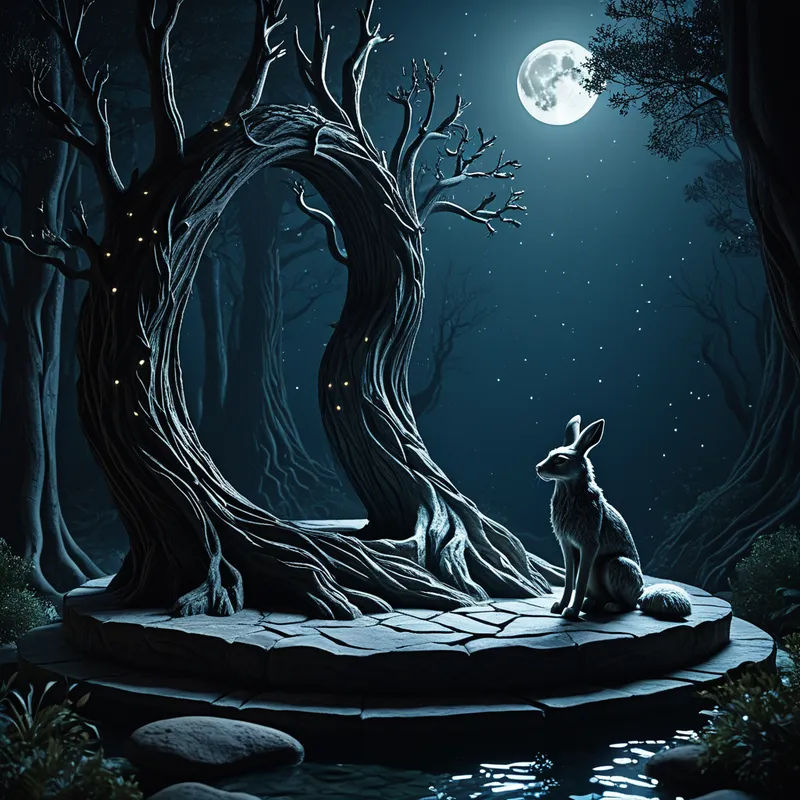
The alchemy of Manabozho’s myth is a perfect model for the Jungian process of individuation—the psychic transmutation of the base lead of the unexamined life into the gold of an integrated Self.
The journey begins in the nigredo, the blackening. This is the foolish, chaotic early life, but it crystallizes in the crushing blackness of the Wolf-brother’s death—the moment of maximum despair and nihilism. This is not a mistake but the essential first matter of the work. From this black grief, the albedo, the whitening, emerges as conscious intention: the decision to fast, to pray, to build the canoe. It is the purification of purpose, the setting of a conscious will against the unconscious tide.
The battle on the lake is the citrinitas, the yellowing or solar confrontation. It is the fierce, illuminating engagement where the ego, armed with whatever consciousness it has gathered, faces the autonomous power of the unconscious (the shadow, the anima/animus, the Self) in a struggle for sovereignty. Victory here is not annihilation, but a hieros gamos, a sacred marriage. The ego does not destroy the Mizhibizhu; it defeats its tyrannical aspect and learns its language, integrating its power. The land is reshaped; the internal geography of the psyche is permanently altered.
Individuation is not about becoming perfect, but about becoming responsible for the monstrous and the divine within your own psychic ecology.
Finally, the rubedo, the reddening, is the return and the gift. Manabozho does not hoard his hard-won knowledge. He translates it into medicine, into ritual, into teachable wisdom for the "people"—which psychologically represents the various sub-personalities and aspects of the total self. The integrated consciousness becomes a governing, healing principle for the entire inner community. The trickster is tempered into the sage; the chaotic creative force is channeled into a sustaining, cultural order. The individual becomes, like Manabozho withdrawing to the horizon, both a part of the world and a watchful steward of the delicate balance between the deep waters and the steadfast shore.
Associated Symbols
Explore related symbols from the CaleaDream lexicon: