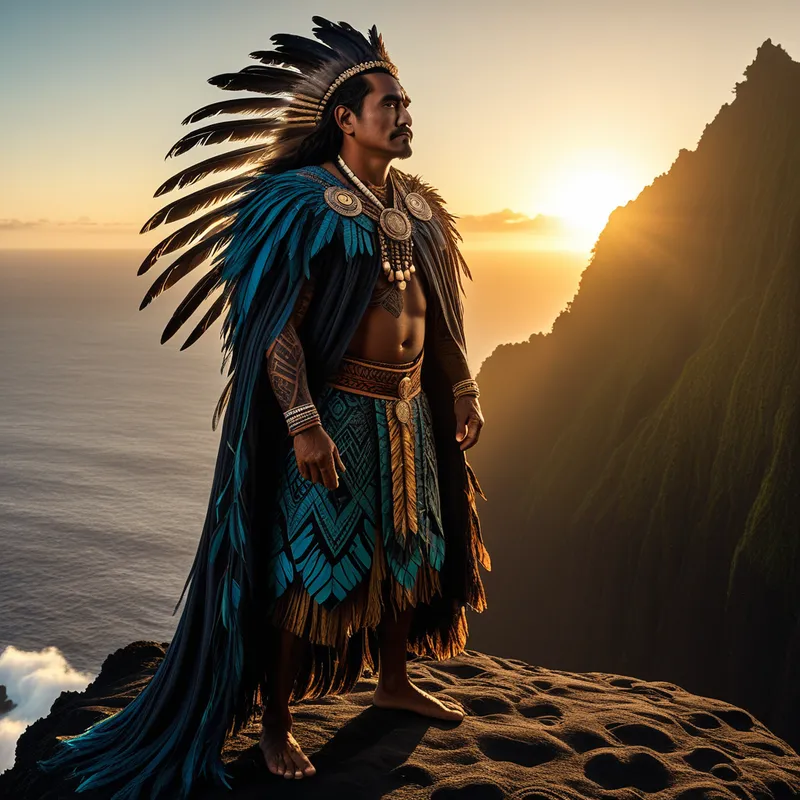
Mana Myth Meaning & Symbolism
Mana is the sacred, animating force flowing through all things, a power earned through right action, ancestral connection, and alignment with the cosmos.
The Tale of Mana
In the beginning, there was the great, dark, and ceaseless Po. From its silent depths, the gods stirred. They were not born of light, but of a yearning for form, for sound, for life. And the first sound was a pulse—a deep, resonant hum that was not a voice, but a presence. This was the first breath of Mana.
It flowed into Ranginui, the Sky Father, and he became vast, holding the stars like thoughts. It saturated Papatūānuku, the Earth Mother, and she became fertile, her body a promise of forests and mountains. Their embrace was so tight, so filled with this new power, that their children lived in darkness between them. These children, the atua, the gods, grew strong on the Mana of their parents’ union, yet they yearned for light, for space to be.
The conflict was a silent, immense pressure. Finally, Tāne Mahuta, with his feet on his mother and his back against his father, began to push. He did not use mere muscle. He gathered the Mana of the earth, the latent power in the seeds, the silent strength in the roots. He sang a karakia, a chant that focused this power into a single, upward thrust. With a groan that shook the universe, Sky and Earth were parted. Light flooded in. And in that first, glorious ray of sunlight, the liberated Mana of creation exploded—it became the wind in Tāwhirimātea’s fury, the first waves of Tangaroa’s domain, the fierce heat in the volcanoes of Rūaumoko.
This power did not vanish with the act of creation. It settled. It flowed into the first man, Tiki, shaped from red earth by Tāne’s own hands. It flowed into the first great voyaging canoe, guiding it across trackless seas by the stars. It gathered in the first chieftain, whose very word could make men act or plants grow. It lived in the master carver’s hands as he revealed the god within the wood, in the warrior’s tattooed skin that told his lineage and courage, in the wise woman’s knowing glance that could heal or reveal truth. Mana was not owned; it was a current. You could step into it through right action, through sacred knowledge, through the weight of your ancestors standing behind you. To hold it was to be a conduit for the cosmos itself. To lose it through cowardice, betrayal, or broken tapu was to become a shell, a whisper against the great, humming song of the world.
Cultural Origins & Context
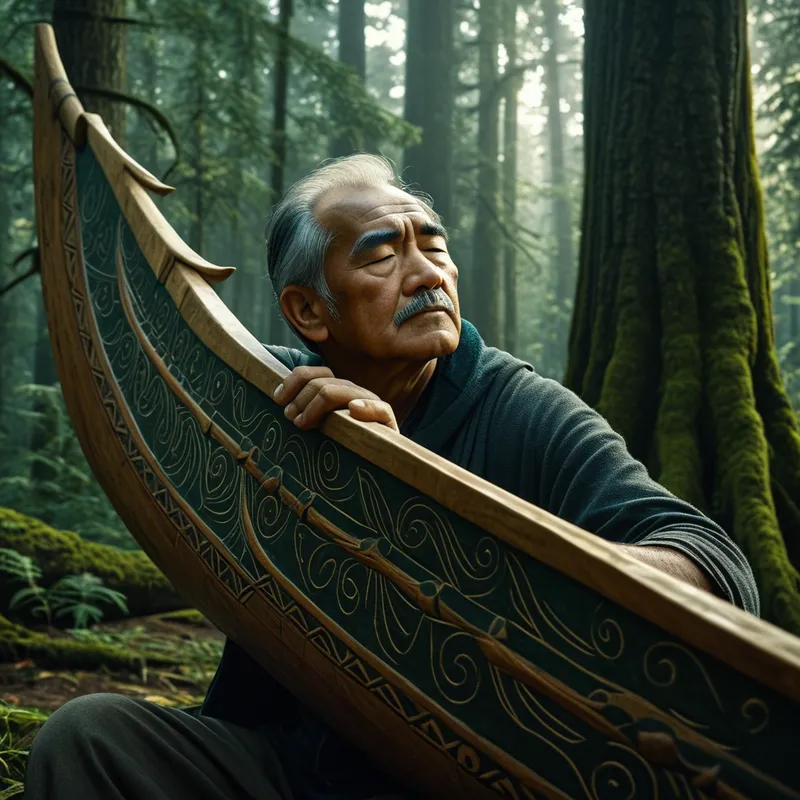
Mana is not a single myth with a plot, but the foundational metaphysical reality underpinning all Polynesian narrative, social structure, and daily life. Its understanding was woven into the fabric of existence across the Polynesian triangle, from Hawaiʻi to Rapa Nui (Easter Island) to Aotearoa (New Zealand). It was transmitted not as a simple story, but as an implicit truth within creation chants (like the Māori whakapapa), genealogies, and the protocols of every significant action.
The primary custodians of Mana’s nuances were the priests (tohunga) and high chiefs (ariki). They were the living conduits. The tohunga understood its flows and blockages, directing it through ritual (karakia) to ensure fertility, victory, or healing. The ariki embodied it; their personal Mana directly influenced the prosperity of the entire tribe (hapū). Its societal function was one of sacred ecology and governance. It created a universe of profound relationship and consequence, where every action either accumulated or dissipated this spiritual capital, binding the individual to the community, the present to the ancestral past, and humanity to the natural and divine world.
Symbolic Architecture
Psychologically, Mana represents the archetypal experience of authentic personal power. It is not the ego’s will to dominance, but the Self’s alignment with a transpersonal source of vitality and efficacy. It symbolizes the energy that makes our actions meaningful, our presence felt, and our creations alive.
Mana is the psychological voltage that animates the connection between intention and manifestation. It is the difference between going through the motions and moving with purpose.
The mythic narrative of its emergence from the primal separation of Sky and Earth symbolizes the birth of consciousness itself. The undifferentiated unity of Rangi and Papa is the unconscious state. The painful, necessary separation—the "divine conflict"—is the dawn of individual awareness, and the liberated Mana is the psychic energy now available for conscious life, creativity, and relationship. The gods who channel it—Tāne the cultivator, Tangaroa the explorer, Tūmatauenga the warrior—represent the differentiated facets of this power within the human psyche: our capacity to build, to navigate deep emotions, and to assert boundaries.
Crucially, Mana is shown to be relational and earned. It flows through right relationship: to ancestors (the personal and collective unconscious), to community (the outer world), and to the natural order (tapu). This makes it a symbol of integrity. Psychic energy drains away when we act in violation of our deep values (break tapu), but amplifies when our actions are congruent with our deepest nature and responsibilities.
The Dreamer's Resonance
When the pattern of Mana manifests in modern dreams, it often signals a critical phase in the dreamer’s relationship with their own vitality and authority. This is not about dreaming of Polynesian imagery per se, but of experiencing its core dynamics.
You may dream of discovering a hidden power source in your home—a vibrating stone, a panel of glowing circuits, a tree with roots of light. This is the somatic discovery of untapped inner resource. Alternatively, you might dream of a ceremony where you are being invested with a cloak, a staff, or a title, feeling a surge of sobering responsibility and strength. This is the psyche preparing to acknowledge and embody a new level of personal authority.
Conversely, dreams of Mana lost are profound warnings. Dreaming of a once-powerful object now dull and cracked, of a vibrant landscape suddenly turning grey and silent, or of your voice making no sound—these speak to a psychological process of depletion. The dreamer may be living out of alignment, ignoring ancestral wounds (personal history), or giving away their power in relationships or work. The dream is a somatic alarm, indicating that the connection to the inner wellspring is blocked, and the cost is a feeling of being ghost-like, ineffective, and disconnected from life’s current.
Alchemical Translation
The alchemical process modeled by Mana is the transmutation of raw potential into authentic, grounded power—a core goal of Jungian individuation. It is the journey from being a passive vessel to becoming a conscious conduit.
The first stage is Recognizing the Source (the primal Po). This is the dark night, the feeling of being trapped between sky and earth—a depression or stagnation where one’s latent potential is pressurized but unexpressed. The second is the Sacred Separation (Tāne’s push). This is the difficult, often painful act of psychological differentiation: setting boundaries, leaving outdated identities, consciously separating from parental or societal complexes that keep us in darkness. This act requires gathering one’s inner resources (the initial gathering of Mana).
The alchemy of Mana teaches that true power is not seized, but received by making oneself a worthy vessel through courageous action and ethical alignment.
The liberated energy that floods forth is the third stage: Integration and Channeling. This is not a manic explosion, but the disciplined application of newfound psychic energy. The modern individual must become their own tohunga and ariki. They learn the "chants" (practices like meditation, therapy, creative work) to focus this energy. They understand their personal "tapu" (core values and limits) to maintain its flow. They acknowledge their "whakapapa" (personal and ancestral history) as the ground from which their unique power grows.
The ultimate triumph is not dominion over others, but sovereignty of the Self. It is the state where one’s actions carry weight because they are an expression of the whole being, aligned with something greater. One’s word has Mana because it is true. One’s work has Mana because it is a genuine offering. One’s presence has Mana because it is rooted, connected, and fully charged with the humble, formidable power of being exactly who and what they are meant to be in the great and humming song of the world.
Associated Symbols
Explore related symbols from the CaleaDream lexicon: