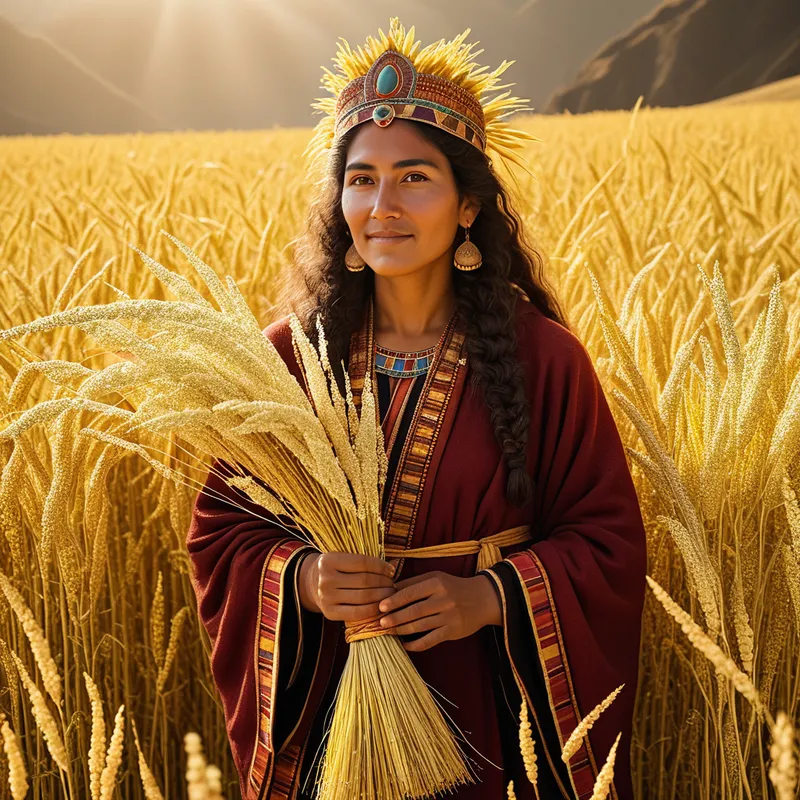
Mama Quinoa Myth Meaning & Symbolism
The myth of the grain mother who sacrificed herself to become the sacred quinoa, sustaining the people and teaching the cycle of life, death, and rebirth.
The Tale of Mama Quinoa
In the time before time, when the world was young and the mountains were still learning their names, the people of the high plains lived in the breath of the sky. The air was thin and sharp, the sun a fierce, close eye, and the earth—the great Pachamama—was a stern and stony mother. The people were hungry. Their bellies were hollow echoes against the wind. They had tried the tough grasses, the bitter roots, but nothing could thrive in the roof of the world where the condors nested and the frost bit deep.
Among them was a woman of quiet strength, known to all as Mama Quinoa. She was not a queen or a warrior, but her hands were wise in the ways of the soil, and her heart held the warmth the sun often withheld. She watched the children grow thin, their laughter fading like mist. She heard the elders’ stories grow faint with weakness. A great sorrow, heavy as a mountain stone, settled in her spirit.
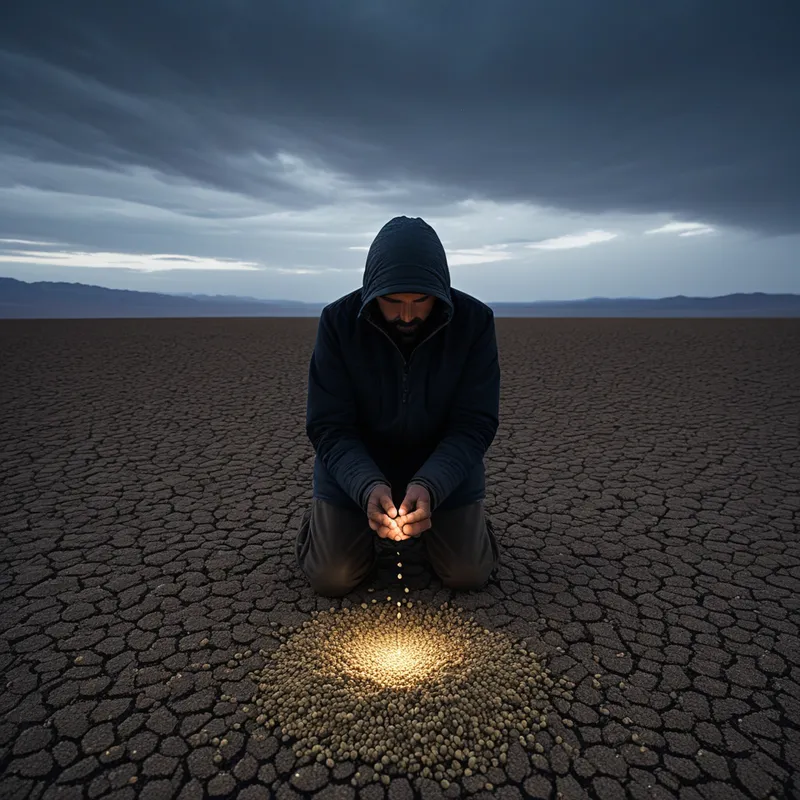
One evening, as the last light bled from the peaks, Mama Quinoa walked far from the village, to a place where the world felt raw and unfinished. She knelt on the cold ground, her fingers digging into the unyielding earth. “Inti,” she whispered to the vanished sun, “Pachamama,” she murmured into the stone, “I am but a woman. I have no gold, no power. All I have is this body, this life. Take it. Let my flesh become something that can hold the sun’s fire. Let my bones become a frame that can withstand the mountain’s wind. Let my blood become the sap that refuses the frost. Let my spirit become a seed.”
The silence that followed was absolute, a listening silence. Then, a deep tremor moved through the earth, not of anger, but of recognition. The stars seemed to lean closer. Mama Quinoa did not rise. She pressed her forehead to the ground, her offering complete.
Where her tears fell, the soil darkened. Where her breath faded, a gentle warmth remained. And as the first cruel fingers of dawn frost reached for the spot, they recoiled. For there, from the very place her body had merged with Pachamama, sprang not one plant, but a multitude. Tiny, resilient plants with leaves like dancing hands and heads heavy with seed. Not just any seed—small, disk-like grains, each one a perfect capsule, colored like the dawn sky: ivory, rose, gold, and deepest sable. They held within them a secret: the resilience of the high altitude, the captured warmth of Inti, and the profound, self-giving love of the woman who was no more.
The wind carried the scent—earthy, nutty, sustaining—to the village. The people came and saw the field of life where only death had been. They harvested the first grains, and when cooked, they found a food that was complete, that strengthened their bodies and fortified their hearts. Mama Quinoa was gone, but she was now in every grain, in every meal, in the strength of every child who grew tall under the Andean sun. She had become what she offered: sustenance itself.
Cultural Origins & Context
The reverence for Mama Quinoa is woven into the fabric of Andean agricultural spirituality, predating and enduring through the Inca Empire. This was not a myth confined to priestly classes but a living story told by ayllus around hearths and in fields. It functioned as sacred ethno-botany, encoding vital survival knowledge within a spiritual narrative.
The myth was performed as much as it was told. During planting and harvest, rituals honored her sacrifice. A handful of the first seeds were always returned to the earth, a symbolic communion with Mama Quinoa and Pachamama. This practice reinforced a core Andean principle of ayni—reciprocity. One does not simply take; one gives back. The myth explained why quinoa (kinwa) could thrive at altitudes that killed other crops: it was literally born of a sacrifice made in that exact, harsh environment. It was a story that linked identity, place, and survival into an unbreakable chain of meaning.
Symbolic Architecture
At its heart, the myth of Mama Quinoa is a profound map of transformative sacrifice. It is not a story of a hero conquering an external foe, but of a caregiver dissolving a boundary. The enemy is scarcity, and the weapon is self-dissolution for the sake of the other.
The ultimate nourishment is not taken, but given; it requires the death of the individual form to birth the communal substance.
Mama Quinoa represents the archetypal principle of the life-giving source that becomes the life it gives. Psychologically, she symbolizes the ego’s capacity to surrender its own isolated existence for the sake of a greater, nourishing wholeness. The grain itself is a perfect symbol: a complete protein, containing all essential elements within a tiny, resilient shell. It mirrors the myth’s promise—that within a seemingly small or humble act of total offering lies everything needed for survival and growth. The transformation is alchemical: human flesh (the perishable) into sacred seed (the enduring), personal grief into collective resilience.
The Dreamer's Resonance
When this myth stirs in the modern unconscious, it often manifests in dreams of profound personal depletion coupled with a deep, urgent call to provide. You may dream of an empty kitchen you must somehow feed a crowd from, of a child you cannot nourish, or of your own body turning into something useful—wood for a fire, clay for a pot, grain for a mill.
Somatically, this can feel like a hollowing out, a fatigue that is more than tiredness—it is a resource fatigue. Psychologically, this is the territory of the burnt-out caregiver, the parent, the healer, the supporter who has given to the point of erosion. The myth does not appear to glorify this exhaustion, but to initiate a process within it. The dream is asking: What is the nature of your offering? Can your very sense of depletion be the soil for something new? It points to a necessary, often terrifying, death of the old identity of the “giver” who is separate from the “gift.” The resolution in the myth suggests that true sustenance emerges not from having more to give, but from a metamorphosis where the giver becomes the gift itself.

Alchemical Translation
The individuation process modeled here is one of psychic transmutation through compassionate dissolution. For the modern individual, the “barren plateau” is any life situation that feels devoid of meaning, resource, or growth—a career that has turned to dust, a relationship that has grown cold, a creative spirit that feels starved.
The alchemical fire is not rage, but the heat of a love that is willing to be consumed to generate a new form of life.
The first step is the conscious, voluntary kneeling on that barren ground—the acknowledgment of depletion and the heartfelt offering of the current form of one’s life. This is the sacrifice of the ego’s current structure. The “body” offered is our old identity, our outdated ways of sustaining ourselves and others. The transformation occurs in the dark, silent womb of Pachamama—the unconscious. We do not control it.
The new growth—the “quinoa”—is the emergent psychic structure. It is resilient (adapted to your unique inner climate), nourishing (it genuinely sustains your soul and, by extension, your world), and seeded with the essence of your sacrifice. You are no longer just giving from your resources; you have become a resource. Your work, your love, your creativity flows from a transformed state of being. The cycle of harvest and return (ayni) becomes internalized: you nourish the world from this new place, and you must also return part of that energy to nourish your own sacred ground. Thus, the myth guides us from scarcity consciousness, through the fire of self-giving, to a state of being that is, itself, a sustainable source.
Associated Symbols
Explore related symbols from the CaleaDream lexicon: