
Malkuth the Kingdom
The tenth and final Sephirah in the Kabbalistic Tree of Life, representing the physical world and the culmination of divine emanation.
The Tale of Malkuth the Kingdom
The tale begins not with a beginning, but with an ending that is a beginning. From the boundless, unknowable Ein Sof, a lightning flash of intention pierced the void. This was the descent of the divine will into form, cascading through nine luminous vessels, the Sephirot, each a more concentrated refraction of the primordial light. The journey was one of increasing density, of spirit clothing itself in the garments of concept, force, and feeling.
Finally, the streaming light reached the tenth and final station. Here, at the very bottom of the Tree of Life, the light did not simply stop. It poured itself out, not into another vessel of pure emanation, but into everything. It became the grit of the earth, the sigh of the wind, the solidity of stone, the pulse of blood. This was Malkuth, the Kingdom. It is the point where the infinite song of the divine becomes the symphony of the sensory world—every leaf, every stone, every human breath is a note in its composition.
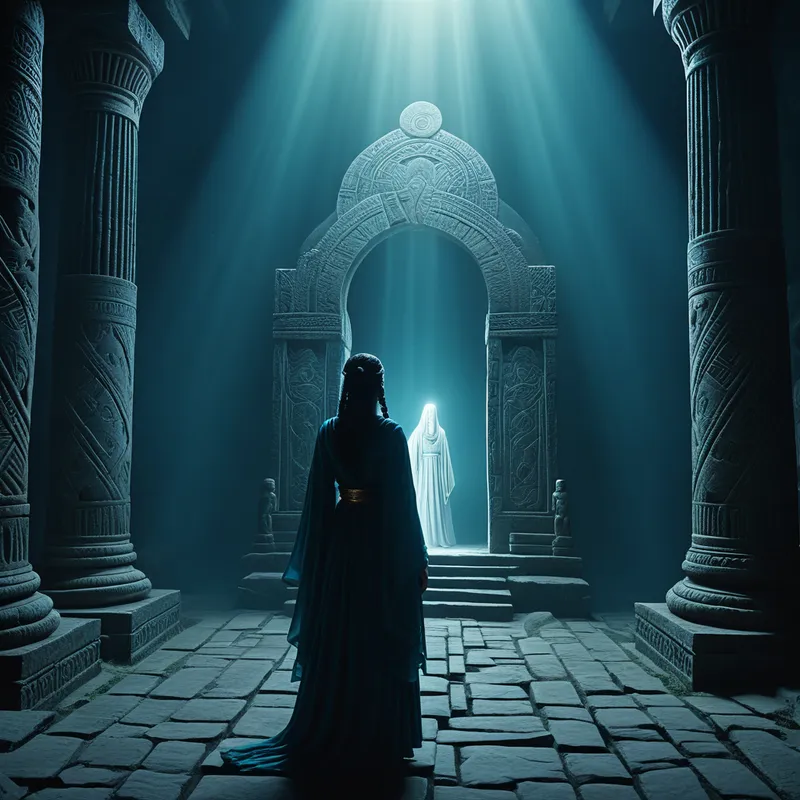
Yet, Malkuth is no mere dumping ground for spent spiritual energy. It is the sacred vessel that receives the totality of the flow from above. It is the Bride, Shekhinah, in exile, awaiting union with her beloved, the Kingly principle of the higher Sephirot. This creates a hidden tension within the Kingdom: a profound homesickness for the source, a feeling of separation, even as it is the very embodiment of the source’s final expression. The myth tells us the divine is not outside the world, looking in; it is the world, dreaming itself into being, with Malkuth as the dreaming culture.") body.
Cultural Origins & Context
Malkuth emerges from the rich soil of Jewish mysticism, particularly the medieval Kabbalah that flourished in Spain and Provence, crystallized in texts like the Zohar. In this system, the Tree of Life is not just a map of God but a map of the soul and the cosmos—all are mirrors of one another. Malkuth, as the tenth Sephirah, occupies a complex position.
It is the culmination of the divine creative process, the “footstool” of God, and the point of interface between the supernal realms and human experience. In traditional Jewish cosmology, it is associated with the physical world (Assiah), the Community of Israel, and the Sabbath Queen—the day when the divine presence is most palpably felt in the world. Its position at the base of the Tree means it is the receiver of all influences, both the nourishing light from above and the chaotic “shells” or <abbr title="The "shells" or forces of impurity and fragmentation in Kabbalistic cosmology.">Kelipot from the outside. Thus, the work in Malkuth is one of tikkun olam, the repair of the world, by elevating the scattered sparks of holiness trapped within material existence.
Symbolic Architecture
The architecture of Malkuth is one of paradox: it is both the lowest point and the fullest expression, the end and the gateway. Its traditional symbols paint a picture of receptive, embodied completion.
Malkuth is the Circle completed, the point where the emanating light, having traveled the path of the Tree, finally returns to itself through the act of perceivable existence. It is the fruit that contains the entire seed of the tree within it.
It is symbolized by the Kingdom (a governed, ordered realm), the Bride, and the Earth. Its divine name is Adonai Melekh, the Lord who is King, emphasizing sovereignty over the manifested realm. It is associated with the element of Earth, but also with the final, densest combination of all four classical elements solidified. Its position is unique; while other Sephirot have clear pathways between them, Malkuth is connected only to Yesod, the Foundation, directly above it. This single, vital channel, the Path of Tau, represents the funnel through which the energies of the entire Tree must pass to become manifest. It is the narrow gate through which the infinite must flow to become finite.
The Dreamer's Resonance
To encounter Malkuth in the inner landscape is to confront the reality of one’s own incarnation. Psychologically, it represents the ego in its healthiest sense: not as an isolated fortress of selfhood, but as the competent, grounded governor of the personal kingdom—the body, the daily life, the immediate environment. It is the function that says, “I am here.”
The “hidden tension” in the myth reflects a core human tension: the feeling of being a spiritual being having a physical experience, the sense of exile within one’s own life. The longing of the Shekhinah is the soul’s longing for meaning, for connection to something greater than the mundane grind. When this connection is severed or ignored, Malkuth becomes a place of exile indeed—a realm of mere survival, materialism, and spiritual numbness, ruled by the “shells” of fragmentation.
Conversely, a conscious Malkuth is where spirituality becomes practical. It is where insight is made real through action, where compassion takes the form of a meal shared, where prayer is embodied in upright posture and mindful breath. It is the archetype of the Ruler who serves the kingdom, managing the resources of the self (body, time, energy) with wisdom and justice, ensuring the inner city is well-ordered so it can receive the blessings from above.

Alchemical Translation
In the alchemical opus, Malkuth corresponds to the stage of Citrinitas (the yellowing) and ultimately the Nigredo revisited in its final form: the Earth itself. It is the Salt, the principle of solidity and crystallization. The alchemical process is not complete when the philosopher’s stone is conceived in the mind or felt in the heart; it is only complete when it is manifested, when it can act upon the base matter of the world.
The great work is to discover the gold of the Crown (Keter, the first Sephirah) hidden in the earth of Malkuth. This is not a spiritual bypass but a sacred digging. One must touch the Stone to find the Spirit within it.
This is the translation of vision into substance. The lightning flash of inspiration (from Keter) must journey through the complexities of emotion, intellect, and form until it can be planted like a Seed in the fertile soil of reality. Malkuth is the field where that seed grows, is tended, and finally yields its harvest. The alchemist, like the Kabbalist, seeks to redeem the matter of Malkuth, to see the divine face in the dirt, thereby performing the ultimate act of healing for the world and the self.
Associated Symbols
Explore related symbols from the CaleaDream lexicon:
- Earth — The solid, receptive element of Malkuth, representing the physical plane, the body, and grounded manifestation.
- Kingdom — The governed realm of embodied existence, the domain where spirit becomes law, form, and tangible reality.
- Circle — The symbol of completion and wholeness, representing Malkuth as the final point where the emanating divine energy returns to its source through manifestation.
- Bride — The feminine, receptive aspect of the divine (Shekhinah) in exile, longing for union, symbolizing the soul’s yearning within the physical world.
- Stone — The densest matter, the ultimate test of the alchemical work; the base substance that contains the secret of transformation.
- Seed — The potential of the entire Tree of Life contained and planted within the soil of the material world, awaiting cultivation.
- Door — The narrow gate of Malkuth, the only direct pathway (from Yesod) through which all higher influences must pass to enter manifestation.
- Manifest — The active principle of bringing the unseen into the seen, the core function and purpose of the Kingdom.
- Root — The hidden, foundational connection of all physical forms to their spiritual source, echoing Malkuth’s link to the entire Tree.
- Temple — The constructed sacred space in the material world, reflecting the order of the higher realms and housing the divine presence.