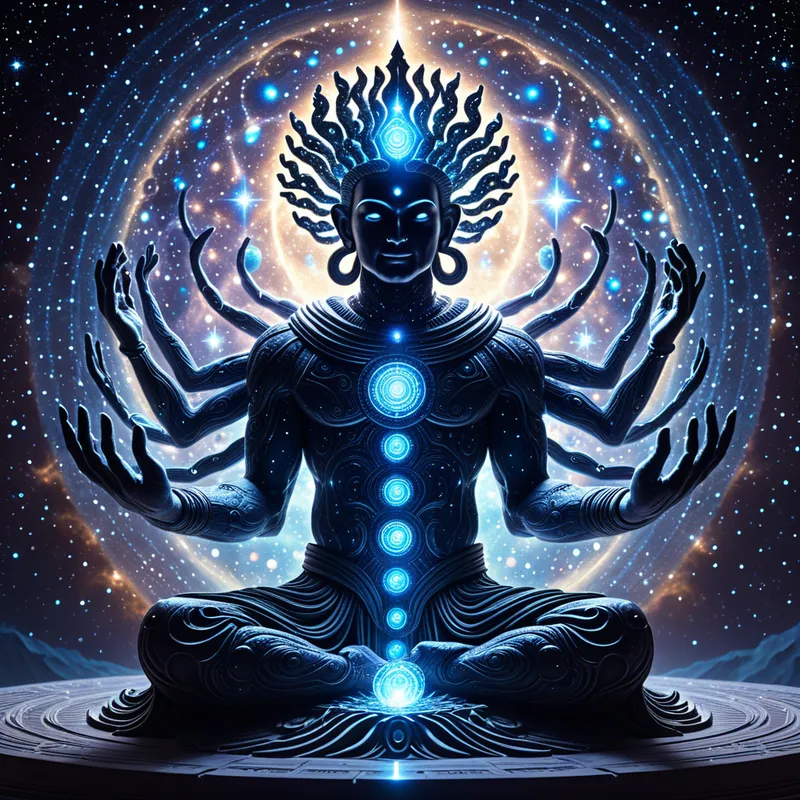
Mala Beads Myth Meaning & Symbolism
A cosmic artisan weaves the suffering of the world into sacred beads, creating a tool to transform chaos into a circle of mindful liberation.
The Tale of Mala Beads
Listen, then, to the tale that is not carved in stone but breathed into being. In the time before time was counted, when the universe was a great, silent exhalation, there existed a being known as the Vishvakarma of the Heart. This was no ordinary craftsman, but the very principle of intention-made-manifest, dwelling in the liminal space between form and emptiness.
His workshop was the cosmos itself. His anvil, the diamond mountain of reality. His forge, the compassionate fire that burns without consuming. And his material? The very substance of sentient experience—the sharp, crystalline shards of grief, the heavy, molten pools of desire, the brittle fragments of fear, and the rare, luminous dust of moments of pure, wordless peace. These were the raw elements scattered across the realms, the psychic debris of countless lives, clattering in a discordant symphony of suffering.
The Vishvakarma observed this chaos. He saw how beings were tossed upon this sea of their own making, grasping at sharp shards that cut their hands, mistaking heavy desire for solid ground. A profound sorrow, not of pity but of ultimate kinship, stirred within him. The chaos was not wrong, but it was untamed. It lacked a vessel, a pattern, a circle.
And so, he began to work. Not to destroy the raw material, but to transform it. With hands that were both mountain-steady and cloud-soft, he gathered the shard of a mother’s grief for her child. He did not smooth its edges to dullness; instead, he polished it until it became a mirror, reflecting the timeless nature of love itself. He took a lump of clinging desire and, in the heat of mindful awareness, spun it into a bead of deep, resonant crimson, containing not the itch of want but the warmth of connection. Each bead was a universe of transmuted feeling.
But a pile of beads, no matter how beautiful, is still a pile. The genius, the sacred magic, was in the string. From the core of his being, the Vishvakarma drew forth a single, unbroken thread. It was not silk, nor gold, nor light. It was the thread of attention itself—continuous, aware, present. One by one, with infinite patience, he strung the 108 beads upon this thread. The chaotic fragments were now in relationship, bound in a circle. The 109th bead, the Meru, he placed outside the circle, a mountain peak pointing beyond the wheel.
He breathed upon the circle, and it began to turn. Not with a physical motion, but with the rhythm of a heartbeat, the cadence of a mantra, the cycle of a breath. He offered it to the world, not as a weapon or a shield, but as a map and a mirror. “Here,” the myth whispers. “Here is your chaos, made sacred. Here is your suffering, made countable. Here is your wandering mind, given a path to walk that returns you, always, to the source.”

Cultural Origins & Context
This mythic narrative, while not a single, canonical scripture, is woven from the very fabric of Buddhist practice and cosmology. It emerges from the oral traditions of early monastic communities, particularly within the Mahayana and Vajrayana streams, where the mala is not merely a tool but a symbolic microcosm. The story was likely told by teachers to novices, not as historical fact, but as a upaya, a skillful means to impart the profound inner meaning of a simple ritual object.
Its societal function was deeply pedagogical. In cultures where complex philosophical doctrines like emptiness (shunyata) and dependent origination could be abstract, the mala served as a tangible, daily reminder. The myth anchored the practice in a cosmic framework. It transformed the act of counting mantras from rote repetition into a participatory ritual in the Vishvakarma’s great work—each recitation another turn of the wheel, another moment of personal and cosmic alchemy. The myth ensured the mala was never seen as a mere necklace, but as a portable altar, a circle of commitment, and a physical echo of the samsaric round and the path to transcend it.
Symbolic Architecture
The myth is a masterclass in symbolic condensation. Every element is a doorway to a psychological state.
The 108 Beads represent not arbitrary number, but the totality of the human predicament—the 108 earthly desires or defilements (kleshas) as described in some traditions. To move bead by bead is to acknowledge and work with each facet of our psychic life, not to exterminate it.
The circle does not reject the fragment; it gives the fragment a home and a purpose in the greater whole.
The Unbroken Thread is the single, continuous stream of mindful awareness. It is the witness consciousness that can hold our disparate experiences—joy, anger, boredom, insight—without losing itself. It is the integrity of the Self that persists through the changing states of the ego.
The Meru Bead, the guru bead outside the circle, is the transcendent function. It is the point of reference that is not of the cycle of thought and emotion, but observes it. It symbolizes the teacher, the awakened mind, or the ultimate goal itself—that which reminds us the circle is a path, not a prison.
The Act of Stringing is the core psychic action: the imposition of conscious order on unconscious chaos. It is the ego’s necessary, sacred work in service of the Self, gathering the scattered complexes of the personality and arranging them into a functional unity.
The Dreamer's Resonance
When this myth surfaces in modern dreams, it rarely appears as a literal string of prayer beads. Instead, one might dream of finding a tangled necklace and patiently untangling it, feeling a profound calm upon completing the circle. Or of gathering scattered, precious stones in a barren landscape and discovering a single, strong cord with which to bind them. Another may dream of a circle that is incomplete, with one bead missing, sparking a deep, somatic search.
These dreams signal a process of psychic integration. The “scattered beads” are often fragmented parts of the self—unprocessed emotions, neglected talents, or buried traumas. The dream is highlighting the psyche’s innate drive toward wholeness. The somatic feeling of calm upon completing the circle is the relief of the nervous system as dissonant parts are brought into a coherent relationship. The dream is an enactment of the Vishvakarma’s work at a personal level, affirming that our inner chaos is not garbage, but the raw material of our becoming.
Alchemical Translation
For the modern individual navigating a fragmented world and a fragmented self, the myth of the Mala Beads models the complete arc of individuation—the Jungian process of becoming an integrated, whole person.
The first alchemical stage, the nigredo, is represented by the chaotic pile of raw shards—the depression, anxiety, confusion, and unresolved conflicts that feel like useless suffering. The myth’s first gift is to reframe this: this is your material. It is not to be discarded in shame, but acknowledged as the prima materia of your transformation.
The albedo, the whitening, is the polishing of each bead. This is the introspective work of therapy, journaling, or mindful meditation. It is looking closely at a single “shard”—a pattern of jealousy, a fear of abandonment—and polishing it with the light of awareness. You see its facets, its origins, and its place in your structure. You do not destroy it; you understand it and thereby change its nature.
Individuation is not the creation of a new self, but the conscious stringing of the self that already exists.
The rubedo, the reddening or culmination, is the stringing of the completed circle. This is the moment of synthesis, where insights cohere into a new, stable identity. The separate, polished understandings of yourself become a functioning system—a personality with a center (the Meru) and a cohesive structure (the circle). The continuous thread of conscious attention now runs through all your experiences. You hold your own history, your flaws and your virtues, as a sacred, integrated whole, ready to turn in the hand of your own daily life, a tool for navigating the world with grounded presence. The wheel of samsara becomes, through this alchemical work, a wheel of the dharma—a vehicle for liberation.
Associated Symbols
Explore related symbols from the CaleaDream lexicon: